Home / iGCSE Physics (0625) 3.2.2 Refraction of light-Exam Style Questions

iGCSE Physics (0625) 3.2.2 Refraction of light-Exam Style Questions- New Syllabus

Question

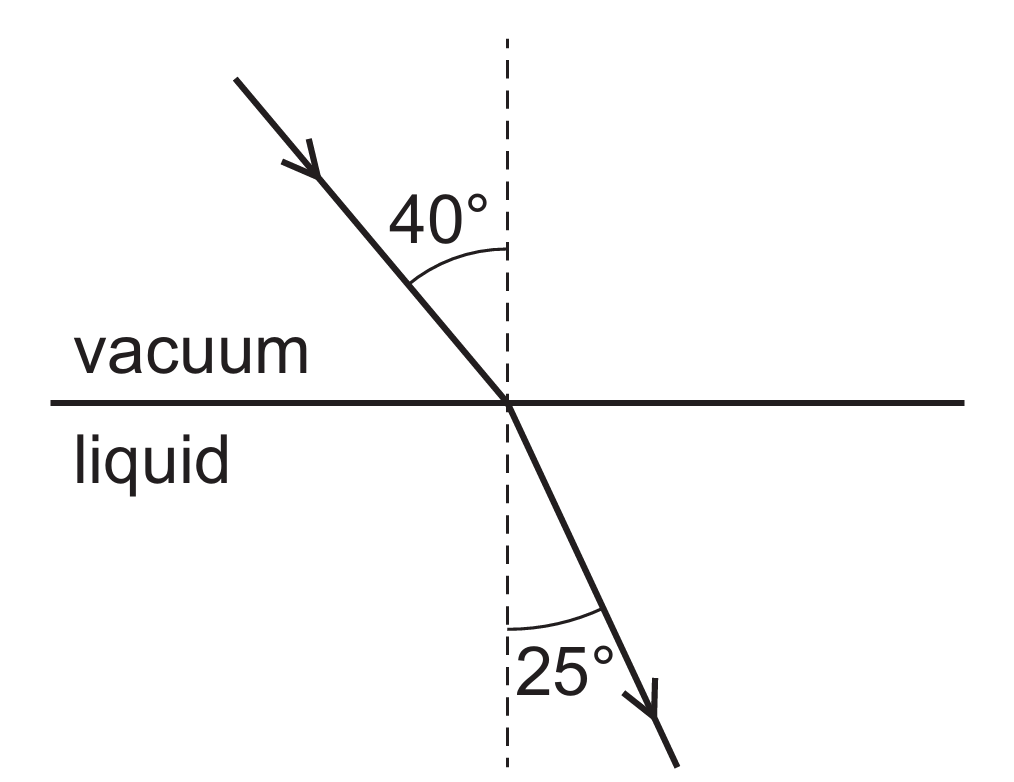
A beam of light passes through a vacuum and then enters a transparent liquid. The diagram shows the path it takes.
The light travels through the vacuum at a speed of $3.0 \times 10^{8}$ m/s.
What is the speed of light in the liquid?
A. $1.9 \times 10^{8}$ m/s
B. $2.0 \times 10^{8}$ m/s
C. $4.6 \times 10^{8}$ m/s
D. $4.8 \times 10^{8}$ m/s
▶️ Answer/Explanation
Correct Option: B

Detailed solution:

First, calculate the refractive index $n$ using Snell’s Law: $n = \frac{\sin i}{\sin r}$, where $i = 40^{\circ}$ and $r = 25^{\circ}$.
This gives $n = \frac{\sin 40^{\circ}}{\sin 25^{\circ}} \approx \frac{0.6428}{0.4226} \approx 1.52$.
The refractive index is also defined by the ratio of speeds: $n = \frac{v_{\text{vacuum}}}{v_{\text{liquid}}}$.
Rearranging for the speed in liquid: $v_{\text{liquid}} = \frac{v_{\text{vacuum}}}{n} = \frac{3.0 \times 10^{8}}{1.52}$.
The resulting speed is approximately $1.97 \times 10^{8}$ m/s, which rounds to $2.0 \times 10^{8}$ m/s.
Thus, option B is the correct choice based on these physical principles.

Question

Which statement about total internal reflection at a glass–air boundary is correct?
A. The angle of incidence inside the glass must be equal to the critical angle.
B. The angle of incidence inside the glass must be less than the critical angle.
C. The critical angle is proportional to the refractive index of the glass.
D. The speed of light in glass must be less than the speed of light in air.
▶️ Answer/Explanation
Correct Option: D

Detailed solution:

Total internal reflection (TIR) occurs only when light travels from an optically denser medium to a less dense medium.
For a glass–air boundary, the refractive index of glass $n_{g}$ is greater than that of air $n_{a}$, meaning light travels slower in glass.
The fundamental condition for TIR is that the speed of light in the first medium must be less than in the second ($v_{glass} < v_{air}$).
Options A and B are incorrect because TIR requires the angle of incidence $i$ to be strictly greater than the critical angle $c$.
Option C is incorrect because the relationship is inverse, defined by the equation $n = \frac{1}{\sin c}$.
Therefore, statement D is the only correct prerequisite for the phenomenon to be possible.

Question
The speed of light in a material is $50\%$ of the speed of light in air.
What is the refractive index of the material?
A. $0.5$
B. $2.0$
C. $6.0 \times 10^{8}$
D. $1.5 \times 10^{8}$
▶️ Answer/Explanation
Correct Option: B

Detailed solution:

The refractive index $n$ is defined as the ratio of the speed of light in air (or vacuum), $v_{air}$, to the speed of light in the material, $v_{mat}$, expressed as $n = \frac{v_{air}}{v_{mat}}$.
The problem states that the speed in the material is $50\%$ of the speed in air, so $v_{mat} = 0.5 \times v_{air}$.
Substituting this into the formula gives $n = \frac{v_{air}}{0.5 \times v_{air}}$.
The velocity terms cancel out, leaving $n = \frac{1}{0.5}$, which calculates to $2.0$.
Refractive index is a dimensionless ratio, so it has no units, making option B the correct choice.

Scroll to Top