
▶️ Answer/Explanation
Detailed solution:
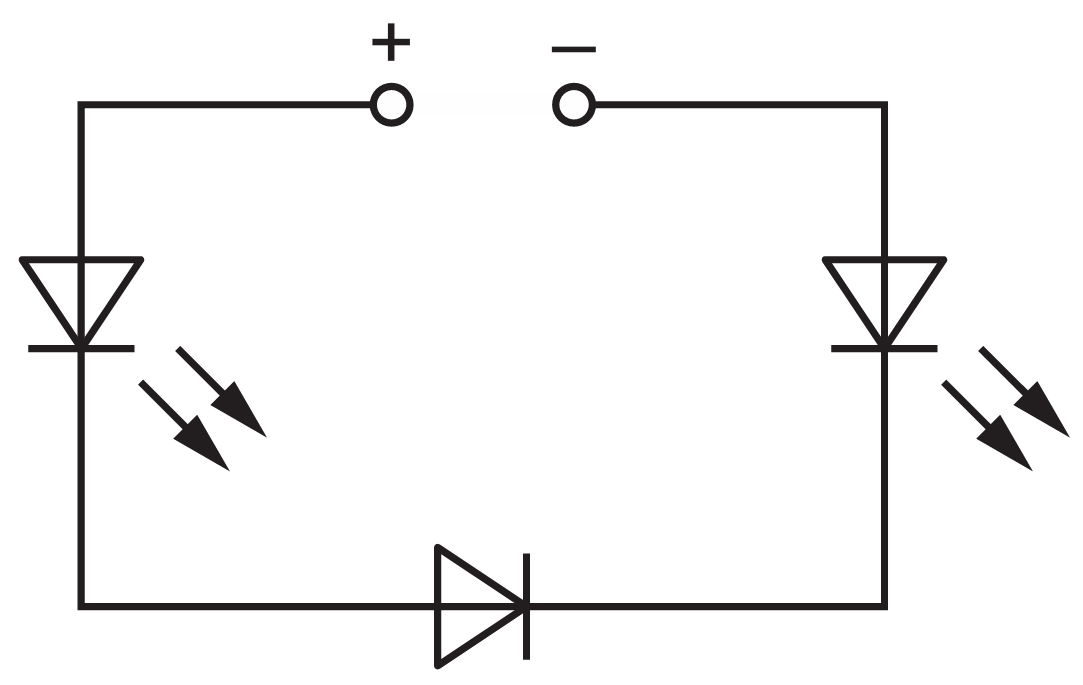
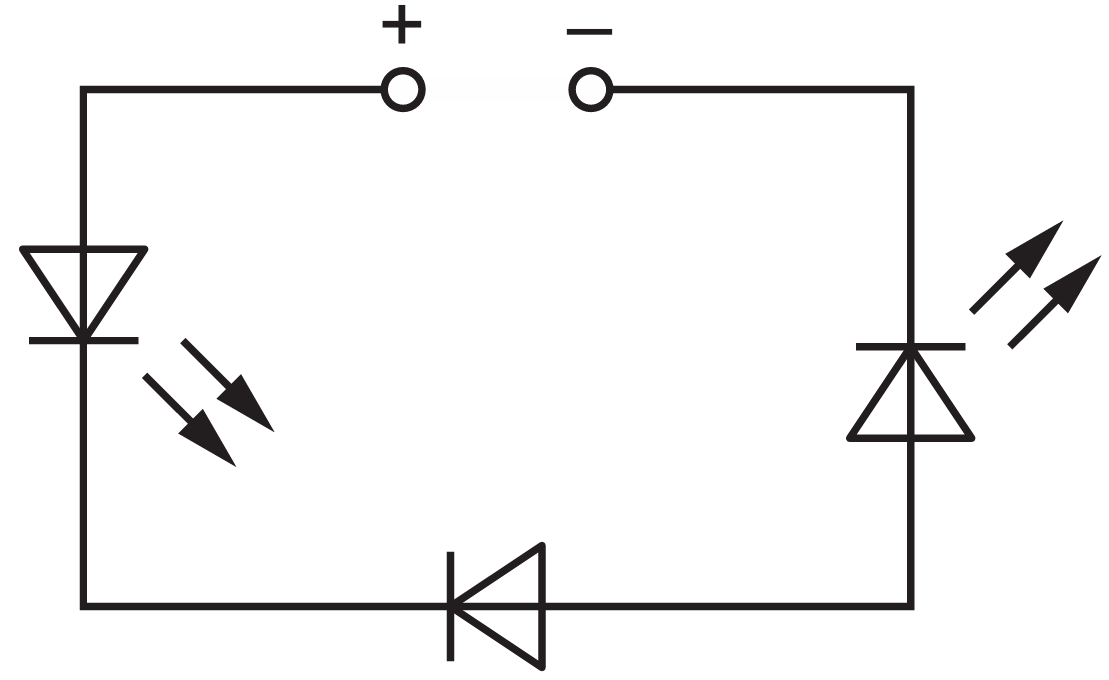
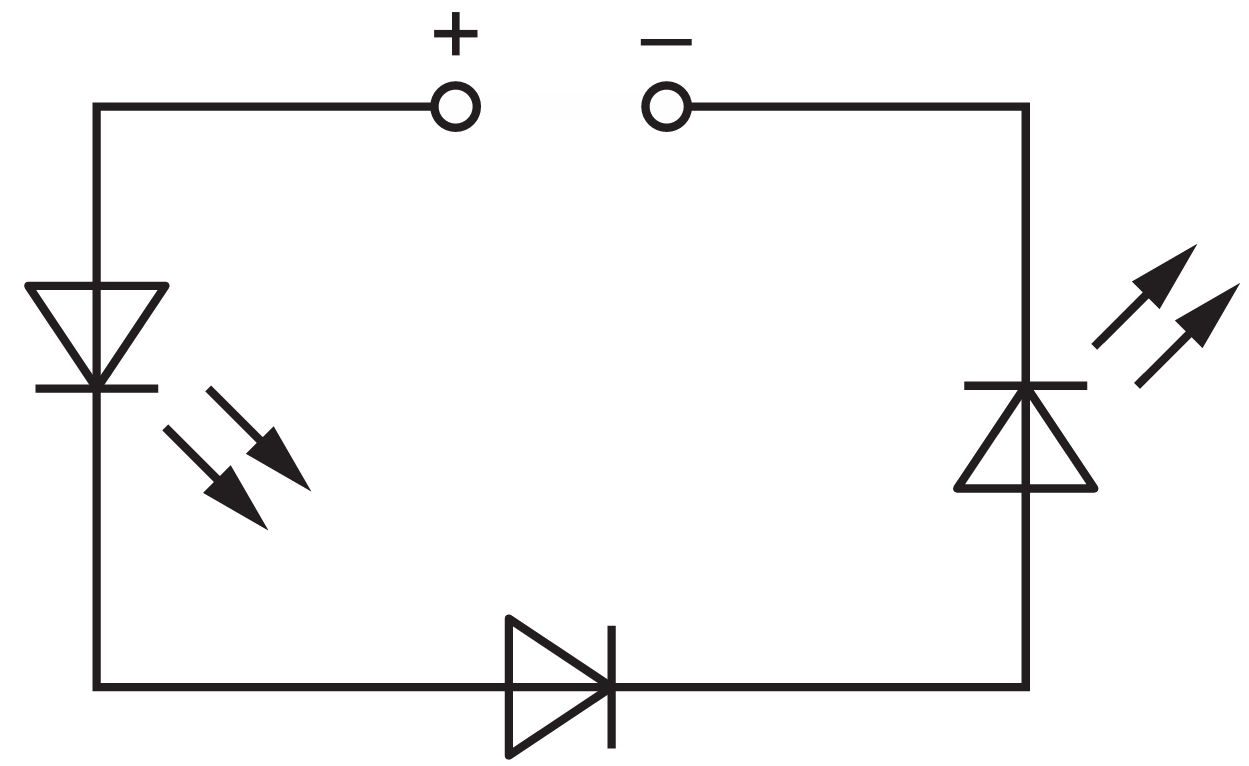
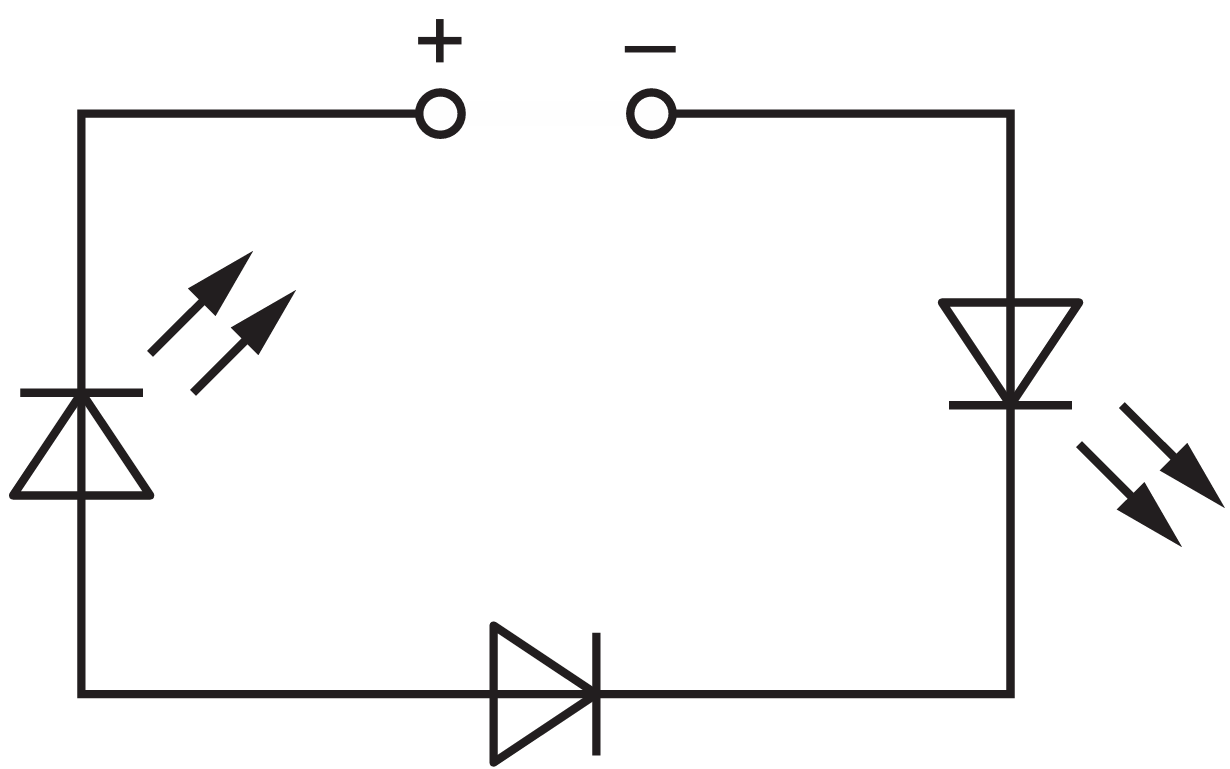
For an LED or diode to conduct, it must be forward-biased, meaning conventional current must flow in the direction of the triangle symbol ($+$ to $-$).
In these circuits, conventional current leaves the positive terminal ($+$) and attempts to return to the negative terminal ($-$).
In Circuit C, the current travels clockwise; it encounters the first LED, the center diode, and the second LED all pointing in the same clockwise direction.
Since all three components are forward-biased, the circuit is complete and both LEDs will illuminate.
In other options, at least one diode or LED is reverse-biased (pointing against the current), which blocks the flow for the entire series loop.
▶️ Answer/Explanation
Detailed solution:
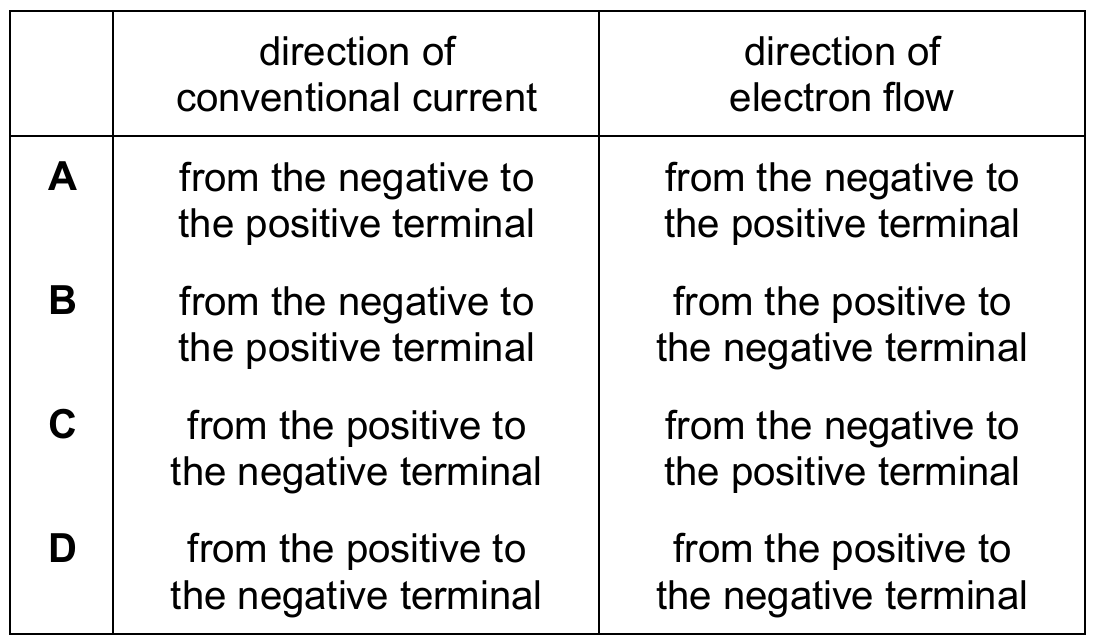
Conventional current is defined by historical convention as the flow of positive charge, moving from the positive ($+$) terminal to the negative ($-$) terminal.
In metallic conductors, current is actually the movement of free electrons, which are negatively charged particles.
Because opposite charges attract and like charges repel, electrons flow away from the negative terminal and toward the positive terminal.
Thus, the direction of electron flow is from the negative ($-$) terminal to the positive ($+$) terminal, which is opposite to the conventional current.
This distinction is essential for analyzing circuit diagrams and using the equation $I = \frac{Q}{t}$.
Option C correctly matches both of these physical directions.