Home / iGCSE Physics (0625) 4.2.4 Resistance-Exam Style Questions

iGCSE Physics (0625) 4.2.4 Resistance-Exam Style Questions- New Syllabus

Question

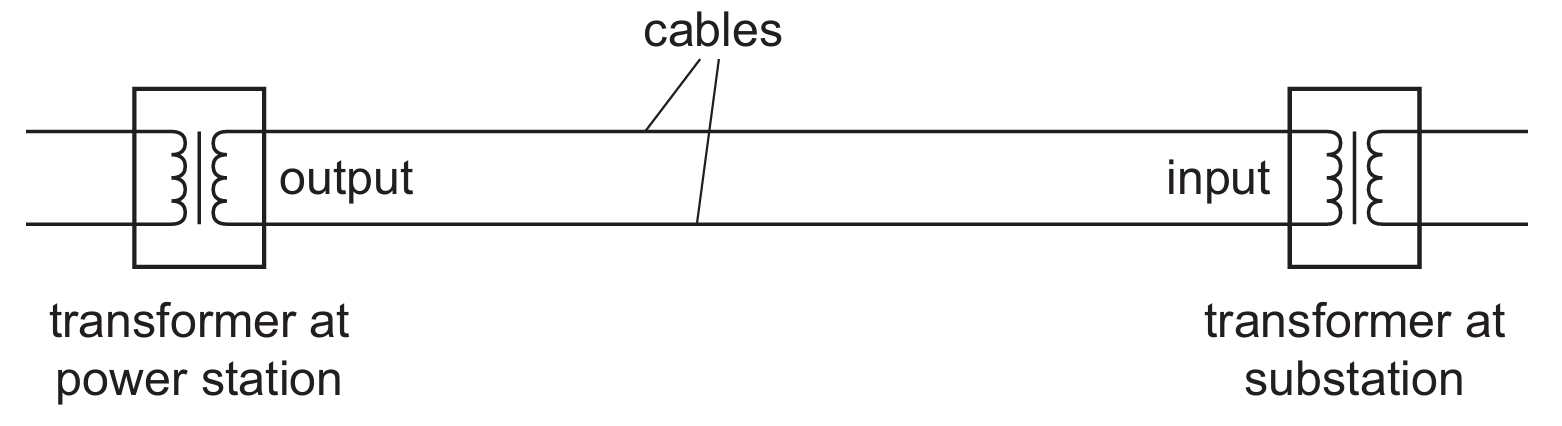
Cables transmit electrical power from the output of the transformer at a power station to the input of another transformer at a substation.
The power at the output of the transformer at the power station is 400 MW.
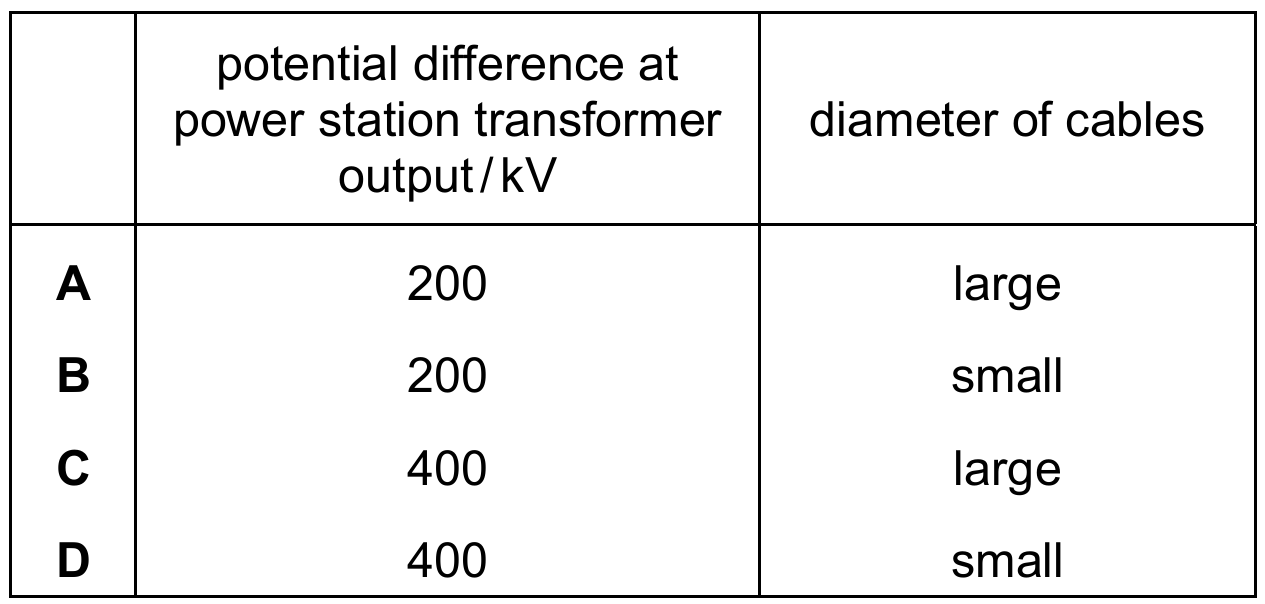
Which situation delivers the most power to the input of the transformer at the substation?
▶️ Answer/Explanation
Correct Option: C

Detailed solution:

To deliver maximum power, we must minimize power loss ($P_{loss} = I^{2}R$) in the cables. Using a higher potential difference ($V = 400 \text{ kV}$) reduces the current ($I$) since $P = IV$. Lower current significantly reduces $I^{2}R$ losses. Additionally, resistance ($R$) is inversely proportional to cross-sectional area; thus, cables with a large diameter have lower resistance. Combining the highest voltage ($400 \text{ kV}$) and the lowest resistance (large diameter) ensures the least energy is wasted as heat, delivering the most power to the substation.
Question

A $0.60\text{ m}$ length of resistance wire with a diameter of $0.25\text{ mm}$ has a resistance of $6.0\text{ }\Omega$.

A second piece of resistance wire of the same material with a diameter of $0.50\text{ mm}$ also has a resistance of $6.0\text{ }\Omega$.

What is the length of the second piece of wire?

A. $0.15\text{ m}$
B. $0.30\text{ m}$
C. $1.20\text{ m}$
D. $2.40\text{ m}$
▶️ Answer/Explanation
Correct Option: D

Detailed solution:

Resistance $R$ is proportional to length $l$ and inversely proportional to cross-sectional area $A$, where $A = \pi(\frac{d}{2})^2$, so $R \propto \frac{l}{d^2}$.
The second wire has a diameter $d_2 = 0.50\text{ mm}$, which is twice the first diameter $d_1 = 0.25\text{ mm}$ ($d_2 = 2d_1$).
Doubling the diameter increases the cross-sectional area by a factor of $2^2 = 4$.
Since both wires have the same resistance ($6.0\text{ }\Omega$) and material, the ratio $\frac{l}{d^2}$ must remain constant.
To maintain the same resistance with $4$ times the area, the length must also increase by a factor of $4$.
Therefore, the new length $l_2 = 4 \times 0.60\text{ m} = 2.40\text{ m}$.

Question
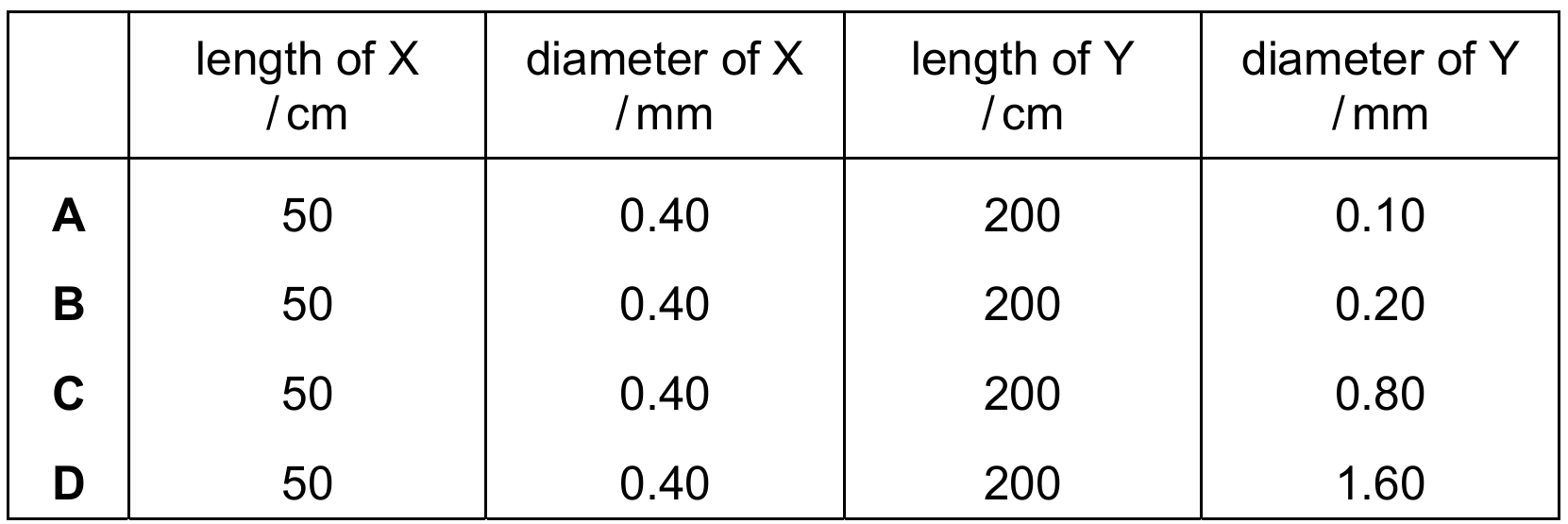
Two wires, $X$ and $Y$, are made from the same metal and have the same resistance. Which row identifies a possible pair of values for $X$ and for $Y$?
▶️ Answer/Explanation
Correct Option: C

Detailed solution:

Resistance $R$ is proportional to length $L$ and inversely proportional to cross-sectional area $A$, where $A = \frac{\pi d^{2}}{4}$. Thus, $R \propto \frac{L}{d^{2}}$.
For wires $X$ and $Y$ to have the same resistance ($R_{X} = R_{Y}$), the ratio $\frac{L_{X}}{d_{X}^{2}}$ must equal $\frac{L_{Y}}{d_{Y}^{2}}$.
The length of $Y$ ($200\text{ cm}$) is $4$ times the length of $X$ ($50\text{ cm}$), so $L_{Y} = 4L_{X}$.
To keep resistance constant, $d_{Y}^{2}$ must also be $4$ times $d_{X}^{2}$, meaning $d_{Y} = \sqrt{4} \times d_{X} = 2d_{X}$.
Given $d_{X} = 0.40\text{ mm}$, the diameter of $Y$ must be $0.40\text{ mm} \times 2 = 0.80\text{ mm}$.
This matches the values provided in Row C.

Scroll to Top