
▶️ Answer/Explanation
Detailed solution:
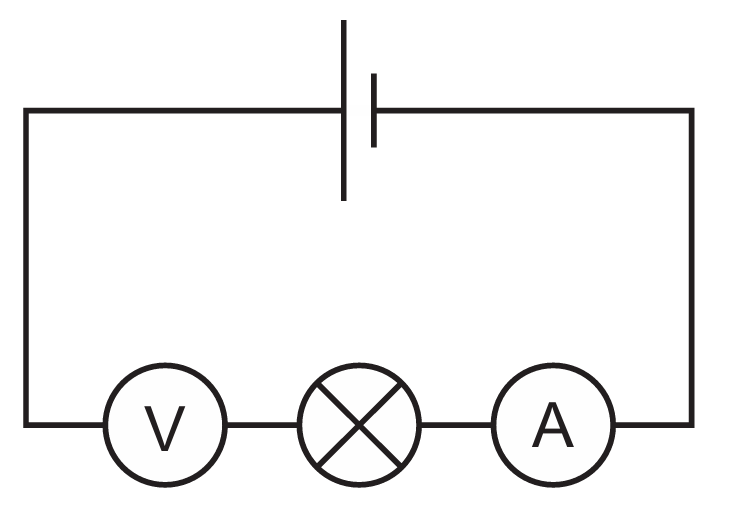
To calculate resistance using $R = \frac{V}{I}$, we must measure the potential difference ($V$) across the lamp and the current ($I$) through it. In the diagram, the voltmeter is incorrectly connected in series, which prevents current flow due to its high resistance. An ammeter must be connected in series to measure the current passing through the component. A voltmeter must be connected in parallel to measure the potential difference across the component. By moving the voltmeter from a series connection to a parallel connection with the lamp, the circuit is corrected. This allows the ammeter to record the current and the voltmeter to record the voltage required for the calculation.
▶️ Answer/Explanation
Detailed solution:
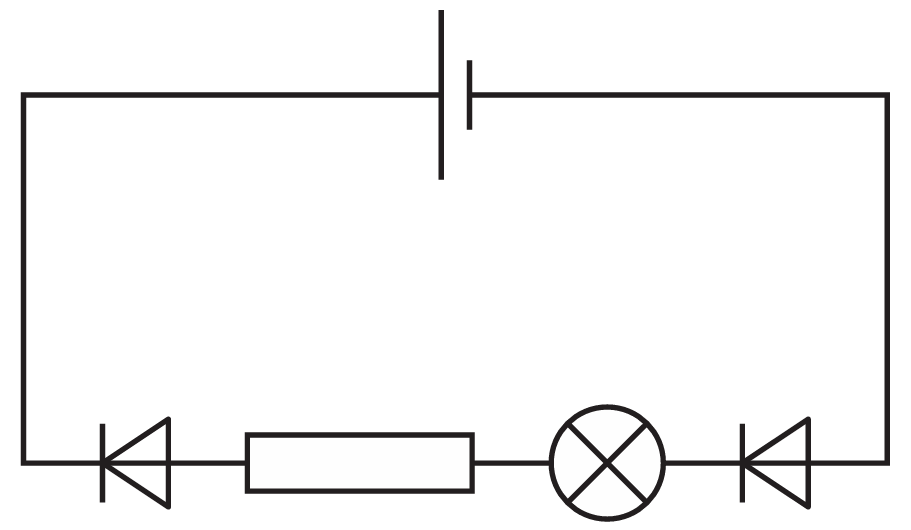
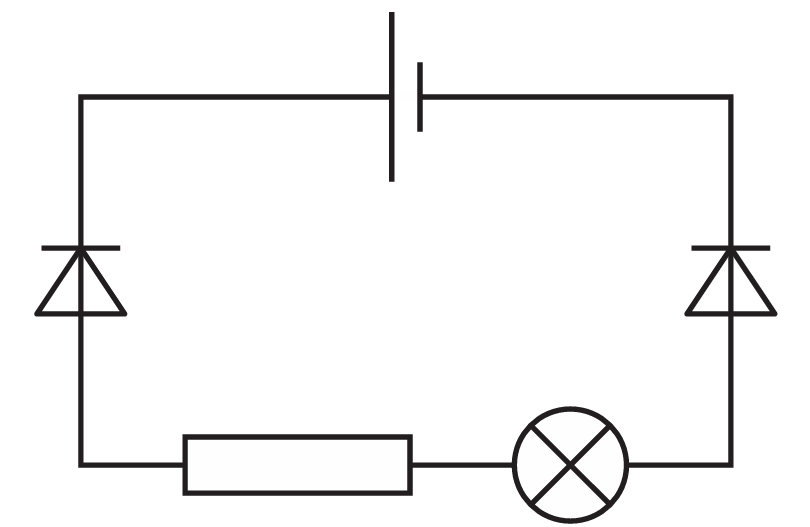
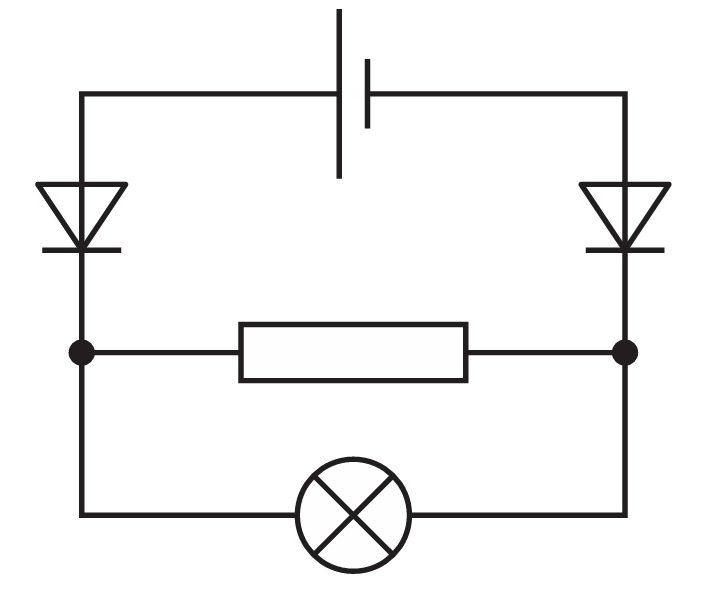
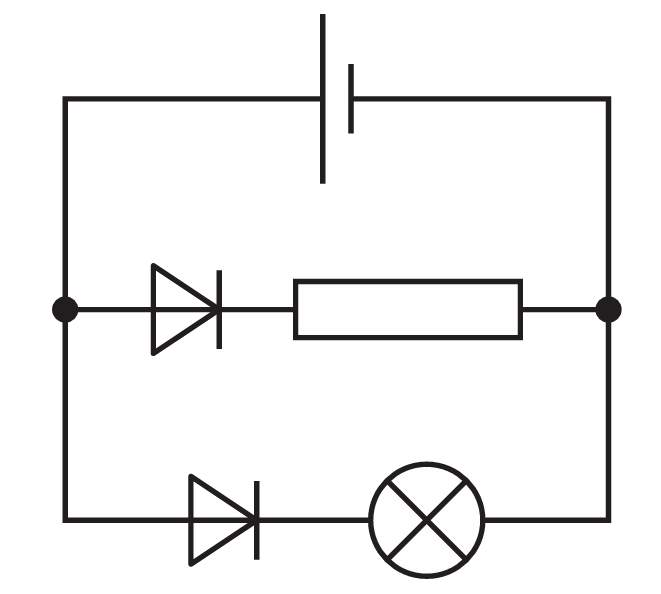
A diode allows current to flow only in the direction of the arrow in its symbol (forward bias).
Current flows from the positive terminal (longer line) to the negative terminal (shorter line) of the battery.
In circuits $A$, $B$, and $C$, at least one diode is reverse-biased, creating an open circuit that prevents current from reaching the lamp.
In circuit $D$, the diode in the bottom branch is forward-biased, allowing current to flow through the lamp.
The parallel branch with the resistor and another forward-biased diode does not prevent the lamp from lighting.
Therefore, only in circuit $D$ does a complete path exist for current to energize the lamp.