iGCSE Physics (0625) 4.3.2 Series and parallel circuits -Exam Style Questions Paper 2 - New Syllabus
Question
A teacher asks three students to write down an equation to determine the combined resistance $R_{C}$ of resistors with resistances $R_{Y}$ and $R_{Z}$.

▶️ Answer/Explanation
Detailed solution:
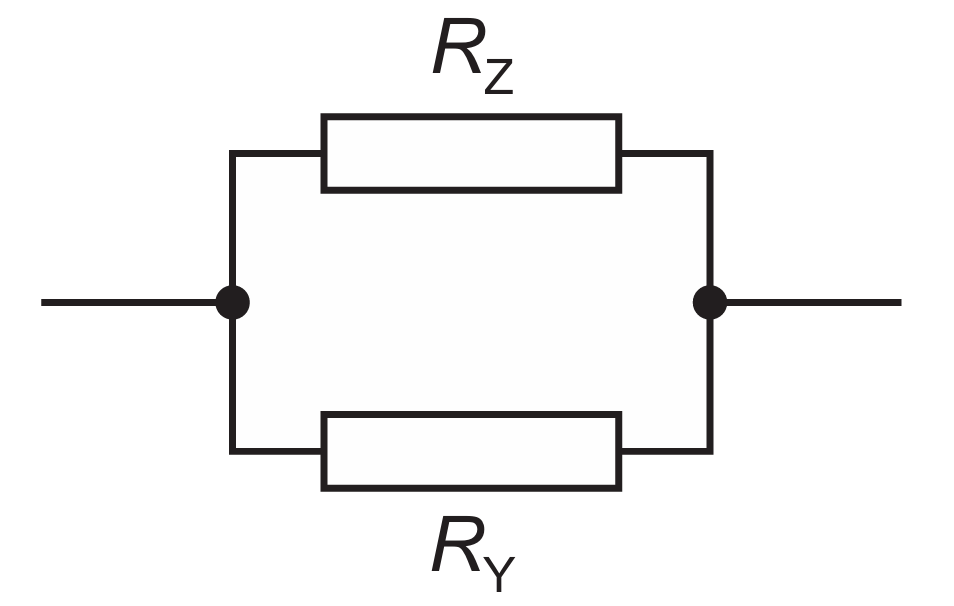
The diagram shows two resistors, $R_{Y}$ and $R_{Z}$, connected in a parallel arrangement.
For resistors in parallel, the reciprocal of the combined resistance $R_{C}$ is the sum of the reciprocals of the individual resistances.
This is mathematically expressed as $\frac{1}{R_{C}} = \frac{1}{R_{Y}} + \frac{1}{R_{Z}}$, which matches the equation provided by student 1.
Student 2 is incorrect because their equation suggests the reciprocal of the sum, which applies to neither standard circuit type.
Student 3 is incorrect because they equated the total resistance directly to the sum of reciprocals without taking the final reciprocal.
Therefore, only student 1 has provided the correct relationship for a parallel circuit.
Question
▶️ Answer/Explanation
Detailed solution:
The e.m.f. ($E$) is the work done per unit charge by the source: $E = \frac{W_{total}}{Q} = \frac{120\text{ J}}{50\text{ C}} = 2.4\text{ V}$.
To find the p.d. ($V$) across one lamp, we first determine the charge $Q_{L}$ passing through each lamp.
Since the lamps are identical and in parallel, the total charge $50\text{ C}$ splits equally, so $Q_{L} = \frac{50\text{ C}}{2} = 25\text{ C}$.
The p.d. across one lamp is the work done per unit charge through that lamp: $V = \frac{W_{lamp}}{Q_{L}} = \frac{40\text{ J}}{25\text{ C}} = 1.6\text{ V}$.
In a parallel arrangement, the p.d. across each branch is the same, so $V$ remains $1.6\text{ V}$ for the pair.
Thus, $E = 2.4\text{ V}$ and $V = 1.6\text{ V}$, which corresponds to option B.
Question
▶️ Answer/Explanation
Detailed solution:
In a parallel circuit, each lamp is connected in its own separate branch across the power supply.
This means the total current I total splits between branches, while the potential difference V remains the same for each lamp.
If one lamp fails, it creates an open circuit in that specific branch only, leaving the other branches intact.
Consequently, charge continues to flow through the remaining functional branches, allowing other lamps to stay lit.
In contrast, a series circuit provides only one path; if one component fails, the entire circuit is broken and all lamps turn off.
Therefore, the independence of components is a primary advantage of parallel wiring in practical lighting systems.
