
▶️ Answer/Explanation
Detailed solution:
The induced e.m.f. depends on the rate of change of magnetic field, not the strength of the field itself.
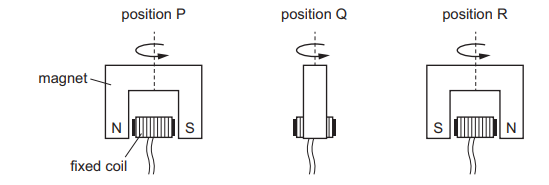
At position Q, the magnetic field through the coil is zero but changing most rapidly, which induces a maximum e.m.f.
At position P (and similarly at R), the rate of change of field is slower, resulting in a smaller magnitude of e.m.f.
Therefore, the e.m.f. at Q is larger than at P, making statement A correct and statements B and C incorrect.
Position R is similar to P in terms of e.m.f. magnitude, so statement D is also incorrect.


▶️ Answer/Explanation
Detailed solution:
Point P on the graph corresponds to the maximum positive potential difference (peak output).
In a simple a.c. generator, the maximum e.m.f. is induced when the plane of the coil is horizontal (parallel to the magnetic field lines).
At this instant, the sides of the coil are cutting the magnetic field lines at the greatest rate.
Diagram C shows the coil in a horizontal position, which correctly represents the orientation at point P on the graph.
This matches the relationship between coil position and output voltage described in the syllabus.
▶️ Answer/Explanation
Detailed solution:
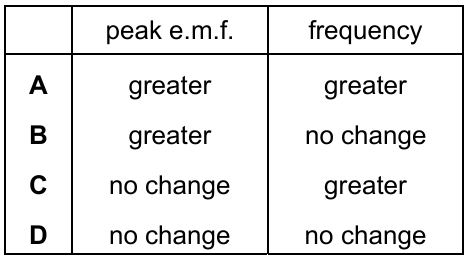
Rotating the coil faster increases the rate of change of magnetic flux linkage, which induces a larger peak e.m.f.
Additionally, a faster rotation means the coil completes each cycle in less time, resulting in a higher frequency.
Therefore, both the peak e.m.f. and the frequency of the alternating current increase.
This corresponds directly to the trend shown in Option A.