Home / iGCSE Physics (0625) 4.5.4 Force on a current-carrying conductor-Exam Style Questions

iGCSE Physics (0625) 4.5.4 Force on a current-carrying conductor -Exam Style Questions Paper 2 - New Syllabus

Question

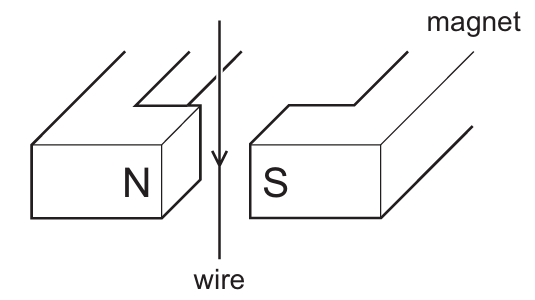
The diagram shows a wire in the magnetic field between two poles of a magnet.
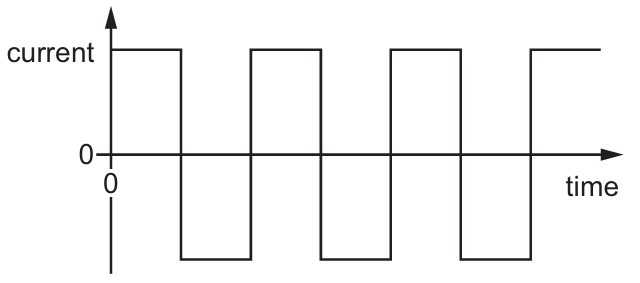
The current in the wire repeatedly changes between a constant value in one direction and a constant value in the opposite direction, as shown in the graph.
What is the effect on the wire?
A. The force on the wire alternates between one direction and the opposite direction.
B. The force on the wire is constant in size and direction.
C. There is no force acting on the wire at any time.
D. There is only a force on the wire when the current reverses.
▶️ Answer/Explanation
Correct Option: A

Detailed solution:

A current-carrying conductor in a magnetic field experiences a force whose direction depends on both the field direction and the current direction.
Since the magnetic field is constant but the current repeatedly reverses direction, the force on the wire must also alternate direction.
The force is present whenever there is a current (not just during the reversal), so it alternates between one direction and the opposite direction.
This matches Option A.
Question

A current passes along a wire placed between the poles of a permanent magnet.
The wire experiences a force due to the magnetic field.
What will change the direction of this force?
A. increasing the current
B. reversing the current
C. increasing the strength of the magnetic field
D. using an electromagnet with the same polarity as the permanent magnet
▶️ Answer/Explanation
Correct Option: B

Detailed solution:

The direction of the force on a current-carrying conductor in a magnetic field is governed by Fleming’s left-hand rule.
This direction depends on the relative orientation of the magnetic field and the current; reversing either the current or the magnetic field will reverse the direction of the force.
Options A and C (increasing current or field strength) only affect the magnitude of the force, not its direction.
Using an identical magnetic polarity maintains the original field direction, so the force direction remains unchanged.
Therefore, reversing the current is the action that specifically changes the direction of the force.

Question

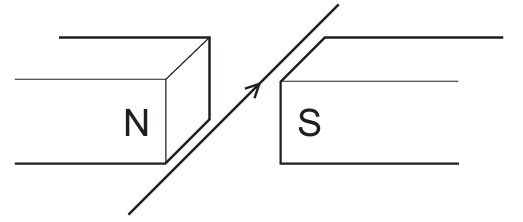
The diagram shows a wire hanging freely between the poles of a magnet. There is a current in the wire in the direction shown. The magnet and current cause a force to act on the wire. In which direction does this force act?

A. into the page (away from you)
B. out of the page (toward you)
C. to the left
D. to the right
▶️ Answer/Explanation
Correct Option: B

Detailed solution:

Fleming’s left-hand rule gives the direction of force on a current-carrying conductor in a magnetic field.
Align the First finger with the magnetic Field (N to S), the seCond finger with the Current, and the Thumb shows the direction of the Thrust (Force).
Applying this rule to the described setup, the force is directed out of the plane of the page, toward the viewer.
This matches Option B: out of the page (toward you).

Scroll to Top