Home / iGCSE Physics (0625) 5.2.2 The three types of nuclear emission-Exam Style Questions

iGCSE Physics (0625) 5.2.2 The three types of nuclear emission-Exam Style Questions- New Syllabus

Question

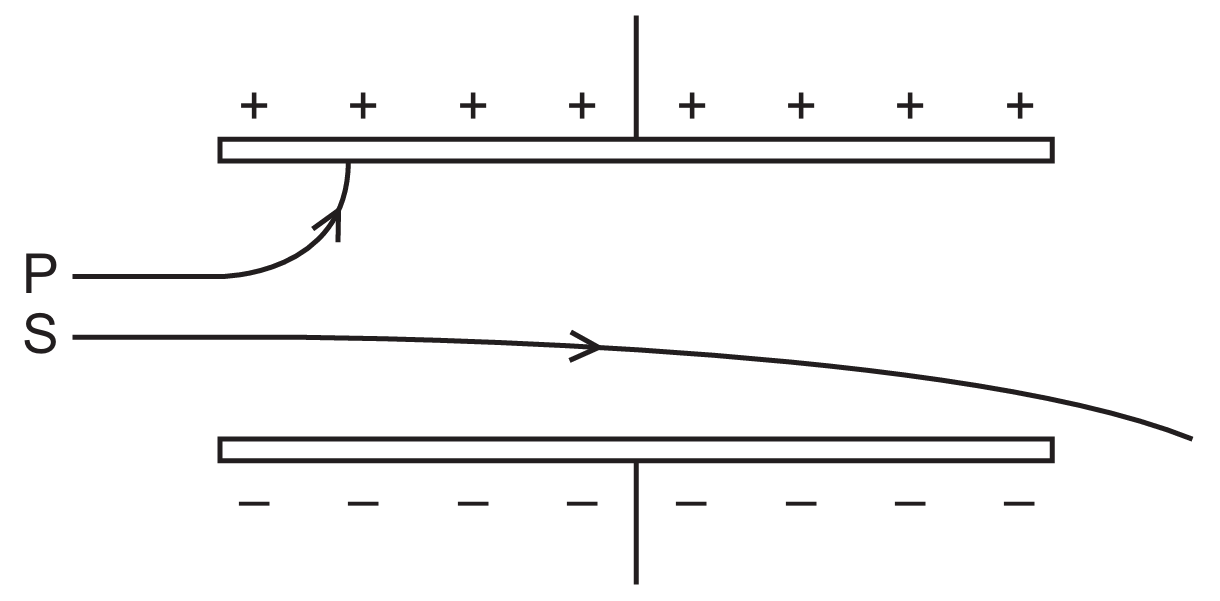
Two beams of radiation, P and S, enter an electric field, as shown.
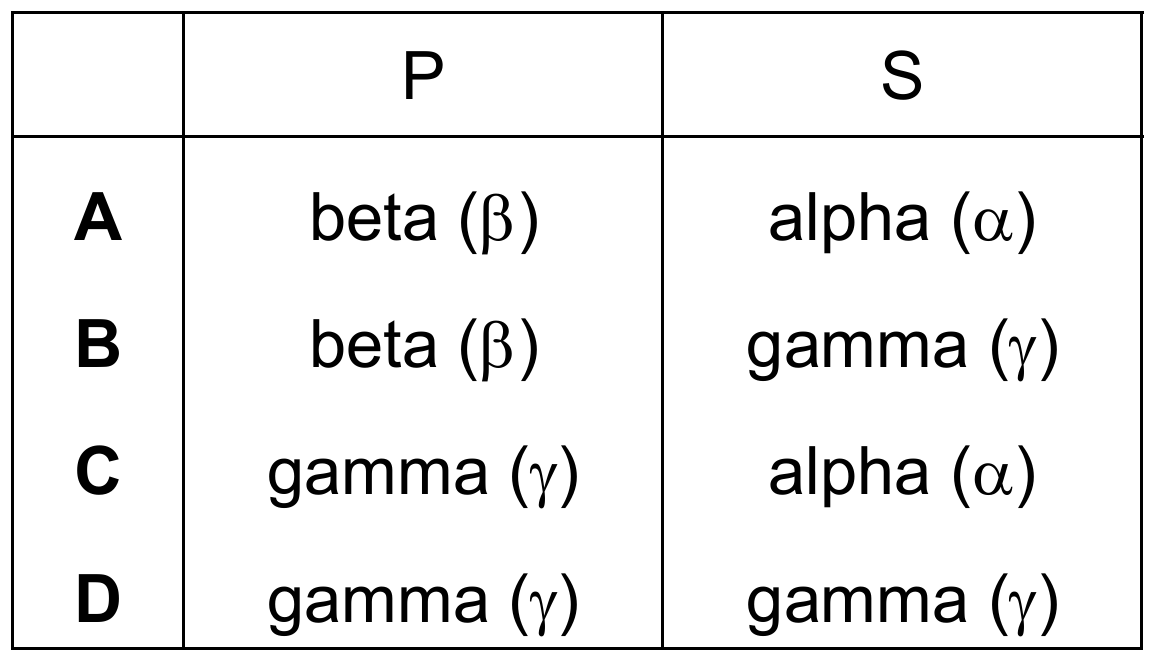
Which types of radiation are P and S?
▶️ Answer/Explanation
Correct Option: A

Detailed solution:

The direction of deflection in an electric field depends on the charge of the radiation. Beam P is deflected toward the positive $(+)$ plate, indicating it carries a negative charge; $\beta$-particles (electrons) are negatively charged and thus attracted to the positive plate. Beam S is deflected toward the negative $(-)$ plate, indicating a positive charge; $\alpha$-particles consist of two protons and two neutrons, giving them a $+2e$ charge. Notably, $\beta$-particles show a larger deflection than $\alpha$-particles because they have a much smaller mass. $\gamma$-radiation carries no charge and would travel straight through without any deflection.
Question

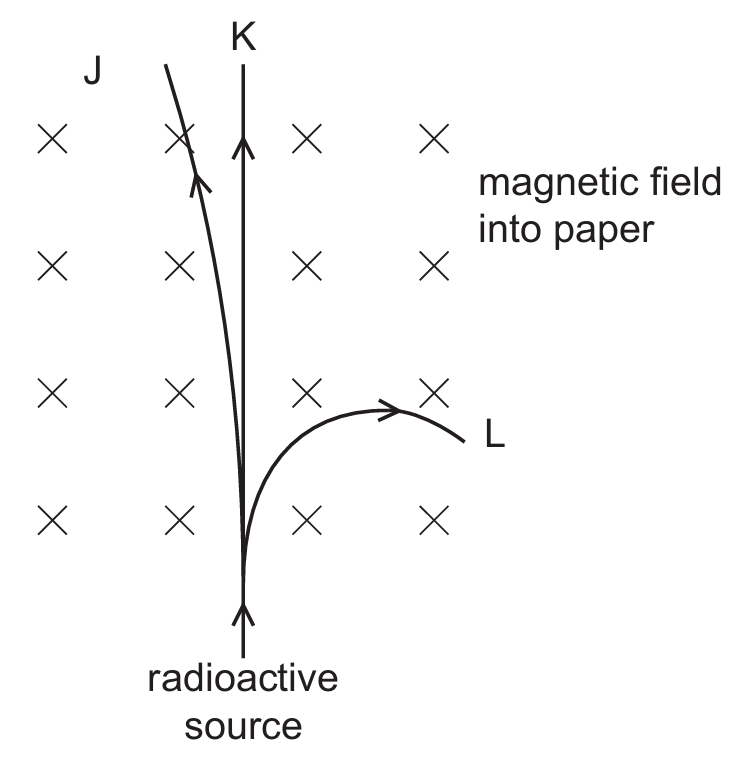
A radioactive source emits $\alpha$-particles, $\beta$-particles and $\gamma$-rays into a vacuum where there is a magnetic field.
The magnetic field acts perpendicularly into the plane of the paper.
The paths $J$, $K$ and $L$ of the three types of radiation through the magnetic field are shown.
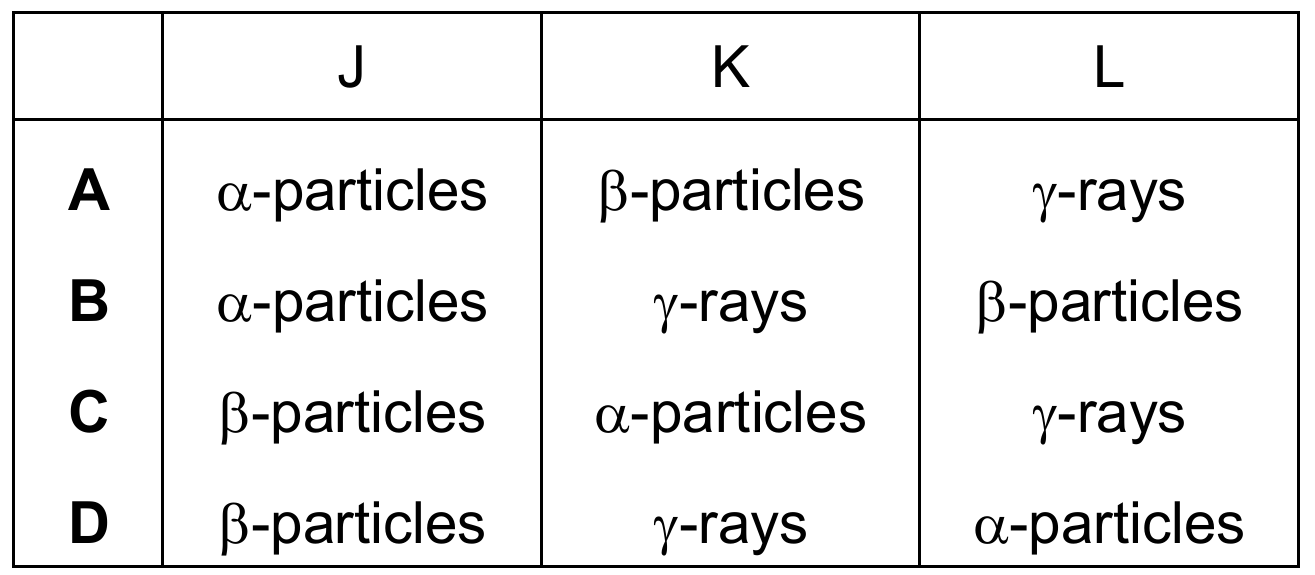
Which radiation follows path $J$, path $K$ and path $L$?
▶️ Answer/Explanation
Correct Option: B

Detailed solution:

$\gamma$-rays have no charge, so they are not deflected by magnetic fields and follow the straight path $K$.
Using Fleming’s Left-Hand Rule, where the magnetic field (Index finger) points into the paper and current (Middle finger) represents positive charge flow upward:
$\alpha$-particles are positively charged, so the force (Thumb) acts to the left, corresponding to path $J$.
$\beta$-particles are negatively charged, so the equivalent current is downward, resulting in a force to the right, corresponding to path $L$.
$\beta$-particles also have less mass than $\alpha$-particles, leading to the more significant deflection seen in path $L$.
Therefore, path $J$ is $\alpha$, $K$ is $\gamma$, and $L$ is $\beta$, which matches Option B.

Question
A radioactive source that emits $\alpha$-particles, $\beta$-particles and $\gamma$-radiation is stored safely in a container. From which material should the container be made?
A. aluminium
B. copper
C. paper
D. lead
▶️ Answer/Explanation
Correct Option: D

Detailed solution:

To store a source emitting all three types of radiation safely, the shielding must stop the most penetrating type, which is $\gamma$-radiation.
While paper (Option C) stops $\alpha$-particles and a few millimetres of aluminium (Option A) stop $\beta$-particles, they are easily penetrated by $\gamma$-rays.
Lead is a very dense material with a high atomic number, making it highly effective at absorbing ionising radiation.
A thick layer of lead is required to significantly reduce the intensity of $\gamma$-radiation to safe levels.
Therefore, a lead container ensures that $\alpha$, $\beta$, and $\gamma$ emissions are all successfully contained.
This aligns with safety protocols for reducing exposure to ionising nuclear radiations.

Scroll to Top