

▶️ Answer/Explanation
Detailed solution:
First, determine the initial count rate due only to the source by subtracting the background: 1000−20=980 counts/minute.
Since 10 minutes is exactly one half-life, the activity of the source will halve: 2 980 =490 counts/minute.
The detector always records both the source and the background, so the background must be added back to the new source activity.
The final recorded count rate is 490+20=510 counts/minute.
This corresponds to option C, accounting for the corrected count rate during decay.
▶️ Answer/Explanation
Detailed solution:
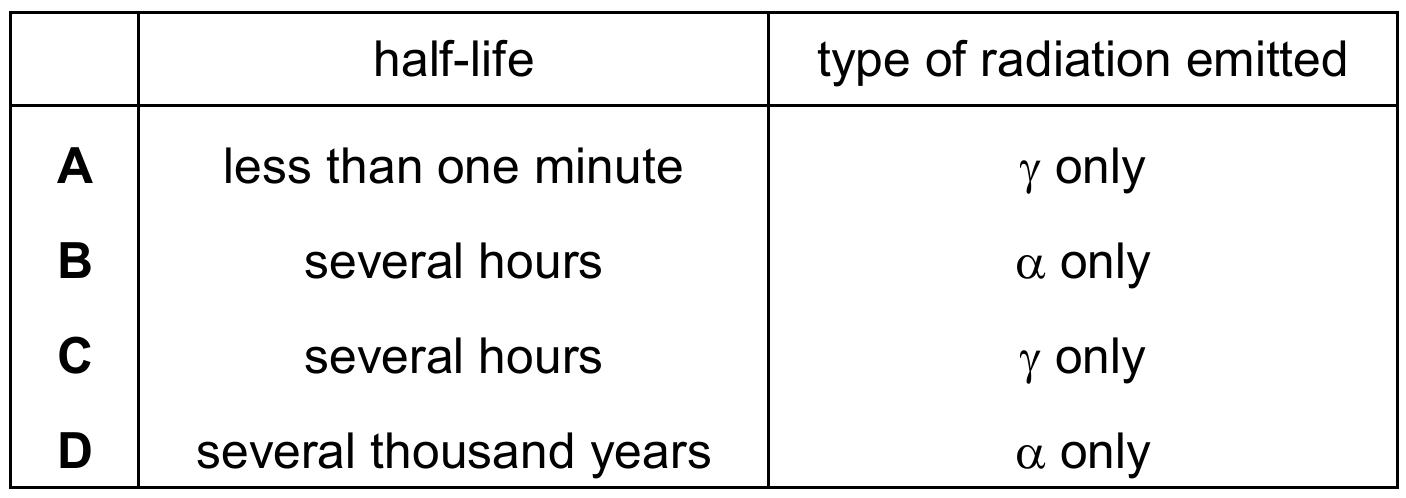
To kill bacteria in food, the radiation must be highly penetrating to reach all parts of the packaging. Gamma (γ) radiation is used because it has the highest penetrating power, whereas alpha (α) radiation is easily blocked by paper or skin. A half-life of several hours is sufficient for the industrial process of irradiation; however, extremely short half-lives (less than one minute) would result in the source losing its activity too quickly to be practical for consistent use. Conversely, while very long half-lives exist, γ emitters with moderate half-lives provide a high enough activity level to effectively sterilize the product. Based on these requirements, option C is the most suitable choice.