
▶️ Answer/Explanation
Detailed solution:
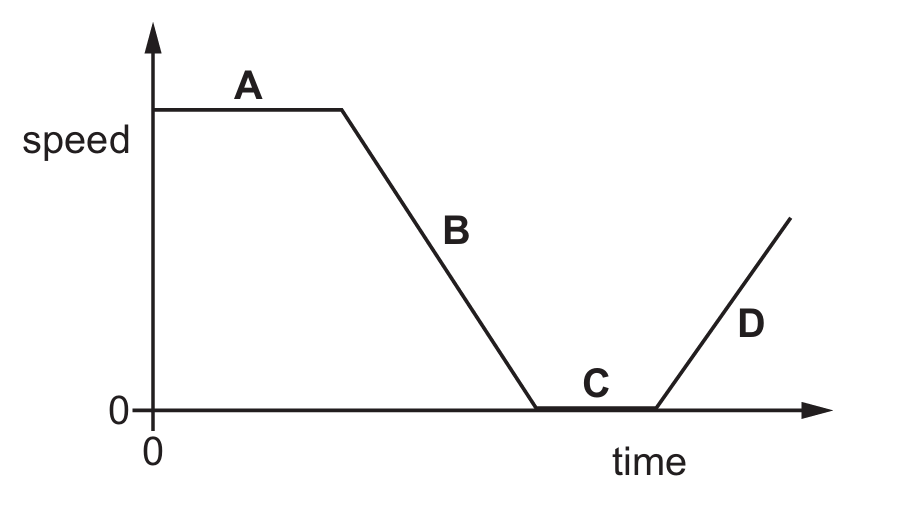
The given figure represents a speed-time graph of a motorcyclist’s journey.
When the motorcyclist is stationary at traffic lights, their speed must be exactly $0$.
On a speed-time graph, a speed of $0$ is represented by a horizontal line that lies entirely on the time axis.
Analyzing the graph, section A shows constant positive speed, and section B represents deceleration.
Section C represents a period where the speed is strictly equal to $0$.
Therefore, section C represents the time when the motorcyclist is entirely stationary.
▶️ Answer/Explanation
Detailed solution:
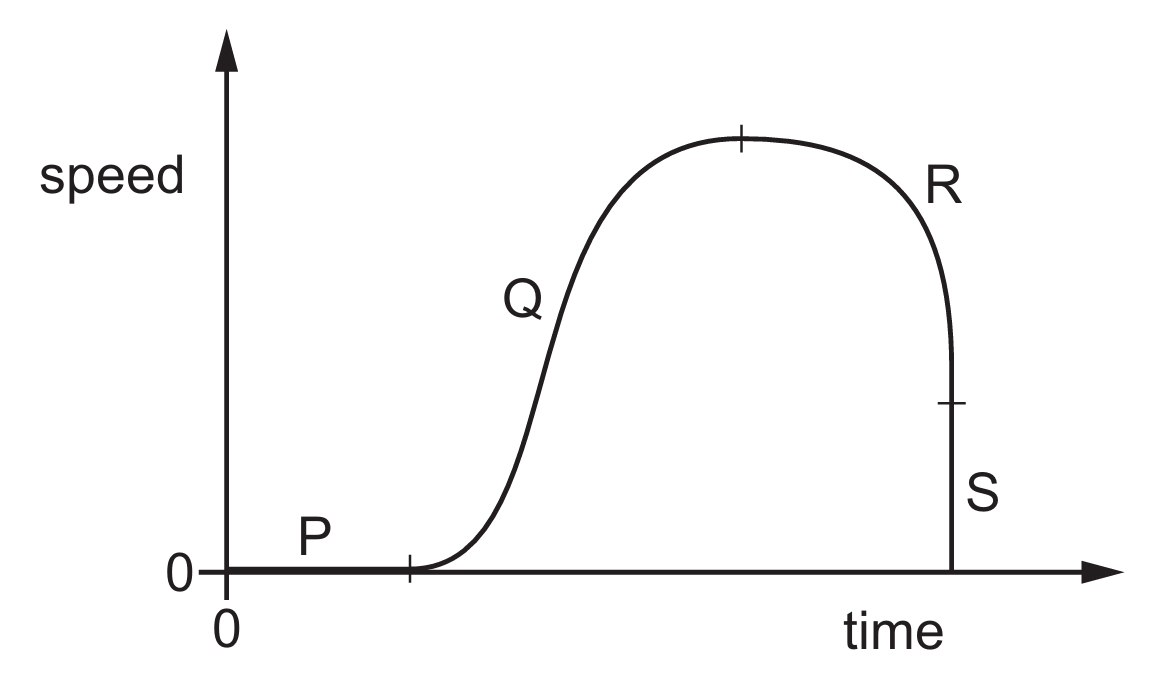
In a speed–time graph, the gradient represents the acceleration $a$. A straight line indicates constant acceleration, while a curved line indicates changing acceleration.
Section $P$ is a horizontal line where $a = 0$, and section $S$ is a vertical line indicating an instantaneous stop (infinite deceleration), neither of which represents a gradual “change” in acceleration.
Sections $Q$ and $R$ are curved, meaning the gradient is constantly varying as the car speeds up and slows down.
Specifically, in $Q$, the gradient increases then decreases, and in $R$, the negative gradient becomes steeper.
Therefore, only sections $Q$ and $R$ show an acceleration that is changing over time.