iGCSE Physics (0625) 4.2.3 Electromotive force and potential difference-Exam Style Questions- New Syllabus
Question

▶️ Answer/Explanation
Detailed solution:
Potential difference (V) is defined as the work done (or energy transferred) per unit charge (Q) passing through a component, expressed as V= Q W .
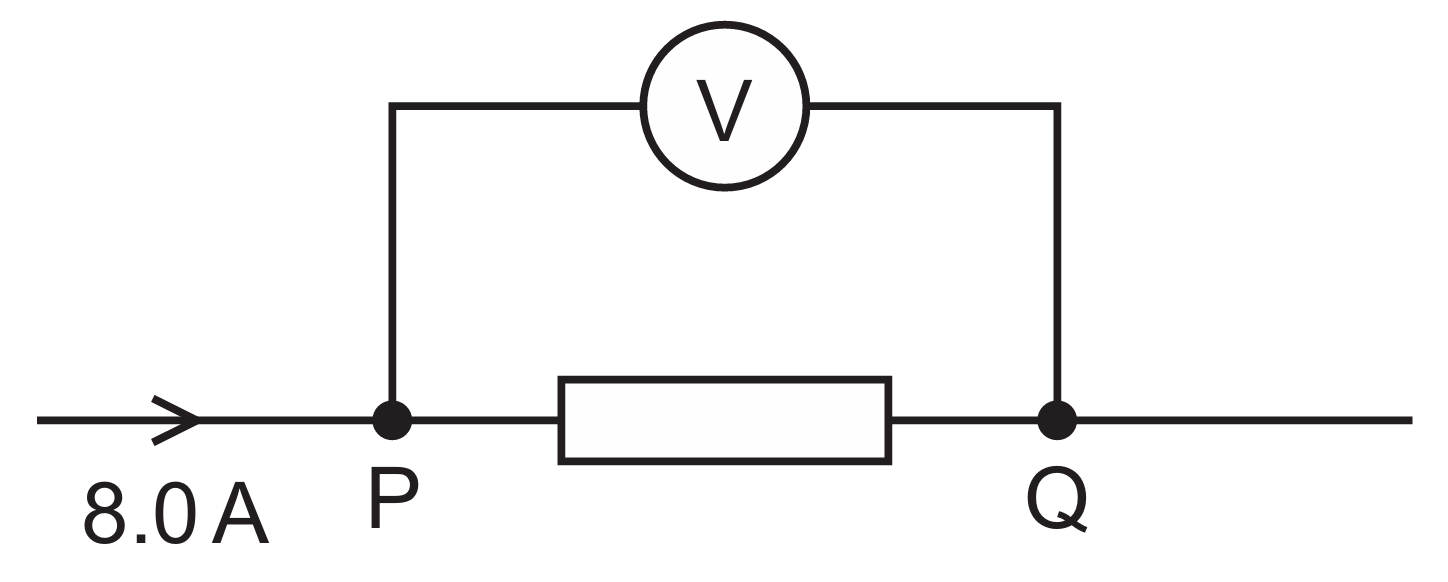
From the question, the voltmeter reading V=16 V represents the energy transferred for every 1 C of charge.
Rearranging the formula to find energy gives W=V×Q.
Substituting the given values: W=16 V×1.0 C=16 J.
Note that the current of 8.0 A is extra information not required for this specific calculation.
Therefore, 16 J of energy is transferred when 1 C of charge flows through the resistor.
Question
▶️ Answer/Explanation
Detailed solution:
Electromotive force $(e.m.f.)$ and potential difference $(p.d.)$ both represent work done per unit charge, defined by the equation $V = \frac{W}{Q}$ or $E = \frac{W}{Q}$.
Consequently, both quantities are measured in the same $SI$ unit: the volt $(V)$.
In contrast, current is measured in amperes $(A)$, charge in coulombs $(C)$, and resistance in ohms $(\Omega)$.
Since $e.m.f.$ and $p.d.$ share the same unit of volts, option B is the only correct pairing.
The other options (A, C, and D) incorrectly pair quantities with distinct units like $A$ and $C$ or $\Omega$ and $V$.
Question
▶️ Answer/Explanation
Detailed solution:
Electromotive force ($e.m.f.$) is defined as the electrical work done (energy supplied) by a source in moving a unit charge around a complete circuit.
Mathematically, this relationship is expressed by the equation $E = \frac{W}{Q}$, where $E$ is the $e.m.f.$, $W$ is the energy or work done, and $Q$ is the electrical charge.
While potential difference ($p.d.$) also involves energy per unit charge, $e.m.f.$ specifically refers to the energy provided to the entire circuit by the source.
Since the definition specifically describes the energy required to drive a “physical quantity,” that quantity is the charge ($Q$).
Therefore, option A is the correct definition according to the syllabus requirements.
