Home / iGCSE Physics (0625) 4.4 Electrical safety-Exam Style Questions

iGCSE Physics (0625) 4.4 Electrical safety -Exam Style Questions Paper 2 - New Syllabus

Question

An electrical appliance has a symbol on it to indicate it is double-insulated. Which statement is correct?
A. A two-core, flexible cable with no earth wire is used to connect it to the mains supply.
B. It needs an earth wire that is connected to a fuse.
C. No fuse or circuit breaker is needed.
D. The cable should be connected to the live and earth connectors of the plug but not the neutral.
▶️ Answer/Explanation
Correct Option: A

Detailed solution:

Double-insulated appliances are designed with non-conducting outer casings, such as plastic, which act as a second layer of insulation.
Because the casing cannot become live even if an internal fault occurs, an earth wire is not required for safety.
Consequently, these appliances use a two-core cable containing only the live and neutral wires, with $0$ earth connection.
A fuse is still necessary in the live wire to protect the circuit from excess current, making option C incorrect.
Option D is incorrect because every appliance requires a neutral wire to complete the circuit and allow current to flow.
Thus, option A is the only statement that correctly describes the wiring of a double-insulated device.

Question

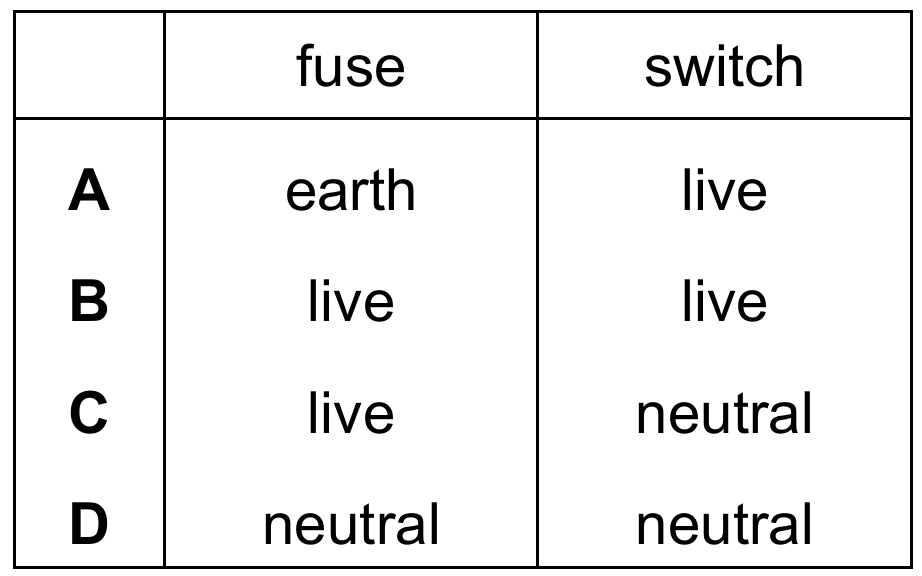
In which mains electric wires are the fuse and the switch placed?
▶️ Answer/Explanation
Correct Option: B

Detailed solution:

In a standard mains circuit, both the fuse and the switch must be connected to the live wire for safety reasons.
The switch is placed in the live wire so that when it is “off,” the appliance is disconnected from the high-voltage supply, making it safe to touch.
The fuse is also placed in the live wire; if a fault occurs and the current exceeds its rating, the fuse melts and breaks the circuit.
This isolates the appliance from the $230\text{V}$ (or equivalent) source, preventing electric shocks and fire hazards.
Placing these components in the neutral or earth wires would leave the appliance at a high potential even if the circuit is broken.
Therefore, Row B correctly identifies that both components belong in the live wire.

Question

Two electrical appliances are connected to the mains supply. The cable connected to one appliance includes an earth wire. The cable connected to the second appliance does not need an earth wire. What is a reason for this difference?
A. One appliance has a metal case, but the other appliance does not.
B. One appliance is fitted with a fuse, but the other appliance is not.
C. One appliance is fitted with a switch, but the other appliance is not.
D. One appliance needs more current than the other appliance
▶️ Answer/Explanation
Correct Option: A

Detailed solution:

An earth wire is a safety feature that prevents electric shock by providing a low-resistance path for current if a fault causes the live wire to touch a metal case.
Appliances with non-conducting (e.g., plastic) cases are often double-insulated and do not require an earth wire as there is no external metal part that could become live.
The presence of a fuse (Option B) or switch (Option C) does not determine the need for earthing; both earthed and unearthed appliances typically include fuses and switches.
The current requirement (Option D) is unrelated to the safety earthing requirement specified by the design of the outer casing.
Therefore, the correct reason for the difference is whether the appliance has a metal case that could conduct electricity to the user.

Scroll to Top