
▶️ Answer/Explanation
Detailed solution:
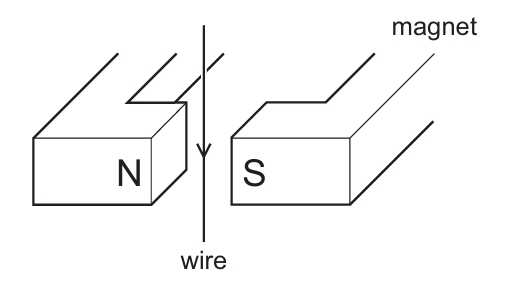
According to Fleming’s left-hand rule, the direction of the force on a current-carrying conductor in a magnetic field depends on the direction of the current.
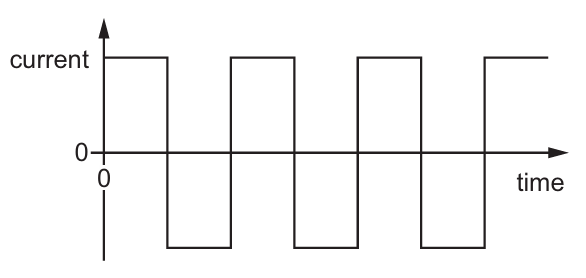
Since the magnetic field direction is fixed and the current alternates direction repeatedly, the force on the wire must also alternate in direction correspondingly.
The magnitude of the force remains constant when the current is constant, but its direction reverses with the current.
Therefore, the force alternates between one direction and the opposite direction, matching Option A.

▶️ Answer/Explanation
Detailed solution:
The direction of the force is determined by Fleming’s left-hand rule and is perpendicular to both the current and the magnetic field.
Reversing the current direction reverses the force direction, whereas changing the magnitude of current or field strength only affects the size of the force.
Using an electromagnet with the same polarity does not alter the field direction, so the force direction remains unchanged.
Therefore, reversing the current is the only change that will reverse the direction of the force.
▶️ Answer/Explanation
Detailed solution:
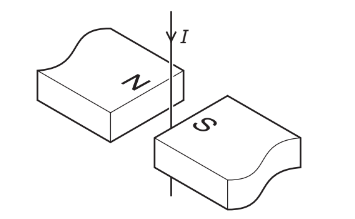
Using Fleming’s left-hand rule: the First finger points in the direction of the magnetic Field (N to S).
The seCond finger points in the direction of the Current (vertically along the wire).
The thuMb will then point in the direction of the force (Motion), which is horizontal.
This force is mutually perpendicular to both the field and the current, making it at right angles to the N-S axis.
Therefore, the correct description is horizontal and at right angles to the direction from N to S.