iGCSE Physics (0625) 4.5.5 The d.c. motor -Exam Style Questions Paper 2 - New Syllabus
Question

▶️ Answer/Explanation
Detailed solution:
To ensure a d.c. motor continues to rotate in one direction, the force on the coil must be reversed every half-turn ($180^{\circ}$).
The split-ring commutator is the specific component designed to reverse the direction of the current in the coil at this interval.
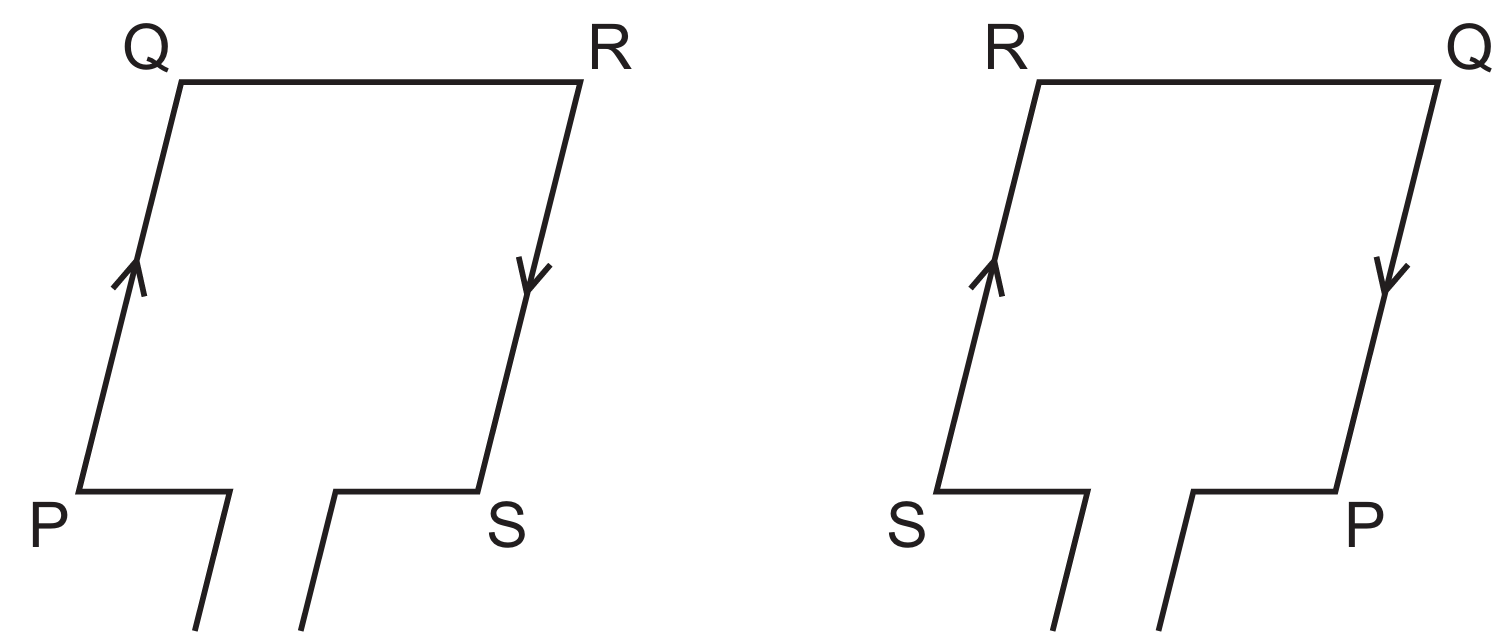
As the coil passes the vertical position, the gaps in the split ring align with the brushes, momentarily breaking the circuit.
Upon further rotation, each half of the commutator connects with the opposite brush, reversing the current flow from $PQRS$ to $SRQP$.
This reversal maintains a constant direction of the turning effect (torque) acting on the coil.
While the brushes provide the electrical contact, the “splitting” mechanism of the commutator is what performs the actual reversal.
Question
▶️ Answer/Explanation
Detailed solution:
The turning effect (torque) on a coil in a magnetic field is determined by the formula $\tau = B I A N \cos\theta$.
To decrease the turning effect, one must reduce the magnetic field strength ($B$), the current ($I$), or the number of turns ($N$).
Options A and C increase $B$, while option B increases $I$, all of which would increase the turning effect.
Reducing the number of turns ($N$) directly reduces the total force acting on the sides of the coil.
Therefore, decreasing the number of turns on the coil is the only change that results in a smaller turning effect.
B. to ensure that the magnetic field in the motor stays in the same direction at all times
C. to ensure that the turning effect on the motor changes direction every half rotation
D. to ensure that the turning effect on the motor stays in the same direction at all times
▶️ Answer/Explanation
Detailed solution:
A d.c. motor works by passing current through a coil in a magnetic field, creating a force $F = BIL$.
As the coil rotates $180^\circ$, the sides swap positions relative to the magnetic poles.
The split-ring commutator reverses the direction of the current in the coil every half-turn.
This reversal ensures the magnetic force on each side of the coil always produces a torque in the same direction.
Without this, the motor would simply oscillate instead of completing a full rotation.
Thus, the commutator ensures the turning effect (torque) remains constant in direction, allowing continuous rotation.
