iGCSE Physics (0625) 5.2.2 The three types of nuclear emission-Exam Style Questions- New Syllabus

Question

A radioactive source is placed $20\text{ mm}$ in front of a detector. The count rate from the source is $2000\text{ counts/minute}$.

With a thin sheet of paper between the source and the detector, the count rate is $2000\text{ counts/minute}$.

With a sheet of aluminium $5\text{ mm}$ thick between the source and the detector, the count rate is $1200\text{ counts/minute}$.

Which radioactive emissions are coming from the source?

A. alpha, beta and gamma
B. alpha only
C. beta and gamma only
D. beta only
▶️ Answer/Explanation
Correct Option: C

Detailed solution:

The count rate remains $2000\text{ counts/minute}$ with paper, meaning no $\alpha$-particles are present as they would be absorbed.
The rate drops to $1200\text{ counts/minute}$ with $5\text{ mm}$ of aluminium, indicating $\beta$-particles are being emitted and absorbed.
Since $1200\text{ counts/minute}$ still pass through the aluminium, $\gamma$-radiation must also be present due to its high penetrating power.
Therefore, the source emits both $\beta$-particles and $\gamma$-rays, making Option C the correct choice.

Question

Strontium-89 is a radioactive beta-emitter used to treat bone cancers.
A solution of strontium chloride is injected into patients and accumulates in their bones.
Which statement about this treatment is not correct?
A. Beta radiation is a form of electromagnetic radiation.
B. Beta-particles are a form of ionising radiation.
C. The strontium-89 atoms change to atoms of another element when they decay.
D. Beta-particles are negatively charged.
▶️ Answer/Explanation
Correct Option: A

Detailed solution:

Beta-particles ($\beta^{-}$) are high-speed electrons emitted from the nucleus, not electromagnetic waves like gamma rays or X-rays.
They possess a relative charge of $-1$, making statement D correct, and they are highly ionising, making statement B correct.
During $\beta$-decay, a neutron changes into a proton ($n \to p + e^{-}$), which increases the proton number $Z$ by $1$.
Because the proton number defines the identity of an atom, the strontium-89 changes into a different element, making statement C correct.
Therefore, statement A is the only incorrect claim, as beta radiation consists of particles with mass and charge, not electromagnetic radiation.

Question

Alpha, beta and gamma emissions are compared.

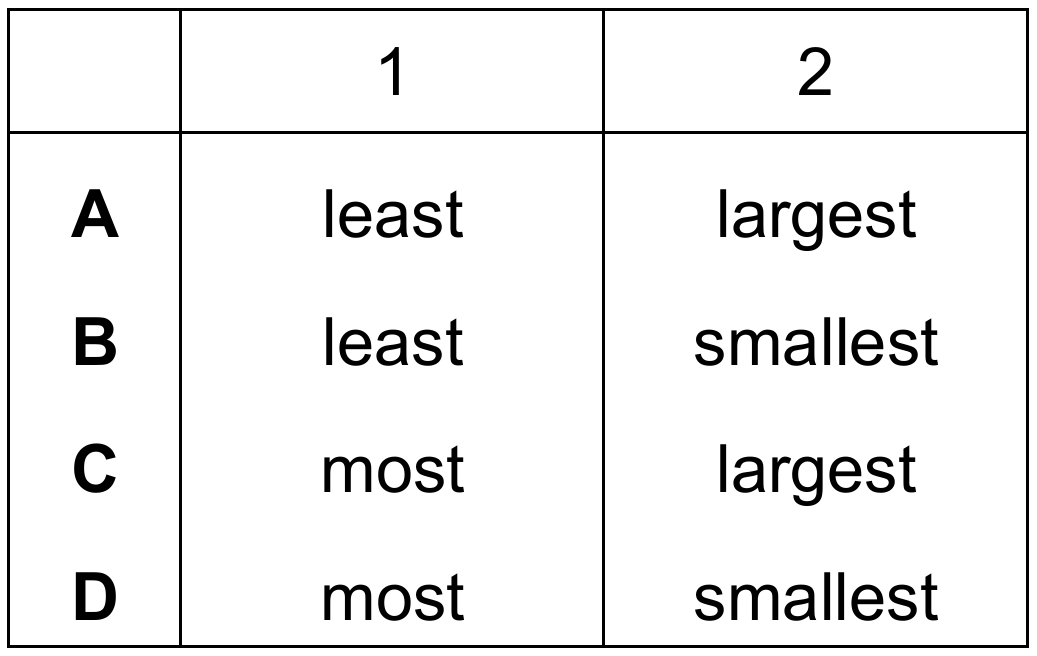
Alpha radiation is the ……1…… ionising as it has the ……2…… electric charge.

Which words correctly complete the sentence?

▶️ Answer/Explanation
Correct Option: C

Detailed solution:

Alpha particles ($\alpha$) consist of two protons and two neutrons, giving them a relative charge of $+2$.
This is the largest electric charge among the three emissions, as beta particles ($\beta$) have a charge of $-1$ and gamma rays ($\gamma$) have $0$ charge.
The high charge and large mass of alpha particles cause them to interact strongly with atoms, making them the most ionising.
Stronger ionisation occurs because the $+2$ charge easily pulls electrons away from nearby atoms during collisions.
Therefore, Row C correctly identifies that alpha radiation is the most ionising due to having the largest electric charge.

Scroll to Top