
CIE iGCSE Co-Ordinated Science B11. Gas exchange in humans Exam Style Questions Paper 4
Question
Most-appropriate topic codes (Cambridge IGCSE Co-ordinated Sciences 0654):
• Topic B11.1 — Gas exchange in humans
• Topic B12.1 — Respiration
• Topic B15.4 — Sexual reproduction in humans
▶️ Answer/Explanation
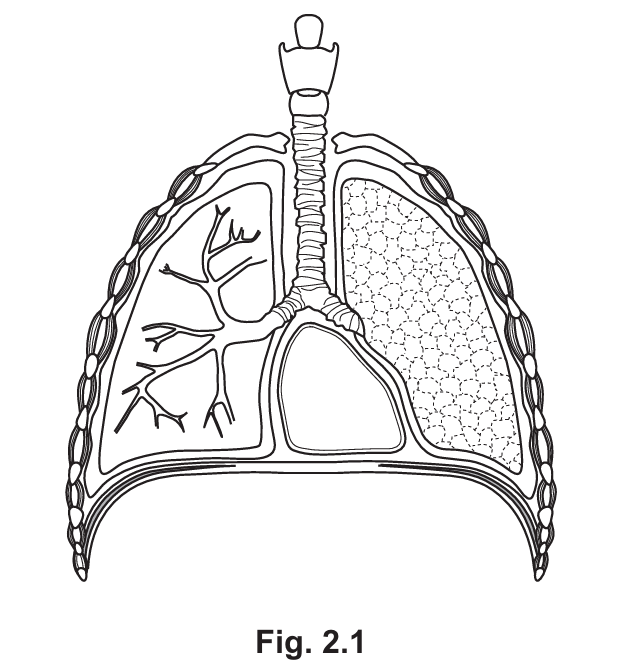
(a)(i) Larynx labelled L or larynx ; bronchus labelled B or bronchus
The larynx is the voice box located at the top of the trachea, while the bronchi are the two main airways that branch off from the trachea into each lung.
(a)(ii) Any two from:
• large surface area
• thin (surface) / thin wall
• good blood supply
• good ventilation (with air)
These features maximise the efficiency of gas exchange. A large surface area allows more gas to diffuse simultaneously, thin surfaces provide a short diffusion distance, good blood supply maintains concentration gradients, and ventilation ensures fresh air is constantly supplied.
(b)(i) C6H12O6 + 6O2 → 6CO2 + 6H2O
This equation shows glucose being oxidised in the presence of oxygen to produce carbon dioxide and water, releasing energy that is used for life processes.
(b)(ii) Any two from:
• anaerobic does not require oxygen / ORA
• anaerobic produces lactic acid / ORA
• anaerobic releases less energy / ORA
• anaerobic does not produce water or carbon dioxide / ORA
Anaerobic respiration is less efficient than aerobic respiration. It occurs when oxygen is in short supply, resulting in the production of lactic acid and a lower energy yield per glucose molecule.
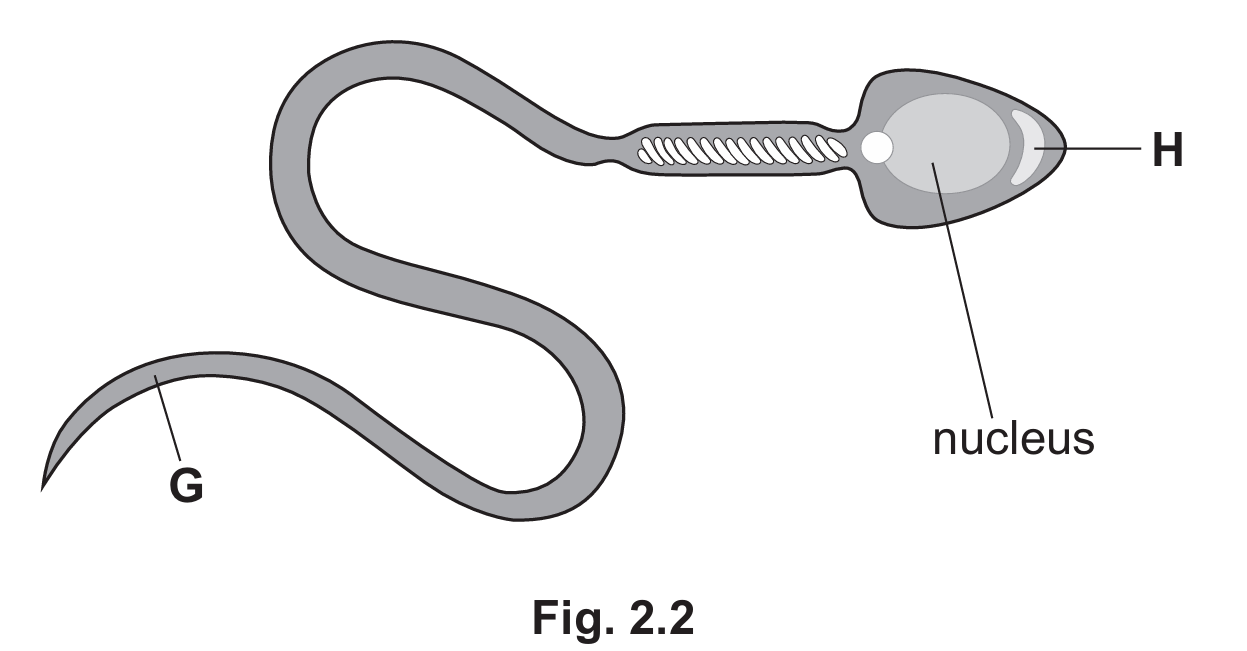
(c)(i) motility / movement / swimming
The tail (flagellum) of the sperm cell allows it to swim through the female reproductive tract to reach the egg for fertilisation.
(c)(ii) name: acrosome ; function: (contains digestive) enzymes to penetrate the egg
The acrosome is a specialised structure at the tip of the sperm head containing hydrolytic enzymes that break down the outer layers of the egg cell, allowing fusion of the sperm and egg membranes.
(c)(iii) contains a single set of chromosomes
A haploid nucleus contains only one set of chromosomes (23 in humans), unlike diploid cells which contain two complete sets (46 chromosomes). This ensures that when the sperm and egg fuse, the resulting zygote has the correct diploid number.
Question
Explain the advantages of a double circulation compared to the circulation in a fish.
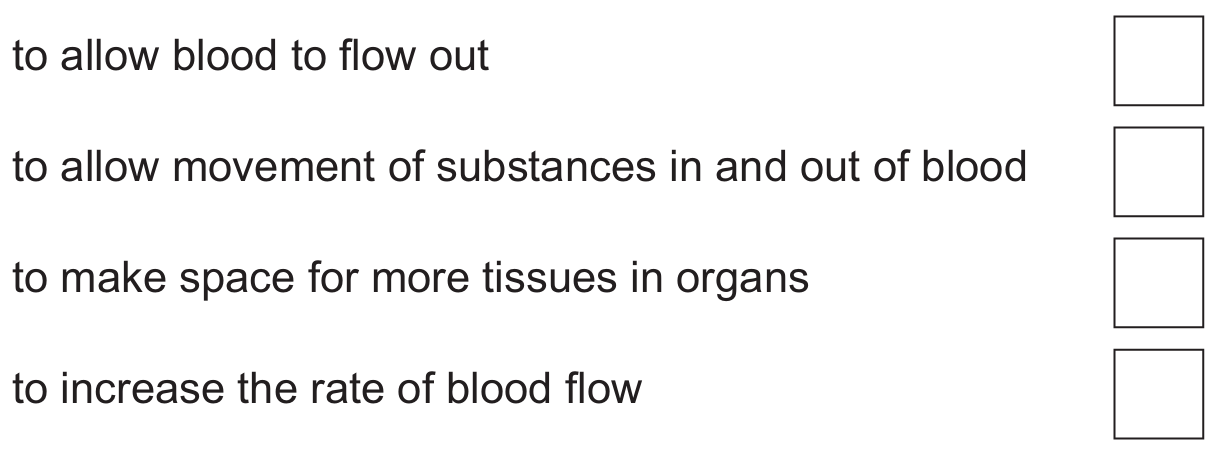
(i) Tick \((\checkmark)\) one box to identify which statement explains why capillaries have thin walls.
(ii) Fish gills have a good blood supply as they have many capillaries with thin walls. Suggest one other feature that makes the gills a good gas exchange surface.
An \(8\text{ mm}^3\) sample is taken from a patient.
The sample contains \(1.022\times 10^{6}\) platelets.
(i) Calculate the number of platelets per mm³ in the sample.
(ii) Suggest how this number of platelets may affect the patient if they cut themselves.
Most-appropriate topic codes (Cambridge IGCSE Co-ordinated Sciences 0654):
• Topic B9.1 — Circulatory systems (Parts (a) & (b))
• Topic B9.3 — Blood vessels (Part (c)(i))
• Topic B11.1 — Gas exchange in humans (Part (c)(ii))
• Topic B9.4 — Blood (Part (d)(i) & (d)(ii))
▶️ Answer/Explanation
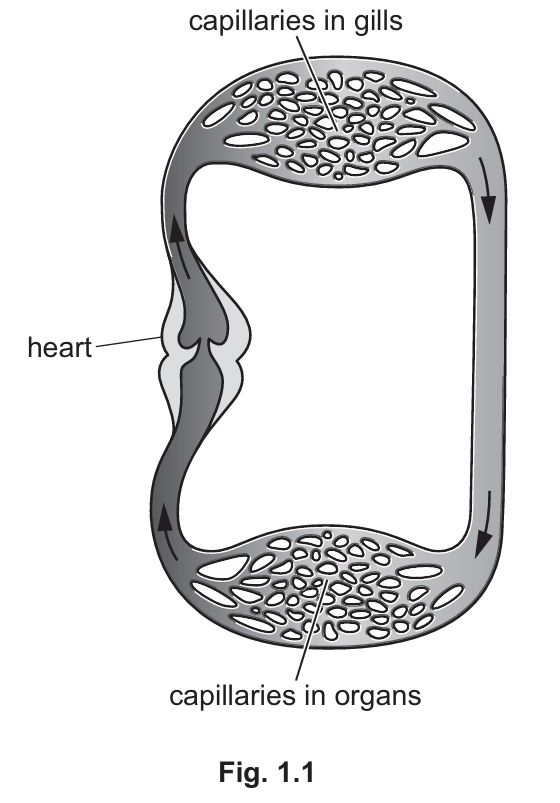
(a) X should be placed on the right-hand side of the circulatory system (the region after the gills).
In fish, blood becomes oxygenated as it passes through the gills. The right side of the diagram shows oxygenated blood flowing from the gills to the organs.
(b) Three advantages of double circulation:
• Blood is circulated more quickly in the mammalian system.
• Higher blood pressure is maintained to supply the body tissues.
• Lower blood pressure is maintained for the lungs, preventing damage to delicate capillaries.
• More effective delivery of oxygen and nutrients to body cells.
• Oxygenated and deoxygenated blood are kept completely separate.
(c)(i) ✓ to allow movement of substances in and out of blood
Thin capillary walls (single cell layer thick) create a short diffusion distance, allowing efficient exchange of oxygen, carbon dioxide, nutrients, and waste products between blood and tissues.
(c)(ii) Large surface area / good ventilation with water.
Gills have many lamellae which increase surface area, and water flows continuously over them maintaining a steep concentration gradient for efficient gas exchange.
(d)(i) Number of platelets per mm³:
\(\frac{1.022 \times 10^6}{8} = 127750\) platelets per mm³
(Alternative: \(1.278 \times 10^5\) platelets per mm³)
(d)(ii) The platelet count is below the healthy range (127750 < 150000).
This may cause:
• Reduced blood clotting ability.
• Increased risk of pathogens entering the wound.
• Increased blood loss from the cut.
• Slower wound healing.