Home / iGCSE / Coordinated Sciences / B12. Respiration Paper 2

CIE iGCSE Co-Ordinated Science B12. Respiration Exam Style Questions Paper 2

Question

Yogurt is a food made by adding bacteria to milk. The bacteria feed on sugars in the milk and produce lactic acid. The lactic acid denatures the milk protein.

Which process produces the lactic acid?

A. aerobic respiration
B. anaerobic respiration
C. assimilation
D. decomposition

▶️ Answer/Explanation
Bacteria in yogurt carry out anaerobic respiration (fermentation) of sugars, producing lactic acid as a waste product. Aerobic respiration would produce carbon dioxide and water, assimilation is building up molecules, and decomposition breaks down dead matter. Thus, the correct process is anaerobic respiration.
Answer: (B)

Question

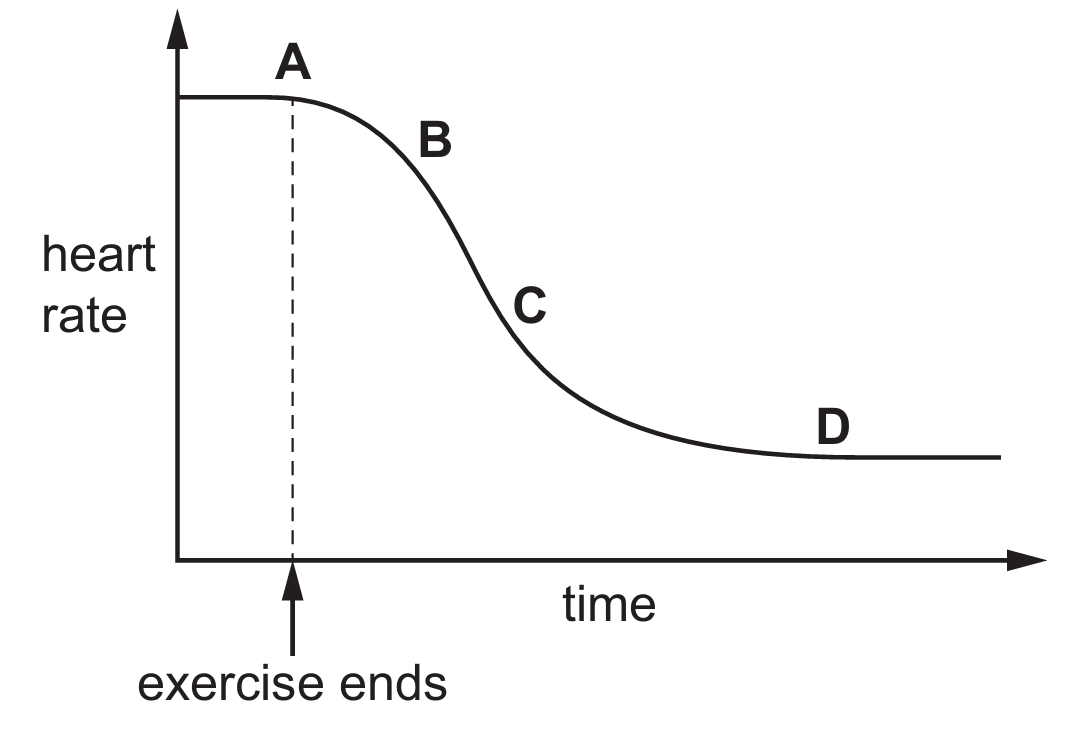
Scientists measure the heart rate of an athlete during and after exercise.

Which point on the graph shows the time when the oxygen debt is removed from the athlete?

▶️ Answer/Explanation
During vigorous exercise, anaerobic respiration produces lactic acid which creates an oxygen debt. After exercise ends, the heart rate remains elevated to transport lactic acid from muscles to the liver, where it is broken down aerobically. When the oxygen debt is fully cleared, the heart rate returns to its normal resting level. On the graph, this is shown at point D where the heart rate has leveled off to its pre-exercise rate. Point A shows heart rate during exercise, B shows the immediate drop after exercise ends, and C shows the recovery phase where oxygen debt is being repaid but not yet fully cleared.
Answer: (D)

Question

The word equation for aerobic respiration is shown.

glucose + oxygen → carbon dioxide + water

How many molecules of carbon dioxide will be produced from the breakdown of four molecules of glucose?

A. 4
B. 8
C. 16
D. 24

▶️ Answer/Explanation
The balanced symbol equation for aerobic respiration is \(\mathrm{C_6H_{12}O_6 + 6O_2 \rightarrow 6CO_2 + 6H_2O}\). This shows that one molecule of glucose produces six molecules of carbon dioxide. Therefore, four molecules of glucose will produce \(4 \times 6 = 24\) molecules of carbon dioxide.
Answer: (D)

Question

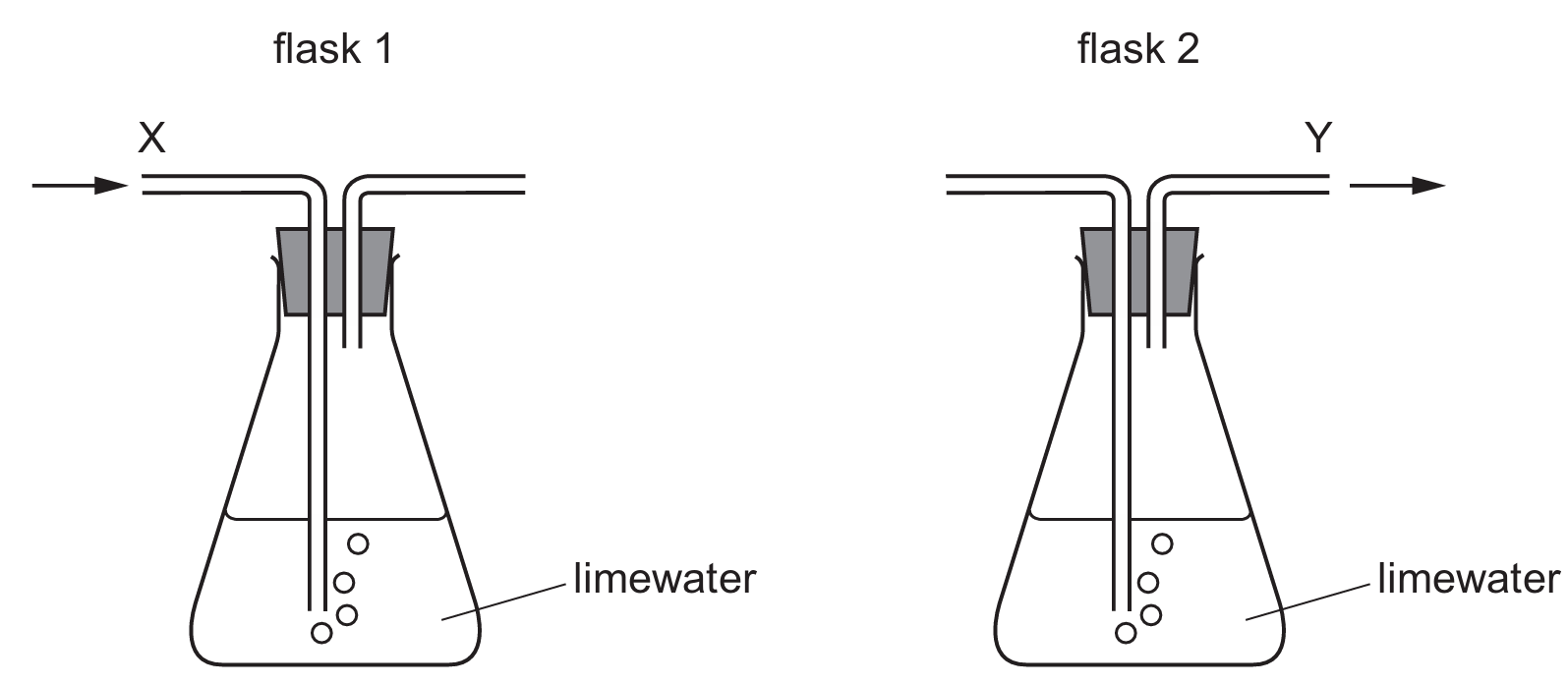
Two flasks are set up as shown. A student breathes out through tube X of flask 1. Another student breathes in through tube Y of flask 2.

The students obtain different results.

Which body process causes this difference?

A. absorption
B. assimilation
C. digestion
D. respiration

▶️ Answer/Explanation
Respiration produces carbon dioxide, which is exhaled. This makes the limewater in flask 1 turn cloudy. The air inhaled through flask 2 has less CO₂, so it stays clear or shows less change. This difference is caused by respiration.
Answer: (D)

Question

Which statement about anaerobic respiration is correct?

A. It does not cause an oxygen debt.
B. It occurs in the muscles during vigorous exercise.
C. It uses oxygen to release energy from nutrient molecules.
D. It releases more energy per glucose molecule compared to aerobic respiration.

▶️ Answer/Explanation
During vigorous exercise, muscles respire anaerobically via \(\text{glucose} \rightarrow \text{lactic acid} + \text{energy}\) when oxygen supply is insufficient.
This creates an oxygen debt and releases far less energy per glucose molecule than the aerobic pathway.
Answer: (B)
Scroll to Top