Home / iGCSE / Coordinated Sciences / B13.1 Coordination and response Paper 2

CIE iGCSE Co-Ordinated Science B13.1 Coordination and response Exam Style Questions Paper 2

Question

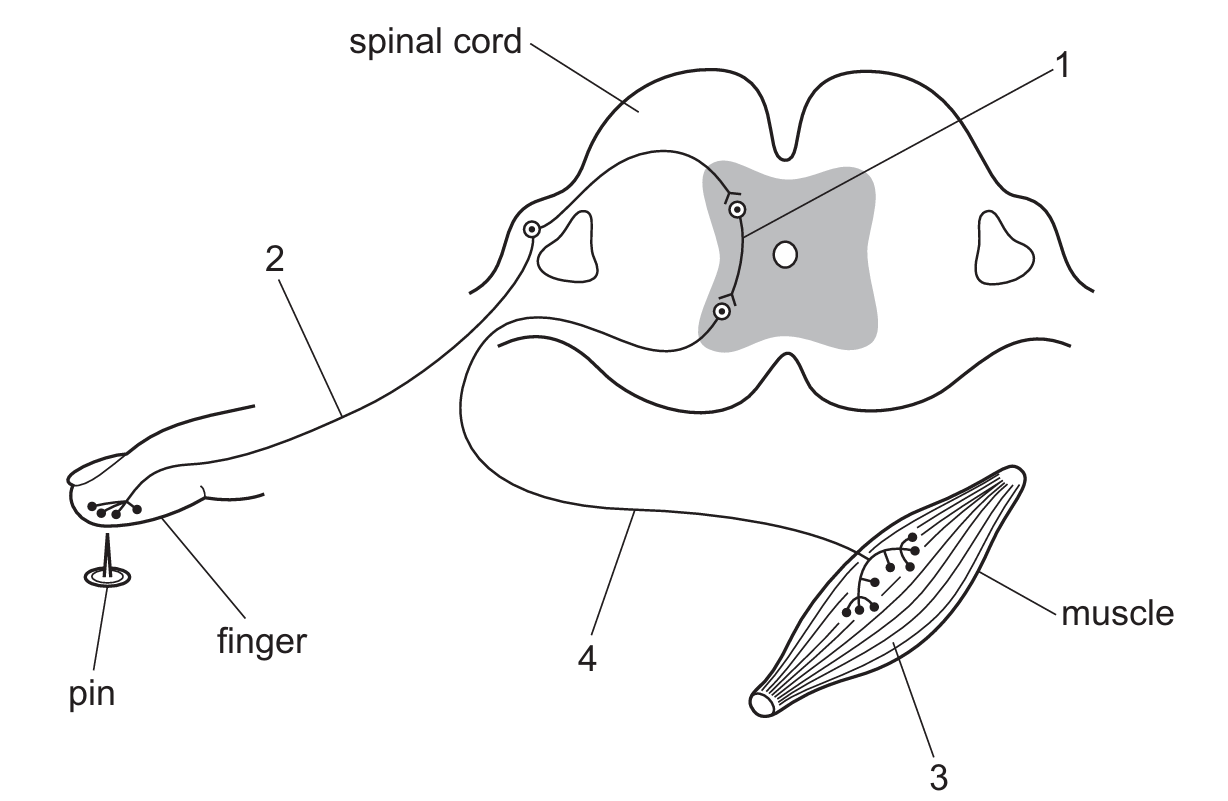
The diagram shows a simple reflex arc.

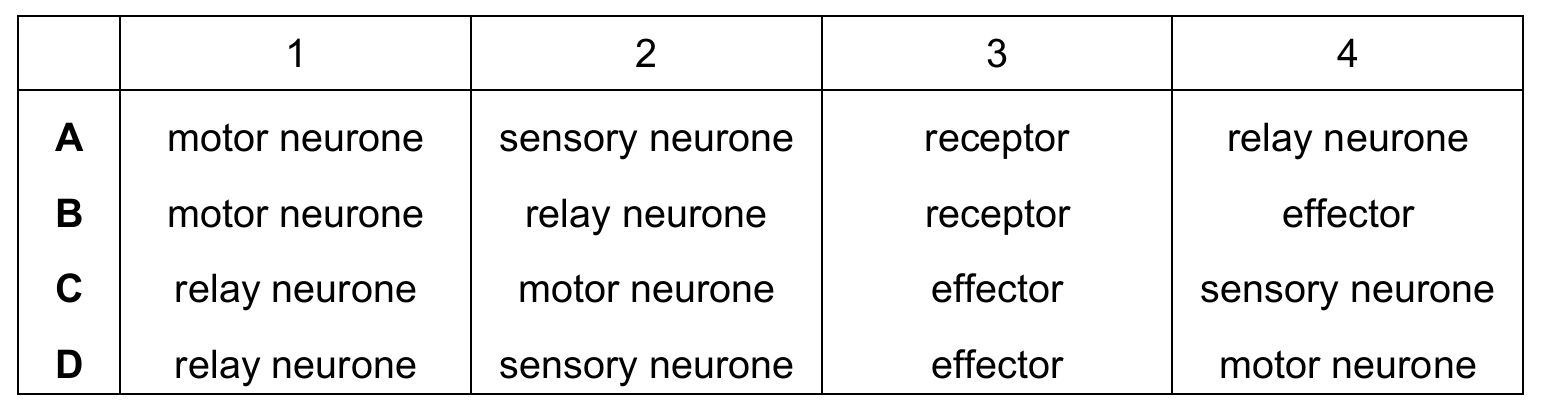
Which row gives the correct labels for the diagram?

▶️ Answer/Explanation
In a reflex arc, the correct pathway is: receptor → sensory neurone → relay neurone → motor neurone → effector. Looking at the diagram, label 1 represents the neurone entering the spinal cord, which is the sensory neurone. Label 2 is inside the spinal cord, which is the relay neurone. Label 3 points to the muscle, which is the effector. Label 4 is the neurone leaving the spinal cord to the effector, which is the motor neurone. Option D correctly matches these labels (1 = relay neurone, 2 = sensory neurone, 3 = effector, 4 = motor neurone).
Answer: (D)

Question

A student looks at an object at a distance and then looks at an object close by. This ability to focus on both objects is brought about by changing the shape of the lens. What is this called?

A. accommodation
B. coordination
C. pupil reflex
D. transmission

▶️ Answer/Explanation
Accommodation is the ability of the eye to focus on objects at different distances by adjusting the shape of the lens through the action of the ciliary muscles and suspensory ligaments.
For near objects the lens becomes fatter (more convex), and for distant objects it becomes thinner — this automatic adjustment is called accommodation, not the pupil reflex (which controls light intensity).
Answer: (A)

Question

During an experiment, auxin is applied to one side of a shoot just behind the tip.

What will this stimulate?

A. decreased cell elongation in all cells
B. decreased cell elongation on the side with extra auxin
C. increased cell elongation in all cells
D. increased cell elongation on the side with extra auxin

▶️ Answer/Explanation
Auxin is a plant hormone that stimulates cell elongation in shoots.
A higher concentration of auxin on one side of the shoot causes greater elongation of the cells on that particular side.
This unequal growth is what causes the shoot to bend, as seen in phototropism.
Answer: (D)

Question

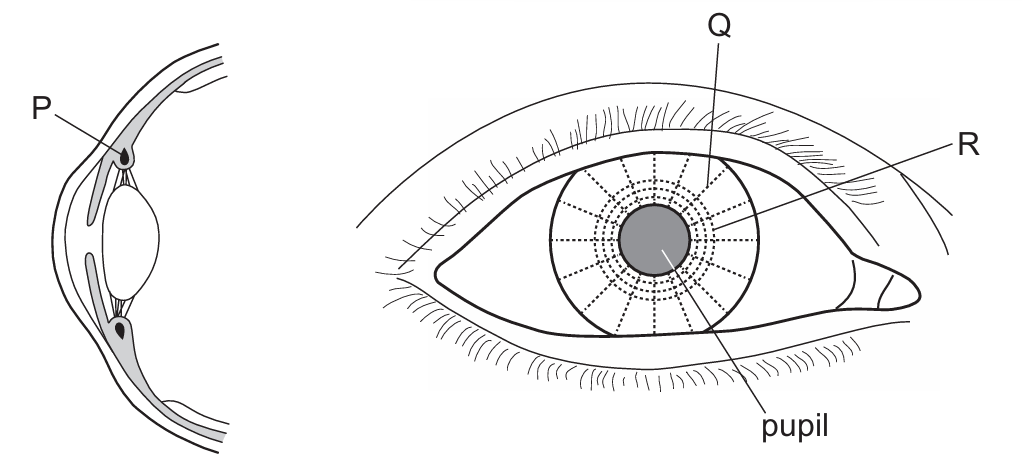
The diagram shows a section through the front of the eye and a front view of the eye.

Which muscles contract when viewing a distant object in dim light?

A. P and R
B. P only
C. Q and R
D. Q only

▶️ Answer/Explanation
In dim light, the pupil must widen to let in more light, which needs the radial iris muscles to contract.
Distance from focal length (ciliary muscles/lens) is not relevant here; only the muscle controlling pupil dilation matters.
The radial muscle labelled Q contracts to widen the pupil.
Answer: (D)

Question

What is the function of the cornea?

A. It carries impulses to the brain.
B. It controls how much light enters the pupil.
C. It focuses light onto the retina.
D. It refracts light.

▶️ Answer/Explanation
The cornea is the transparent front covering of the eye and its main role is to refract (bend) incoming light rays.
The iris controls pupil size, the lens fine-tunes focusing onto the retina, and the optic nerve carries impulses to the brain — none of these is the cornea’s job.
Answer: (D)
Scroll to Top