Home / iGCSE / Coordinated Sciences / B13.3 Homeostasis Paper 2

CIE iGCSE Co-Ordinated Science B13.3 Homeostasis Exam Style Questions Paper 2

Question

Which statement about blood flow to the skin in the maintenance of a constant internal body temperature is correct?

A. If the internal body temperature is too high then vasoconstriction of skin arterioles occurs.
B. If the internal body temperature is too low then vasoconstriction of skin capillaries occurs.
C. If the internal body temperature is too high then vasodilation of skin arterioles occurs.
D. If the internal body temperature is too low then vasodilation of skin capillaries occurs.

▶️ Answer/Explanation
When the internal body temperature is too high, vasodilation of the skin arterioles occurs. This widens the blood vessels, increasing blood flow to the surface capillaries, allowing more heat to be lost to the environment through radiation and convection. Vasoconstriction is the response to a decrease in body temperature, where blood vessels narrow to reduce heat loss.
✅ Answer: (C)

Question

Which statement about the role of blood vessels in the skin is correct?

A. If the environment is too cold, vasoconstriction of capillaries occurs.
B. If the environment is too cold, vasodilation of arterioles occurs.
C. If the environment is too hot, vasoconstriction of capillaries occurs.
D. If the environment is too hot, vasodilation of arterioles occurs.

▶️ Answer/Explanation
In hot conditions, arterioles supplying skin capillaries dilate (vasodilation), increasing blood flow to the skin surface.
This allows more heat to be lost by radiation, cooling the body down.
In cold conditions the opposite occurs: arterioles constrict (vasoconstriction) to reduce heat loss.
✅ Answer: (D)

Question

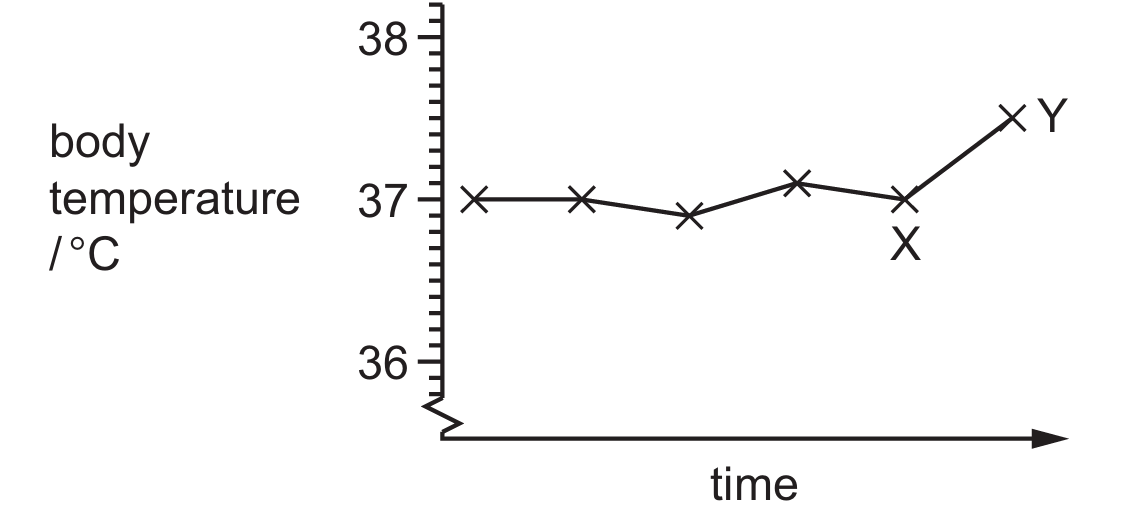
The graph shows the variation of body temperature over time of a healthy person at rest.

How will the body reverse the temperature change shown between times X and Y?

A. decreased breathing rate
B. decreased pulse rate
C. shivering
D. sweating

▶️ Answer/Explanation
Between X and Y, body temperature rises above the normal set point of about \(37\,^{\circ}\text{C}\).
To lose this excess heat, sweat glands produce more sweat, which cools the skin as it evaporates.
Shivering, and decreased breathing/pulse rate, would not cause cooling.
✅ Answer: (D)

Question

The graph shows the changes in blood glucose concentration during two hours of exercise.

What causes the change in blood glucose concentration between 30 and 60 min?

  1. increased adrenaline release
  2. increased glucagon release
  3. increased insulin release

A. 1 only
B. 1 and 2
C. 1 and 3
D. 2 only

▶️ Answer/Explanation
Between 30 and 60 minutes the graph shows blood glucose concentration rising back up during continued exercise.
Adrenaline released during exercise stimulates the liver to break down glycogen into glucose, raising blood glucose levels.
Increased insulin release would lower blood glucose rather than raise it, so option 3 does not fit the observed rise.
✅ Answer: (A)

Question

What is homeostasis?

A. the maintenance of the body’s external environment
B. the maintenance of the body’s internal environment
C. the processes that produce heat in the body
D. the removal of waste from the body

▶️ Answer/Explanation
Homeostasis refers to the regulation and maintenance of a constant internal environment within the body, despite external changes. This includes controlling temperature, blood glucose, water levels, and pH. It is not about the external environment, heat production alone, or just waste removal.
✅ Answer: (B)
Scroll to Top