
CIE iGCSE Co-Ordinated Science B13.3 Homeostasis Exam Style Questions Paper 4
Question
Most-appropriate topic codes (Cambridge IGCSE Co-ordinated Sciences 0654):
• Topic B13.2 — Hormones (Part (a))
• Topic B13.3 — Homeostasis (Part (b)(ii))
• Topic B13.1 — Coordination and response (Part (c)(i), (c)(ii), (c)(iii))
▶️ Answer/Explanation
(a)
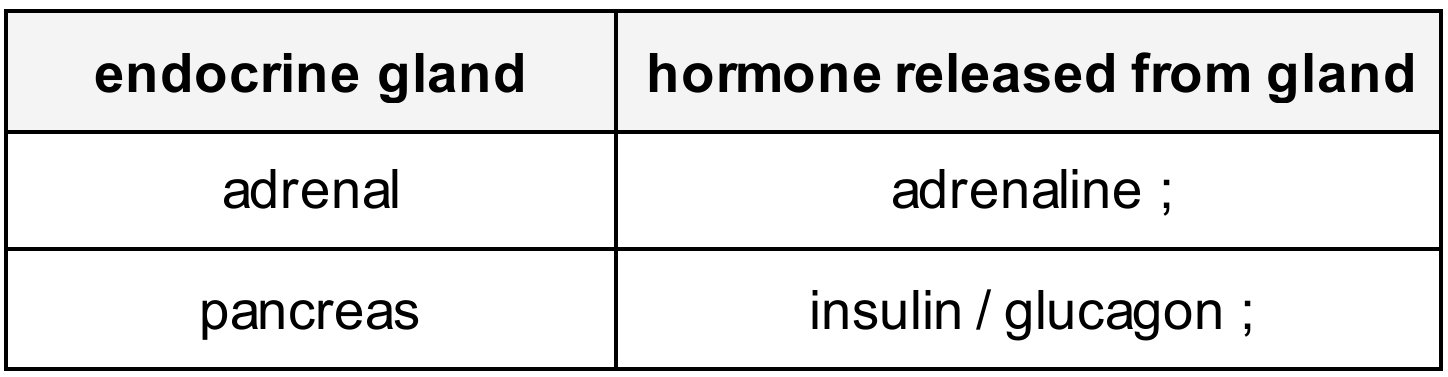
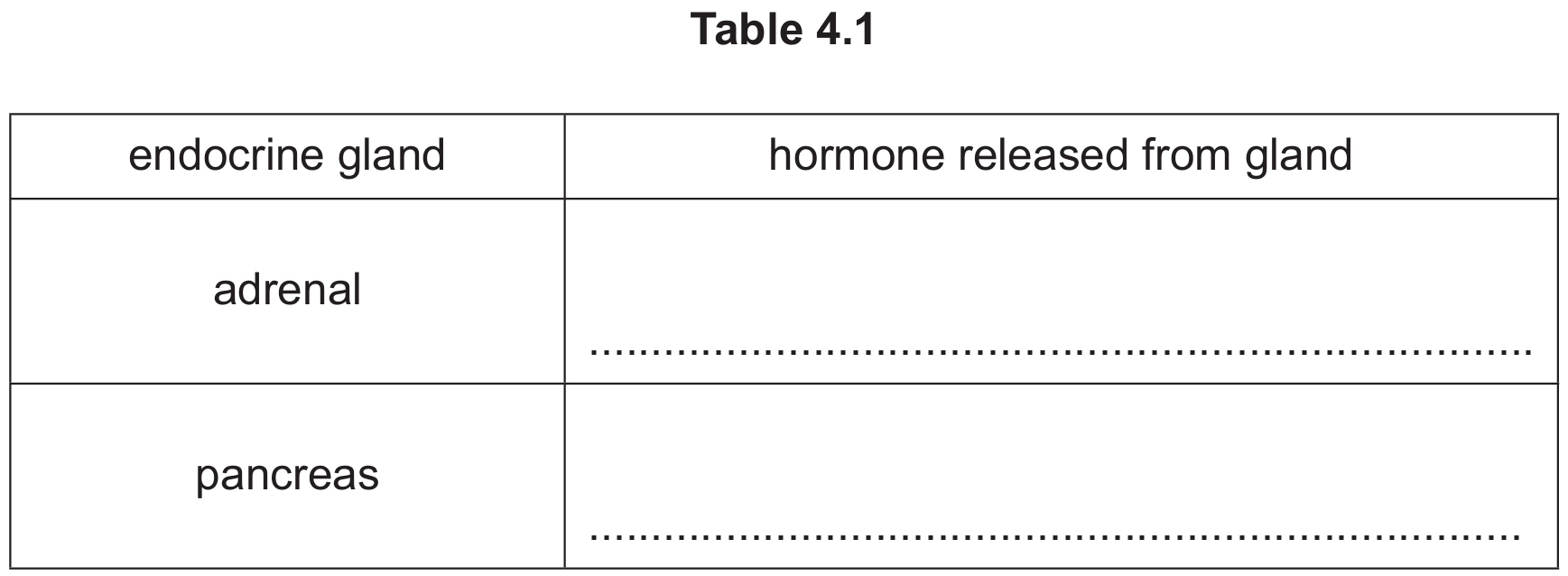
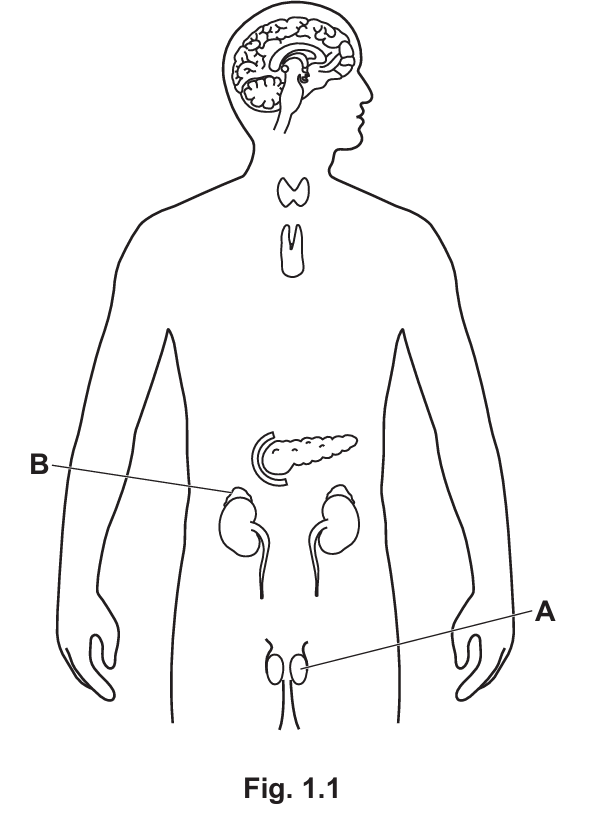
The adrenal glands, located above the kidneys, secrete the hormone adrenaline. Adrenaline is responsible for the “fight or flight” response, preparing the body for stressful situations. The pancreas is a dual-function organ (endocrine and exocrine). Its endocrine function involves secreting the hormones insulin (which lowers blood glucose) and glucagon (which raises blood glucose) directly into the bloodstream to regulate blood glucose concentration.
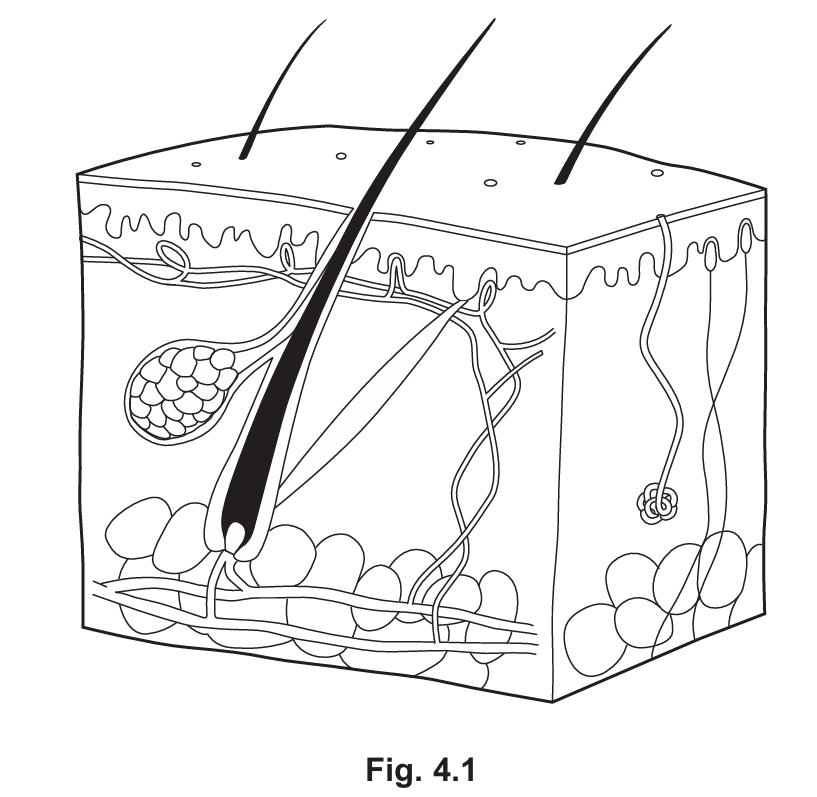
(b)(i) Label line to the sweat gland with the letter S.
Sweat glands are coiled tubular structures found in the dermis layer of the skin. They produce sweat, which is released onto the skin surface through pores. In a diagram, they can be identified as coiled structures in the lower part of the skin.
(b)(ii) The body responds to reduce body temperature by:
- Increased sweating (more sweat produced, which evaporates and cools the skin).
- Vasodilation (arterioles supplying skin capillaries widen, increasing blood flow to the skin surface, allowing more heat to be lost by radiation).
- Hairs lie flat (reducing the insulating layer of trapped air).
When body temperature rises above the normal set point (approximately 37°C), the hypothalamus in the brain triggers several responses: Sweating increases, and the evaporation of sweat from the skin surface removes latent heat, cooling the body. Vasodilation (widening of arterioles) increases blood flow to capillaries near the skin surface, allowing more heat to be radiated away from the body. Hair erector muscles relax, allowing hairs to lie flat, which reduces the trapped air layer and increases heat loss by convection and radiation.
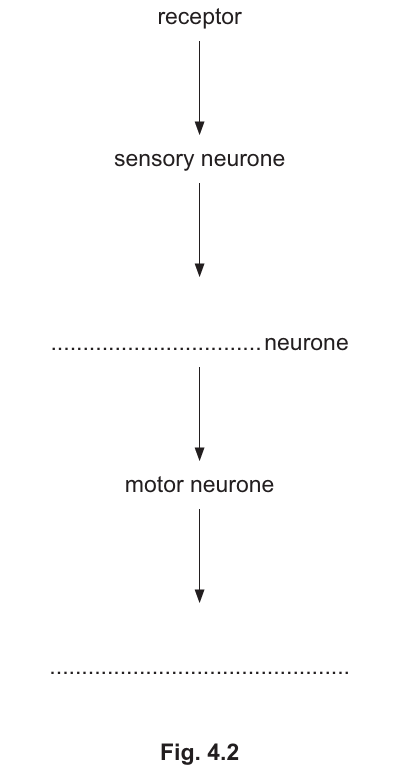
(c)(i) receptor → sensory neurone → relay neurone → effector.
A reflex arc is the neural pathway that controls a reflex action. The correct sequence is: receptor (detects stimulus) → sensory neurone (carries impulse to CNS) → relay neurone (connects sensory to motor neurone within the CNS) → motor neurone (carries impulse to effector) → effector (muscle or gland that produces the response).
(c)(ii) The two parts of the central nervous system are the brain and spinal cord.
The central nervous system (CNS) consists of the brain and the spinal cord. It is the control centre for the body, processing information from sensory neurones and coordinating responses via motor neurones.
(c)(iii) Speed in motor neurone = 74.0 ÷ 1.51 = 49.0 m/s (to 3 significant figures).
The calculation is straightforward. “1.51 times slower” means the speed is 1.51 times smaller, i.e., the motor neurone speed = 74.0 ÷ 1.51.
Performing this division gives 49.0066…, which rounds to 49.0 m/s when expressed to 3 significant figures.
Question
- hormone J ______
- hormone K ______
Most-appropriate topic codes (Cambridge IGCSE Co-ordinated Sciences 0654):
• Topic B13.2 — Hormones
• Topic B13.3 — Homeostasis
▶️ Answer/Explanation
(a)(i) gland ; blood / plasma ; target
Hormones are chemical messengers produced by endocrine glands. They are transported in the bloodstream to their target organs where they exert their effects by altering cellular activity.
(a)(ii)
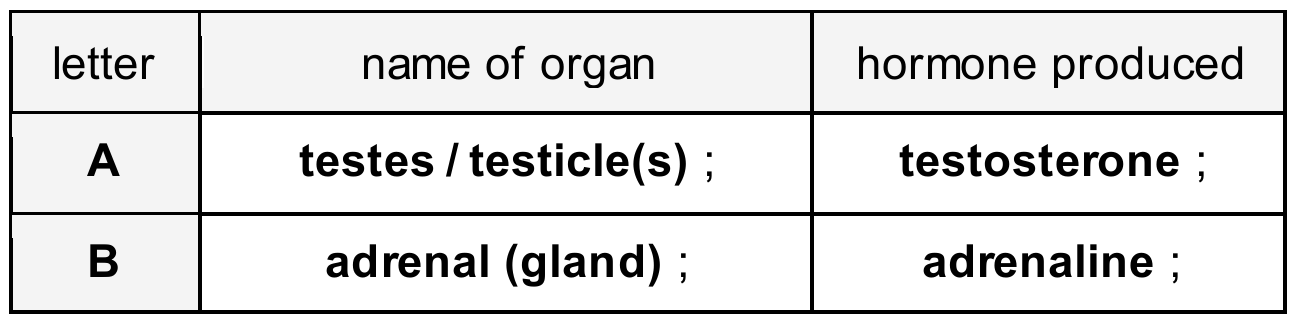
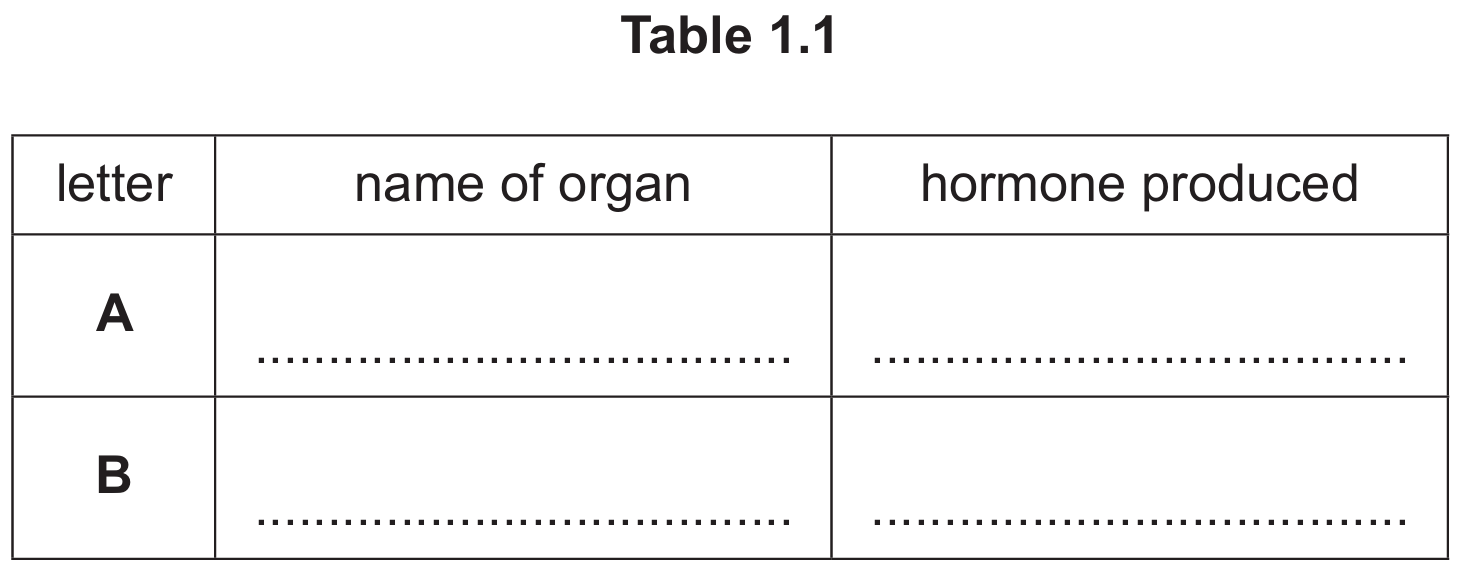
Testosterone is responsible for male secondary sexual characteristics such as deepening of the voice and growth of facial hair. Adrenaline is involved in the ‘fight or flight’ response, preparing the body for action.
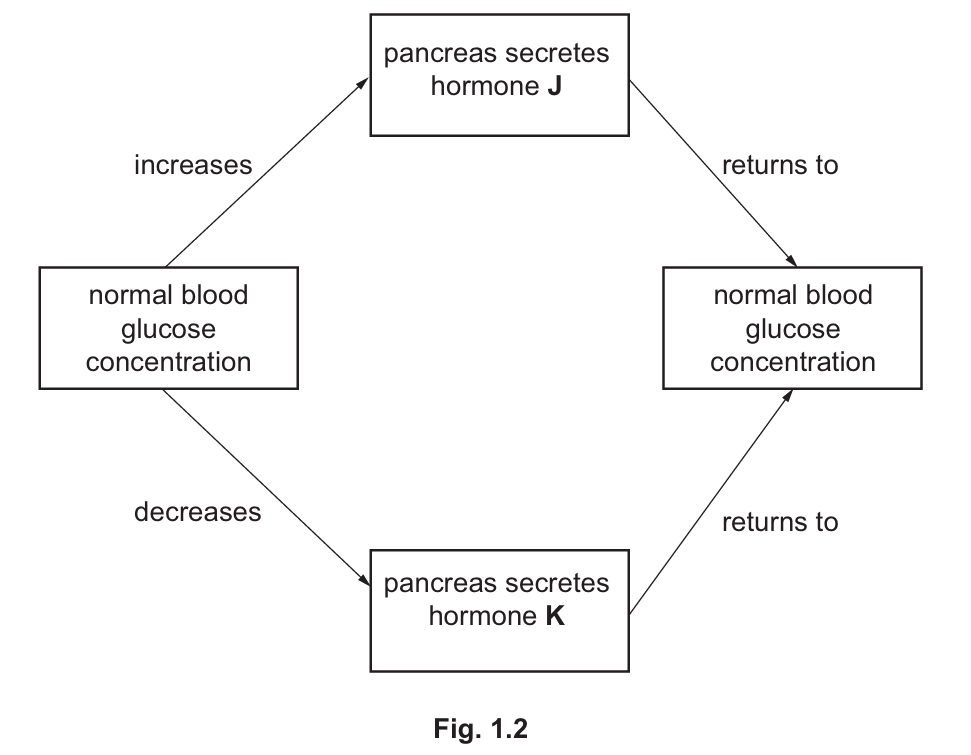
(b)(i) hormone J — insulin ; hormone K — glucagon
Insulin is secreted by the pancreas when blood glucose concentration is too high, promoting the conversion of glucose to glycogen in the liver. Glucagon is released when blood glucose is too low, stimulating the breakdown of glycogen to glucose.
(b)(ii) negative feedback
Negative feedback is a control mechanism where a change in a physiological variable triggers a response that counteracts the initial change. This keeps conditions stable and within narrow limits.