
CIE iGCSE Co-Ordinated Science B14. Drugs Exam Style Questions Paper 4
Question
• increased breathing rate and depth
• hotter body temperature.
(i) State what is meant by the term drug.
(ii) State one other way the patient may reduce his risk of coronary heart disease.
Most-appropriate topic codes (Cambridge IGCSE Co-ordinated Sciences 0654):
• Topic B13.1 — Coordination and response (Part (a)(i))
• Topic B13.3 — Homeostasis (Part (a)(ii))
• Topic B14.1 — Drugs (Part (b)(i))
• Topic B9.2 — Heart / Coronary heart disease (Part (b)(ii))
▶️ Answer/Explanation
(a)(i) Three effects explained:
• Muscles require more energy during exercise, so the rate of respiration increases.
• More oxygen and glucose must be delivered to the muscles for aerobic respiration.
• Increased carbon dioxide concentration in the blood is detected by the brain, which sends impulses to increase the heart rate (pumping blood faster) and breathing rate/depth (to remove CO₂ and take in more O₂).
• The heart pumps blood faster to deliver oxygen and remove waste products more quickly.
(a)(ii) Three responses to increased body temperature:
• The increased blood temperature is detected by the thermoregulatory centre in the brain.
• Sweating increases; sweat evaporates from the skin surface, transferring thermal energy away from the body.
• Vasodilation occurs — arterioles near the skin surface widen, increasing blood flow to skin capillaries, allowing more heat to be lost to the surroundings.
• Hair erector muscles relax, causing hairs to lie flat, reducing insulation and allowing more heat loss.
(b)(i) A drug is a substance/chemical taken into the body that affects or modifies chemical reactions in the body.
Drugs can alter physiological processes, including those involved in disease prevention and treatment.
(b)(ii) One other way to reduce the risk of coronary heart disease:
• Maintaining a balanced diet (low in saturated fats and cholesterol).
• Reducing stress levels.
• Stopping smoking.
• Maintaining a healthy body weight.
Question
Most-appropriate topic codes (Cambridge IGCSE Co-ordinated Sciences 0654):
• Topic B14.1 — Drugs, antibiotic resistance (Part (a))
• Topic B17.1 — Variation, mutation (Part (b)(i)); Topic P5.2.5 — Effects of ionising radiation (Part (b)(ii))
• Topic B17.2 — Selection, natural selection (Part (c))
▶️ Answer/Explanation
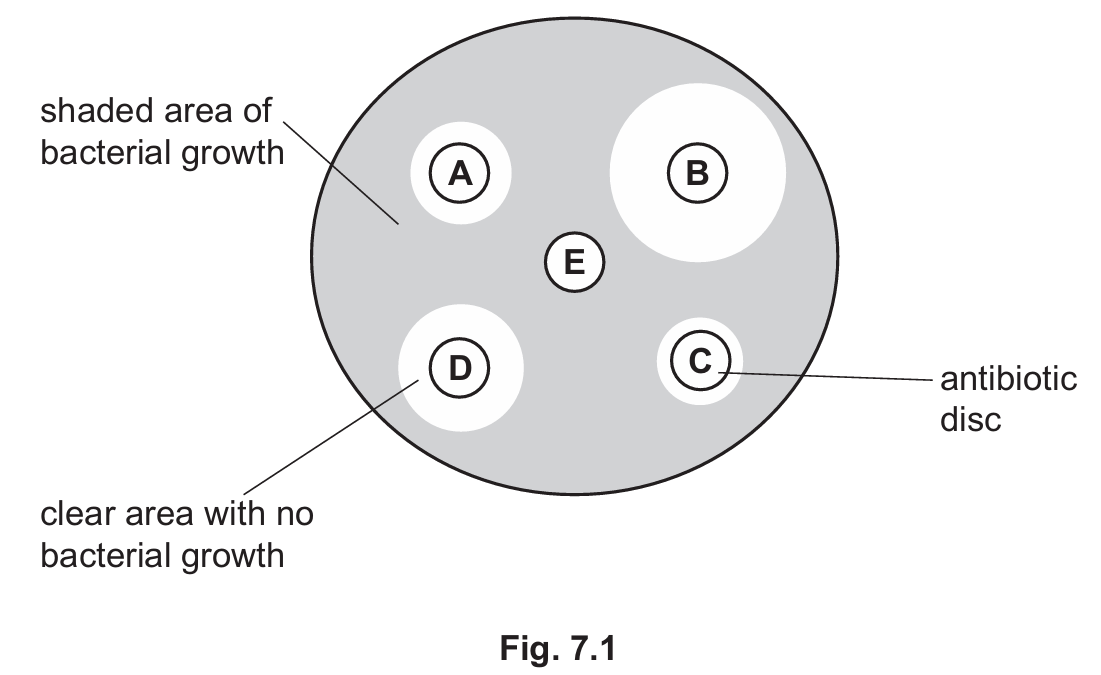
(a) Antibiotic B
B has the largest clear area of no bacterial growth around the disc.
A larger clear zone means that antibiotic diffused further while still killing bacteria, showing it is the most effective.
(b)(i) Gene/chromosome/nucleus/DNA.
Mutations are random changes that occur in the DNA/genetic material found in the nucleus of a cell.
(b)(ii) Ionising radiation
Ionising radiation (e.g. gamma rays, X-rays, ultraviolet) can damage DNA and increase the rate of mutation.
(c) Random mutation produces resistant bacteria, which survive and reproduce, passing on the resistance.
Genetic variation within the bacterial population means some individuals are randomly resistant to an antibiotic.
Resistant bacteria survive exposure to the antibiotic and have a greater chance of reproducing.
Their alleles for resistance are passed to the next generation, so the adaptive feature becomes more common over time — the basis of evolution by natural selection.