Home / iGCSE / Coordinated Sciences / B15.1 Asexual reproduction Paper 2

CIE iGCSE Co-Ordinated Science B15.1 Asexual reproduction Exam Style Questions Paper 2

Question

Which statement is correct?

A. Asexual reproduction produces offspring which can adapt quickly to changes in the environment.
B. Asexual reproduction produces genetically different offspring much faster than sexual reproduction.
C. Sexual reproduction produces genetically different offspring enabling natural selection to occur.
D. Sexual reproduction produces genetically identical offspring by the production of gametes.

▶️ Answer/Explanation
Sexual reproduction involves the fusion of gametes, producing offspring that are genetically different from each other and from their parents. This genetic variation is essential for natural selection, as it provides the raw material for evolution. Asexual reproduction produces genetically identical offspring (clones) and does not generate variation, limiting the ability to adapt to environmental changes.
Answer: (C)

Question

In a plant, what leads to offspring that are genetically identical to the parent?

A. asexual reproduction
B. insect pollination
C. seed germination
D. sexual reproduction

▶️ Answer/Explanation
Asexual reproduction involves \(1\) parent only, with no fusion of gametes, so no genetic variation is introduced.
The offspring are therefore genetically identical clones of the parent, unlike sexual reproduction which combines genes from \(2\) parents.
Answer: (A)

Question

What are the advantages of a plant reproducing asexually?

  1. increased variety of genetic material
  2. only small flowers need to be produced
  3. rapid increase in population size

A. 1 only
B. 2 only
C. 3 only
D. 1, 2 and 3

▶️ Answer/Explanation
Asexual reproduction produces genetically identical offspring (clones), so statement \(1\) is false.
Asexual reproduction does not require flowers at all, so statement \(2\) is false.
It allows many offspring to be produced quickly without needing a mate, so statement \(3\) is a true advantage.
Answer: (C)

Question

Which statement describes one similarity between asexual and sexual reproduction?

A. They both involve gametes.
B. They both involve parent and offspring.
C. They both produce genetically identical individuals.
D. They both require fertilisation to take place.

▶️ Answer/Explanation
Both asexual and sexual reproduction involve at least one parent organism producing offspring — this is the one universal similarity between the two types of reproduction.
Gametes and fertilisation are exclusive to sexual reproduction, and genetically identical offspring are a feature of asexual reproduction only (sexual reproduction produces genetic variation).
Answer: (B)

Question

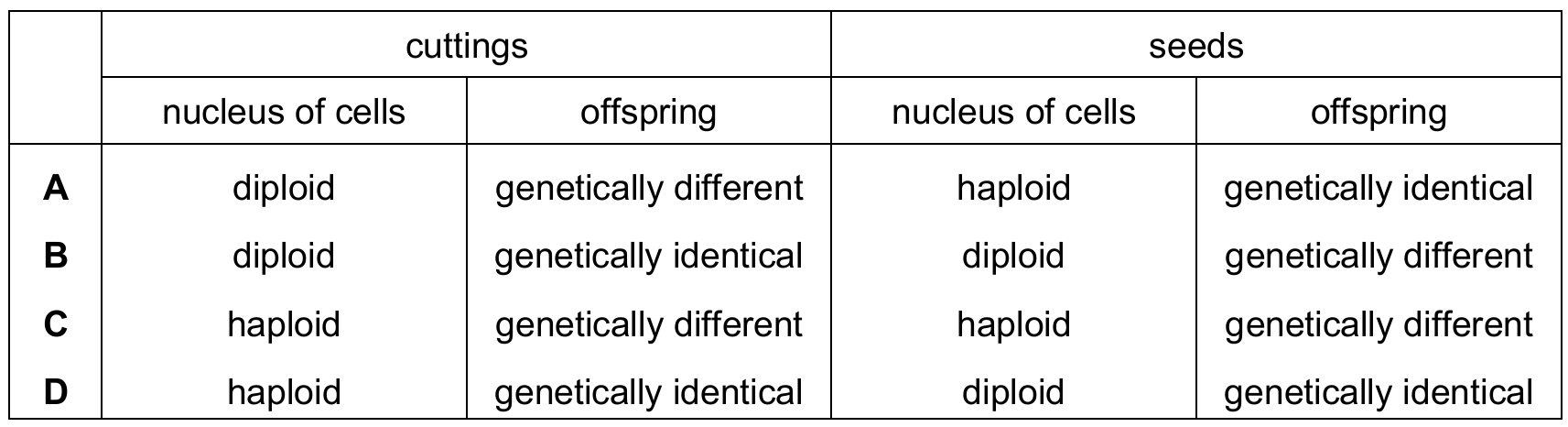
Growing new plants from cuttings is asexual reproduction.

Growing new plants from seeds is sexual reproduction.

Which row is correct for both cuttings and seeds?

▶️ Answer/Explanation
Cuttings are produced by mitosis from parent plant cells, which are diploid, producing genetically identical offspring. Seeds are produced by sexual reproduction involving fusion of haploid gametes, forming a diploid zygote that develops into genetically different offspring. Option B correctly matches these.
Answer: (B)
Scroll to Top