
CIE iGCSE Co-Ordinated Science B15.1 Asexual reproduction Exam Style Questions Paper 4
Question
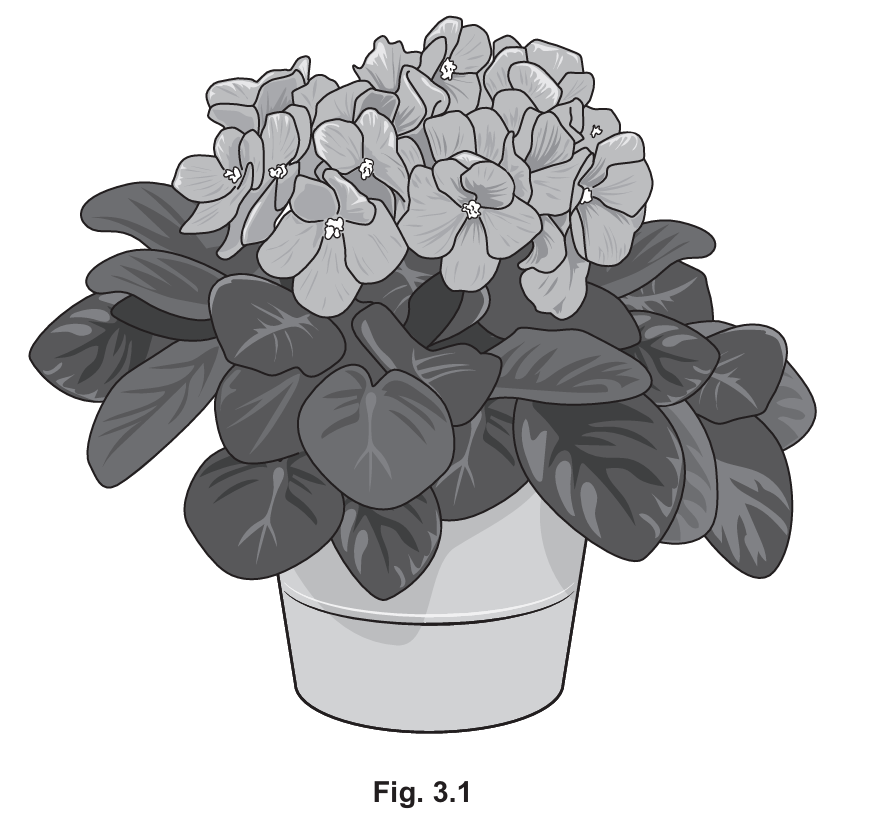
Most-appropriate topic codes (Cambridge IGCSE Co-ordinated Sciences 0654):
• Topic B15.1 — Asexual reproduction (Part a(i))
• Topic B15.2 — Sexual reproduction (Part a(ii))
• Topic B15.3 — Sexual reproduction in plants (Parts b(i) & b(ii))
• Topic B16.2 — Cell division (Parts c(i) & c(ii))
▶️ Answer/Explanation
(a)(i) Advantages of asexual reproduction in violet plants:
1. Faster reproduction — asexual reproduction allows rapid production of many offspring without the need for pollination or fertilisation.
2. Requires only one parent — no need for a mate, pollinators, or production of flowers and scent, saving energy.
3. Genetically identical offspring — if the parent plant has desirable characteristics, these are passed on unchanged (clones).
4. Less energy required — resources are not wasted on producing flowers, nectar, or attracting pollinators.
(a)(ii) Sexual reproduction in plants:
Sexual reproduction is the process involving the fusion of nuclei of two gametes to form the zygote.
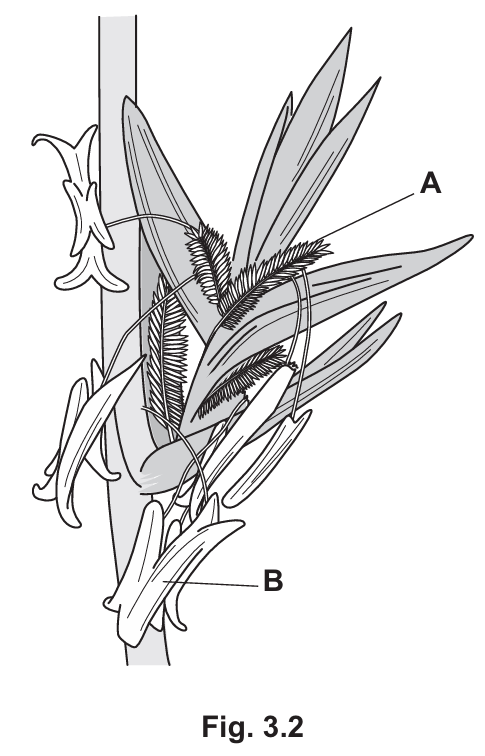
(b)(i) Functions of structures in Fig. 3.2:
Structure A (Stigma) — It is the part of the female reproductive organ (carpel) that is adapted to capture pollen grains from the air. In wind-pollinated flowers, it is often feathery or branched to increase the surface area for catching airborne pollen.
Structure B (Anther) — It is part of the male reproductive organ (stamen) that produces pollen grains. Pollen grains contain the male gametes (sperm nuclei).
(b)(ii) Difference in an insect-pollinated flower:
In an insect-pollinated flower, structure B (the anther) would not be hanging down outside the flower. Instead, it would be enclosed within the flower, positioned so that insects brushing against it pick up pollen. Additionally, insect-pollinated flowers typically have large, colourful petals, nectar, and scent to attract insects, unlike wind-pollinated flowers which often lack these features.
(c)(i) Chromosome numbers in violet plants:
Root hair cells contain 30 chromosomes. Root hair cells are diploid (2n) as they are somatic (body) cells.
A leaf cell is also a somatic cell, so it is diploid (2n) and contains 30 chromosomes.
An ovule is a female gamete, which is haploid (n). Therefore, it contains half the diploid number: 15 chromosomes.
(c)(ii) Process leading to formation of gametes:
The process is meiosis — a type of nuclear division that reduces the chromosome number from diploid (2n) to haploid (n), producing genetically different gametes.
Question
Most-appropriate topic codes (Cambridge IGCSE Co-ordinated Sciences 0654):
• Topic B15.3 — Sexual reproduction in plants (Parts (a), (b))
• Topic B15.1/B15.2 — Asexual and sexual reproduction (Part (c))
• Topic B1.1 — Characteristics of living organisms (Part (d))
▶️ Answer/Explanation
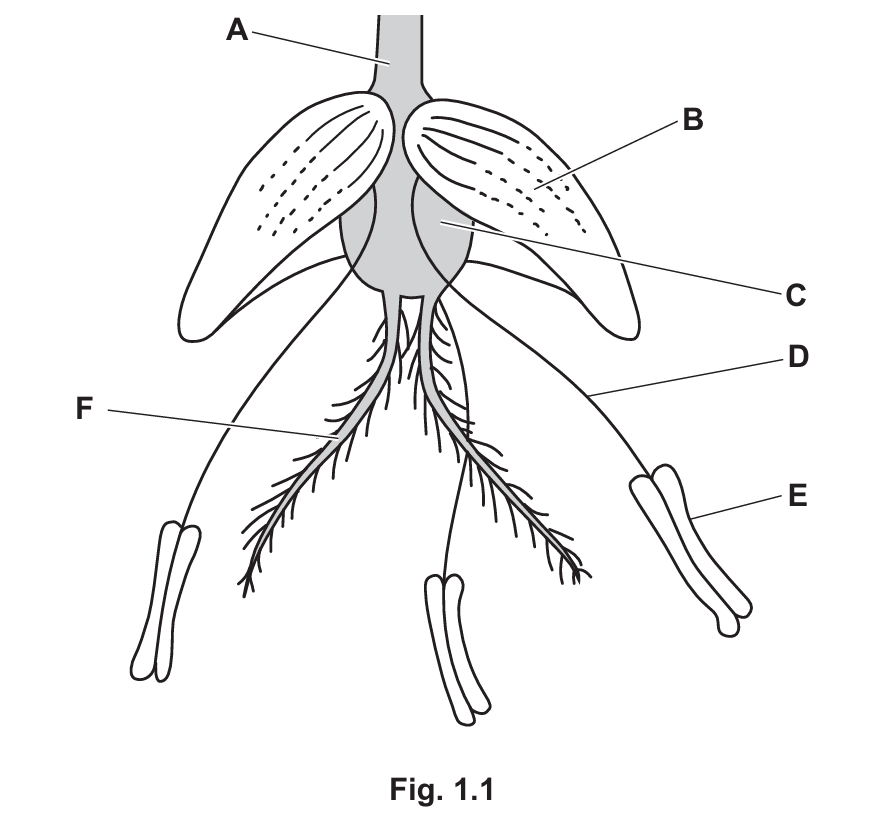
(a)(i) Fertilisation: C; Pollen produced: B
C is the carpel/stigma region leading to the ovule where fertilisation occurs.
B is the anther where pollen grains are produced.
(a)(ii) Feathery, exposed stigma (E); anthers hanging outside the flower (B/C).
A feathery stigma increases surface area to catch airborne pollen.
Anthers hanging loosely outside the flower allow pollen to be released easily into the wind.
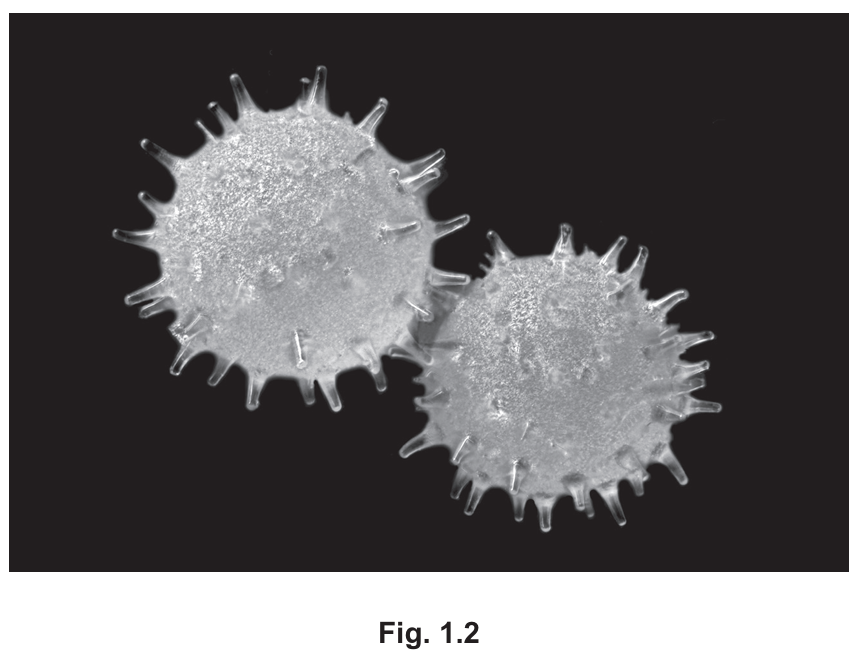
(b) Wind-pollinated pollen is smoother (not spiky); wind-pollinated pollen is smaller.
Insect-pollinated pollen (Fig. 1.2) is spiky/sticky to attach to insect bodies.
Wind-pollinated pollen lacks these spikes and is lighter/smaller so it can be carried by air currents.
(c)(i) Sexual reproduction increases genetic diversity; allows adaptation to a changing environment.
Genetic variation means a disease is unlikely to wipe out all the plants.
Variation also allows natural selection/evolution to occur, helping the species adapt.
(c)(ii) Asexual reproduction is useful when the plant is isolated from other plants or pollinators are scarce.
\(\text{No mate/pollinator needed for asexual reproduction}\)
This allows rapid colonisation of a favourable habitat without depending on pollination.
(d) Any two of: movement, respiration, sensitivity, growth, excretion, nutrition.
Movement is a change of position caused by the organism.
Respiration releases energy from nutrients in cells.
Excretion removes waste products of metabolism.