

▶️ Answer/Explanation
Sexual reproduction requires the fusion of two gametes (fertilisation) and results in genetic variation in offspring, because each gamete carries a unique combination of alleles.
Row C correctly identifies that sexual reproduction involves two parents, fusion of gametes, and genetically varied offspring.
✅ Answer: (C)
Row C correctly identifies that sexual reproduction involves two parents, fusion of gametes, and genetically varied offspring.
✅ Answer: (C)
▶️ Answer/Explanation
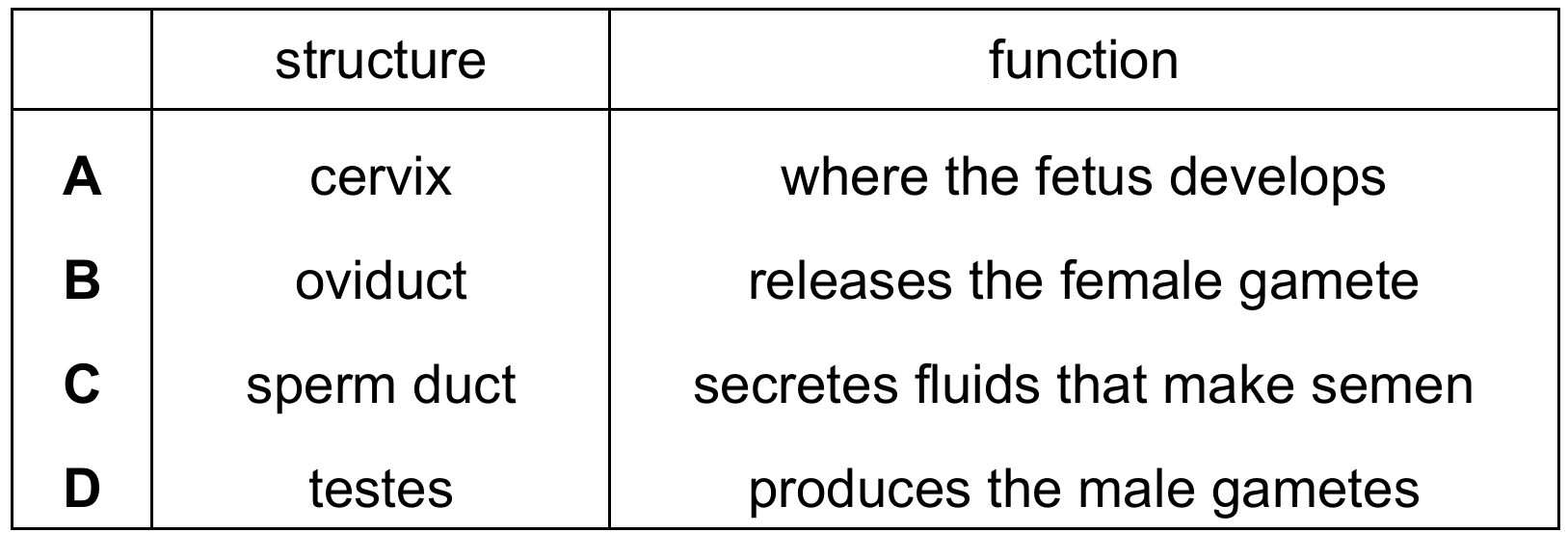
The testes are the site of sperm (male gamete) production.
The fetus develops in the uterus (not the cervix), the ovary releases the female gamete (not the oviduct), and it is glands such as the prostate — not the sperm duct itself — that secrete the fluids of semen.
Only the testes-function pairing is correct.
✅ Answer: (D)
The fetus develops in the uterus (not the cervix), the ovary releases the female gamete (not the oviduct), and it is glands such as the prostate — not the sperm duct itself — that secrete the fluids of semen.
Only the testes-function pairing is correct.
✅ Answer: (D)


▶️ Answer/Explanation
The anther is the part of the stamen that produces pollen, and the ovary contains the ovules that develop into seeds after fertilisation.
From the labelled diagram, structure S corresponds to the anther and structure Q corresponds to the ovary.
✅ Answer: (D)
From the labelled diagram, structure S corresponds to the anther and structure Q corresponds to the ovary.
✅ Answer: (D)
▶️ Answer/Explanation
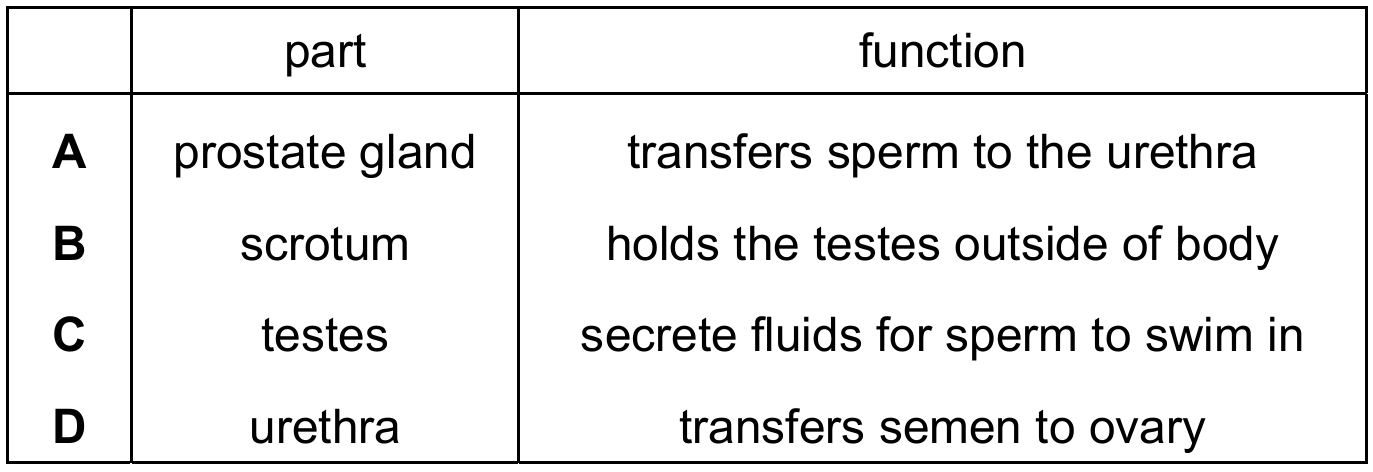
The scrotum is the sac that holds the testes outside the main body cavity, where the temperature is slightly lower and more suitable for sperm production.
The prostate gland (not sperm ducts) adds fluid to semen, the testes produce sperm and testosterone (fluid is from other glands), and the urethra carries semen out through the penis, not to an ovary.
Only row B correctly matches a structure with its true function.
✅ Answer: (B)
The prostate gland (not sperm ducts) adds fluid to semen, the testes produce sperm and testosterone (fluid is from other glands), and the urethra carries semen out through the penis, not to an ovary.
Only row B correctly matches a structure with its true function.
✅ Answer: (B)