Home / iGCSE / Coordinated Sciences / B16.2 Cell division Paper 1 |IITIAN ACADEMY

CIE iGCSE Co-Ordinated Science B16.2 Cell division Exam Style Questions Paper 1

Question

Three stages involved in the selective breeding of wheat to increase the size of the seeds are shown.

  1. crossing wheat plants to produce the next generation
  2. selection by humans of wheat with large seeds
  3. selection of wheat offspring with large seeds

What is the correct sequence of these stages?

A. \(1 \to 2 \to 3\)
B. \(2 \to 1 \to 3\)
C. \(2 \to 3 \to 1\)
D. \(3 \to 1 \to 2\)

▶️ Answer/Explanation
Selective breeding begins with humans selecting parent plants that show the desired trait (large seeds). These selected parents are then crossed to produce the next generation. Finally, offspring that exhibit the desired trait are selected to continue the breeding process. Therefore, the correct sequence is 2 → 1 → 3.
Answer: (B)

Question

Two parents with genotypes of BB and Bb are crossed.

What is the predicted ratio of genotypes in the offspring?

A. 1 BB : 1 Bb
B. 1 Bb : 1 bb
C. 3 BB : 1 Bb
D. 3 Bb : 1 BB

▶️ Answer/Explanation
The BB parent produces only B gametes, while the Bb parent produces B and b gametes in equal proportions. When crossed, the possible offspring genotypes are BB and Bb in a 1:1 ratio. There are no bb offspring because the BB parent cannot contribute a b allele.
Answer: (A)

Question

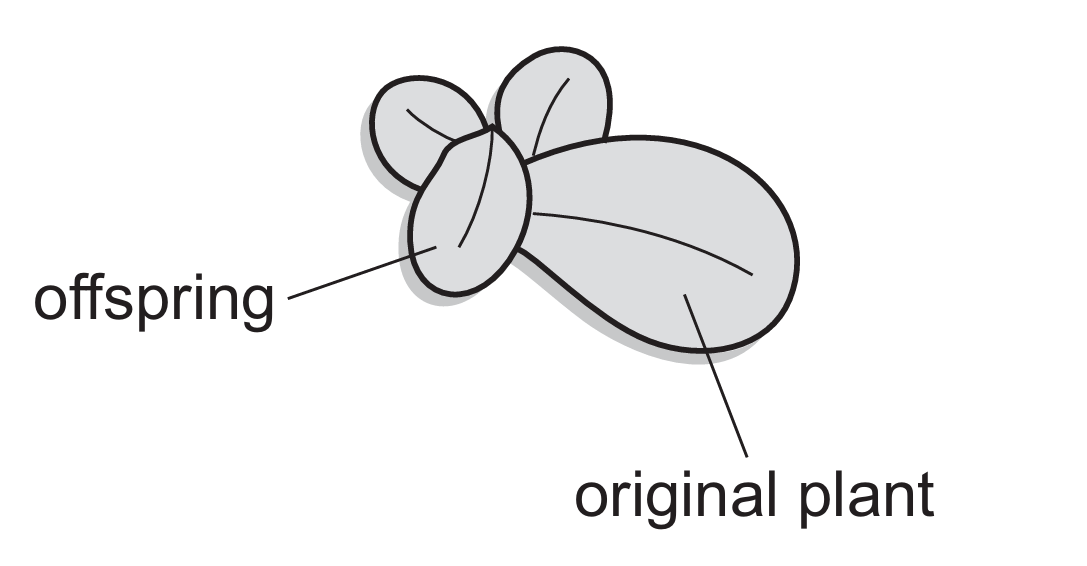
A certain aquatic plant reproduces by forming offspring from the original plant.

Which statement describes the reproduction of this aquatic plant?

A. asexual reproduction which produces genetically different plants
B. asexual reproduction which produces genetically identical plants
C. sexual reproduction which produces genetically different plants
D. sexual reproduction which produces genetically identical plants

▶️ Answer/Explanation
The plant produces offspring directly from the original plant without the fusion of gametes, indicating asexual reproduction. Since there is no genetic mixing from two parents, the offspring produced are genetically identical to the parent and to each other (clones).
Answer: (B)

Question

A list of the stages of a process is shown.

  1. Choose animals with the desired characteristics.
  2. Breed the animals together.
  3. Choose the offspring with the desired characteristics and breed the offspring.
  4. Repeat over many generations.

What is this process called?

A. asexual reproduction
B. artificial selection
C. mutation
D. natural selection

▶️ Answer/Explanation
The process described is selective breeding (artificial selection). Humans choose individuals with desirable traits, breed them, and continue selecting the best offspring over many generations to enhance those traits. Natural selection occurs without human intervention, and mutation is a random change in genes.
Answer: (B)

Question

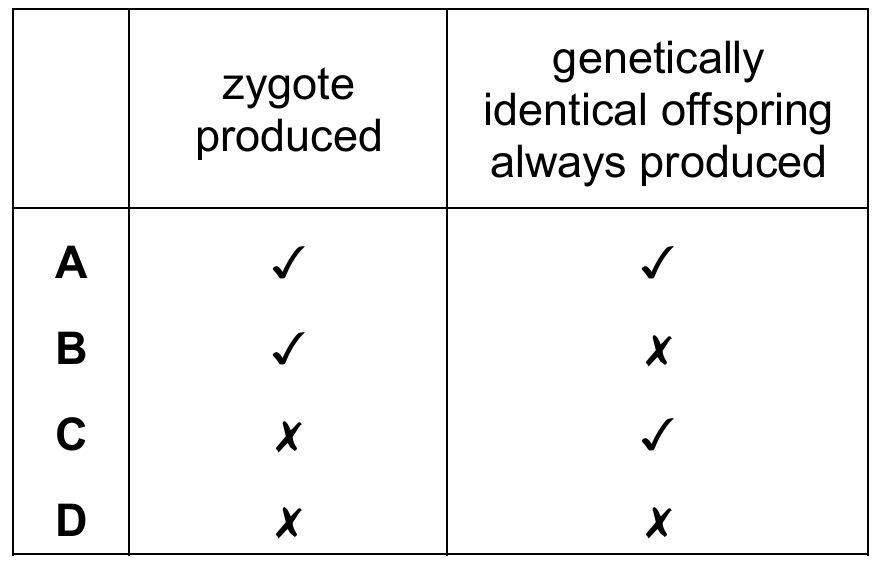
Which row describes sexual reproduction?

▶️ Answer/Explanation
Sexual reproduction involves the fusion of male and female gametes to form a zygote. The offspring are genetically different from each other and from the parents due to the combination of genetic material from two parents. Asexual reproduction produces genetically identical offspring. Thus, zygote produced = yes, genetically identical offspring = no.
Answer: (B)
Scroll to Top