
▶️ Answer/Explanation
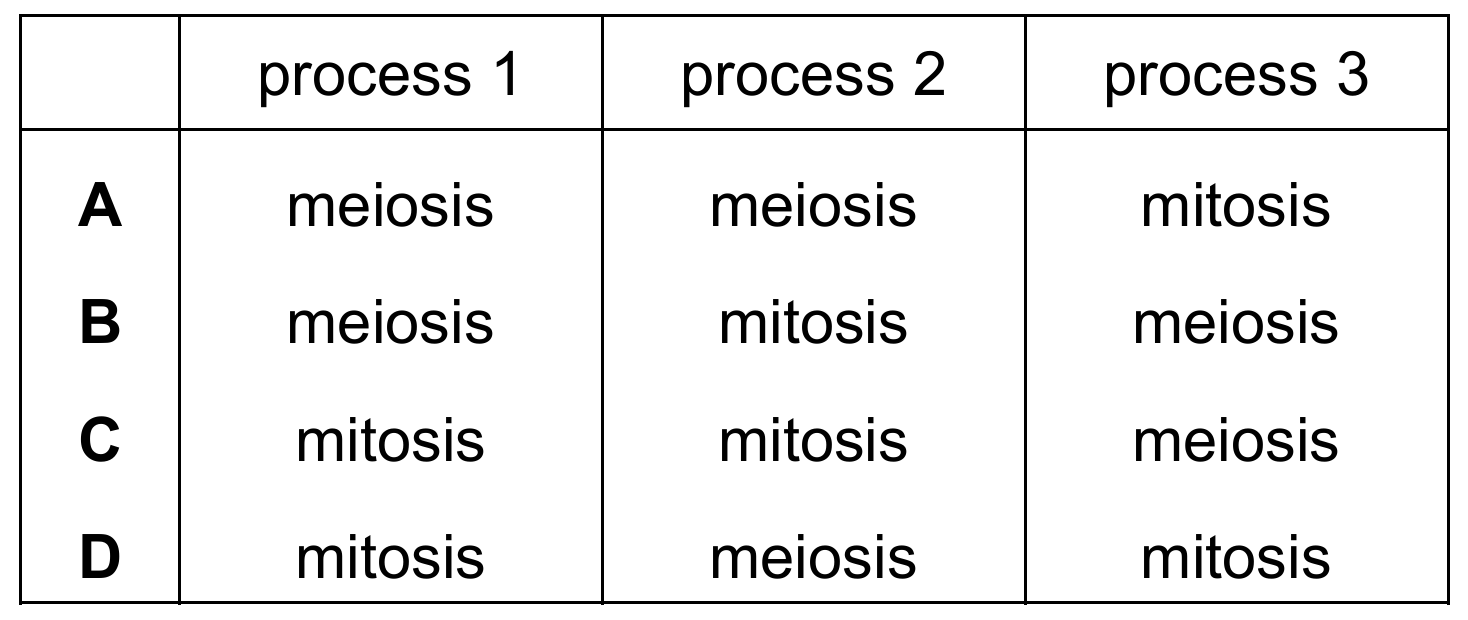
Statement 1 refers to the production of gametes, which occurs by meiosis. Statement 2 states that the cells produced are genetically different, which is also a characteristic of meiosis (not mitosis, which produces genetically identical cells). Statement 3 describes the zygote dividing for growth, which occurs by mitosis. Therefore, process 1 and 2 are both meiosis, and process 3 is mitosis, which matches row A.
✅ Answer: (A)
✅ Answer: (A)
▶️ Answer/Explanation
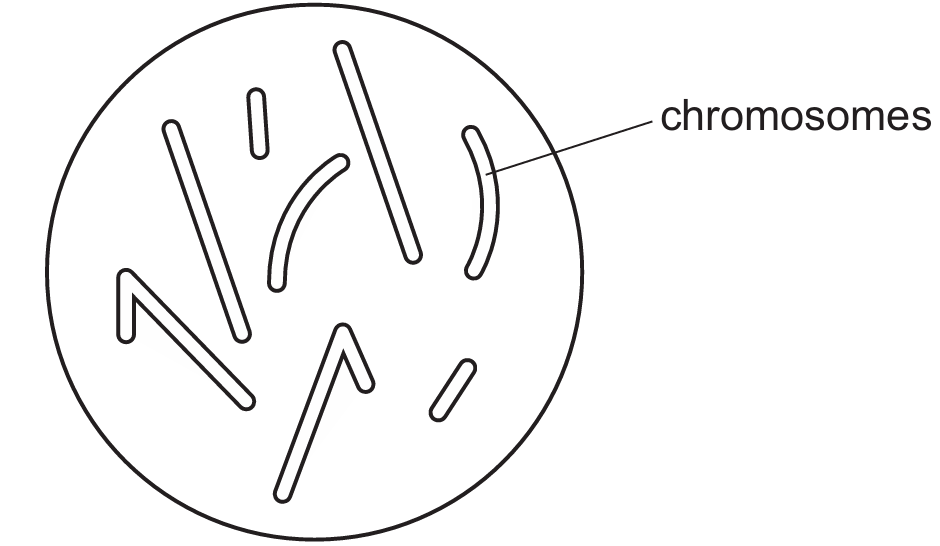
Meiosis halves the chromosome number of the parent cell, producing haploid cells (each with one set of chromosomes rather than two).
The original cell shown has 8 chromosomes (4 pairs), so the daughter cells produced by meiosis will have 4 chromosomes each.
Meiosis also involves crossing over and independent assortment, so the four cells produced are all genetically different from one another.
✅ Answer: (B)
The original cell shown has 8 chromosomes (4 pairs), so the daughter cells produced by meiosis will have 4 chromosomes each.
Meiosis also involves crossing over and independent assortment, so the four cells produced are all genetically different from one another.
✅ Answer: (B)
▶️ Answer/Explanation
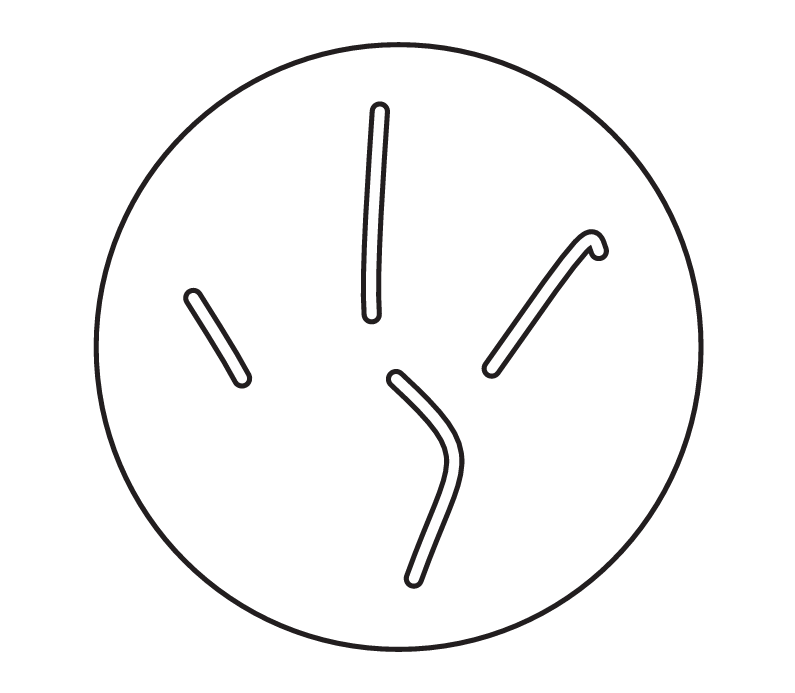
Haploid means one full set of chromosomes, with no matching (homologous) pairs.
The diagram shows \(4\) different, unpaired chromosomes — no two are alike.
The number of chromosomes itself does not define “haploid”; the lack of pairing does.
✅ Answer: (D)
The diagram shows \(4\) different, unpaired chromosomes — no two are alike.
The number of chromosomes itself does not define “haploid”; the lack of pairing does.
✅ Answer: (D)
Question
If 2n is the diploid number of chromosomes in a nucleus, which diagram is correct for meiosis?

▶️Answer/Explanation
Ans: D