
▶️ Answer/Explanation
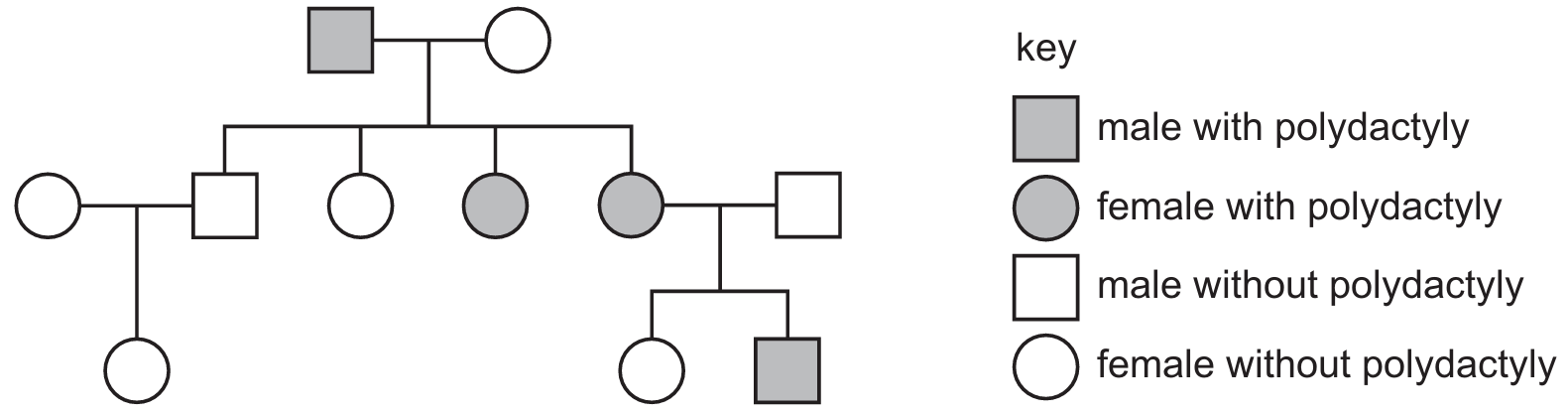
By examining the pedigree, individuals who are affected but have an unaffected parent must be heterozygous. Also, if two affected parents have an unaffected child, both parents are heterozygous. Counting these gives 4 heterozygous individuals. The answer is 4.
✅ Answer: (B)
✅ Answer: (B)
▶️ Answer/Explanation
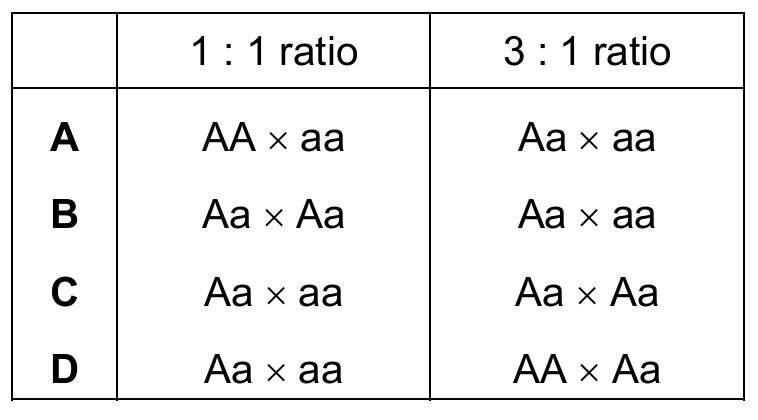
A cross between a heterozygous individual (Aa) and a homozygous recessive individual (aa) produces offspring in a 1:1 phenotype ratio. A cross between two heterozygous individuals (Aa × Aa) produces offspring in a 3:1 phenotype ratio. Option C correctly matches these crosses: Aa × aa gives a 1:1 ratio, and Aa × Aa gives a 3:1 ratio. Option A’s AA × aa gives all dominant phenotype (not 1:1), and option D’s AA × Aa gives all dominant phenotype (not 3:1).
✅ Answer: (C)
✅ Answer: (C)
▶️ Answer/Explanation
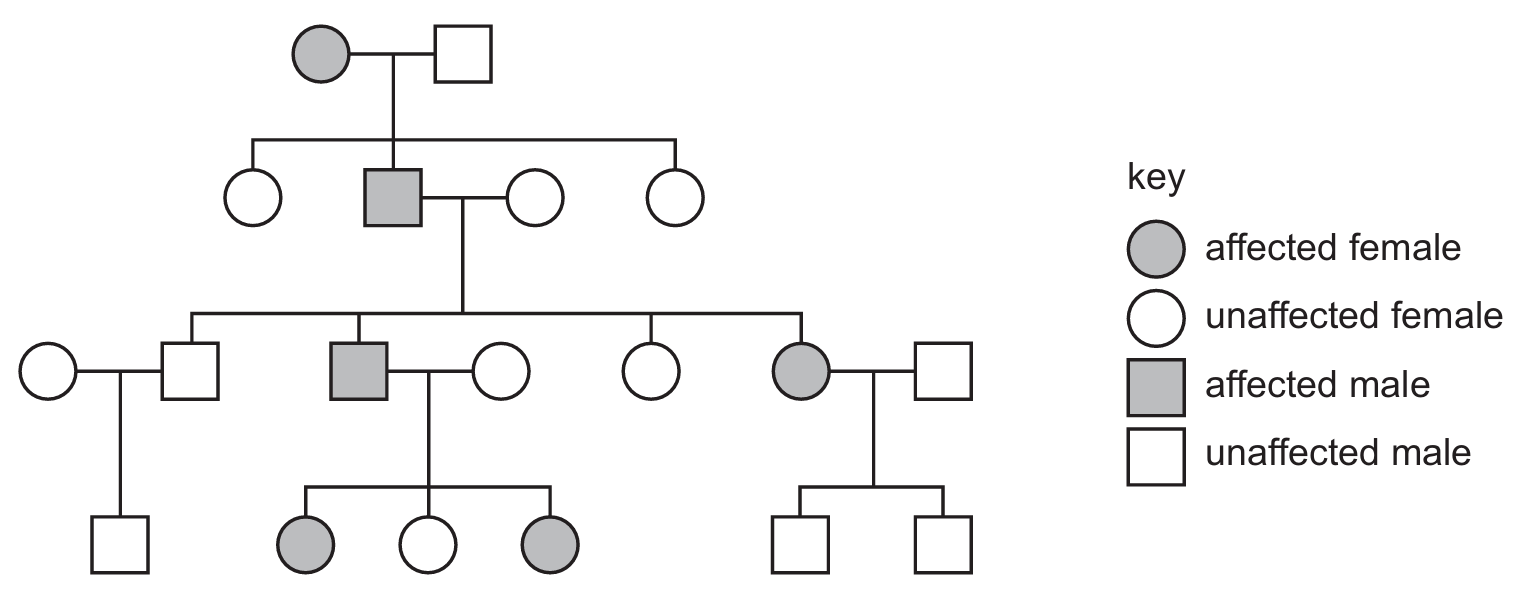
Polydactyly is dominant, so affected individuals have at least one dominant allele (D). Unaffected individuals are recessive (dd). Heterozygous individuals (Dd) must have one affected parent and one unaffected parent (or produce an unaffected child). Counting the pedigree diagram gives 6 individuals who are heterozygous.
✅ Answer: (B)
✅ Answer: (B)
▶️ Answer/Explanation
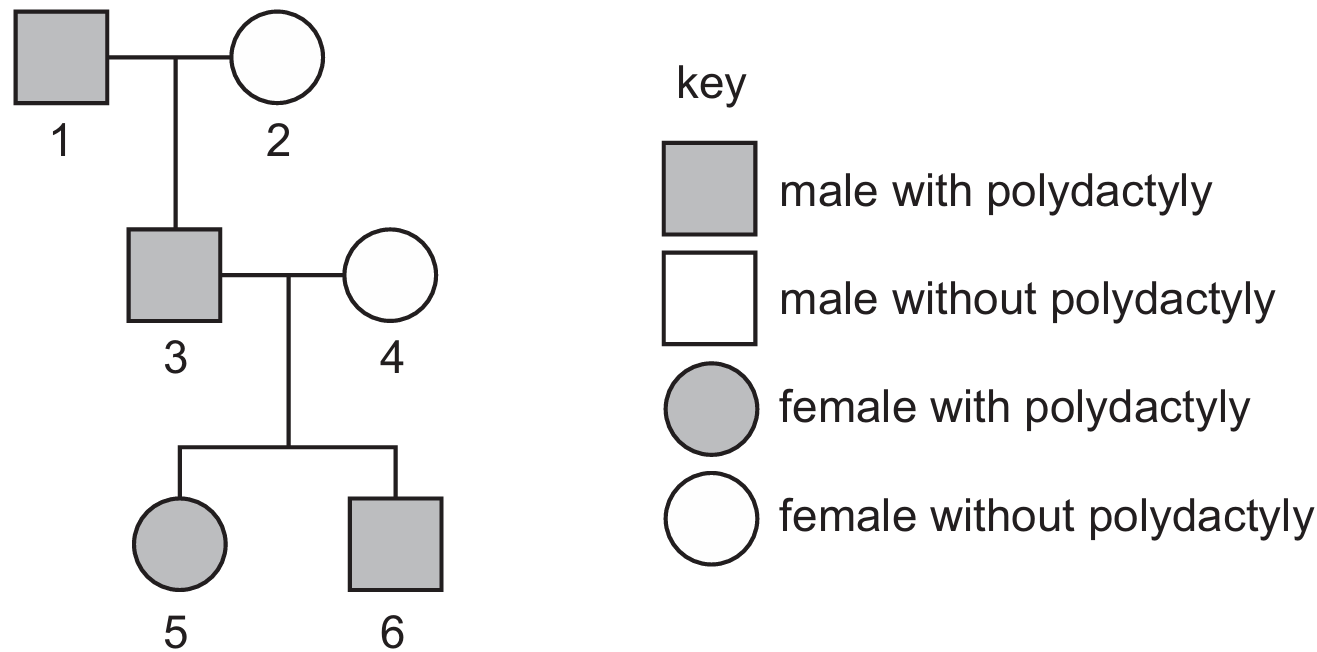
Since both parents 3 and 4 have polydactyly but have already produced a five-digit (pp) offspring in the pedigree, both parents must be heterozygous (Pp).
Crossing \(\text{Pp} \times \text{Pp}\) gives offspring in the ratio 1 PP : 2 Pp : 1 pp.
So the probability of a five-digit (pp) kitten is \(\frac{1}{4} = 0.25\).
✅ Answer: (B)
Crossing \(\text{Pp} \times \text{Pp}\) gives offspring in the ratio 1 PP : 2 Pp : 1 pp.
So the probability of a five-digit (pp) kitten is \(\frac{1}{4} = 0.25\).
✅ Answer: (B)
▶️ Answer/Explanation
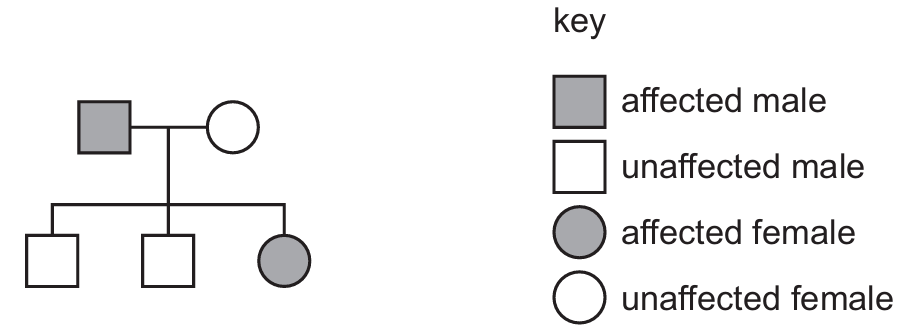
Cystic fibrosis is caused by a recessive allele, so an affected child must inherit one recessive allele from each parent.
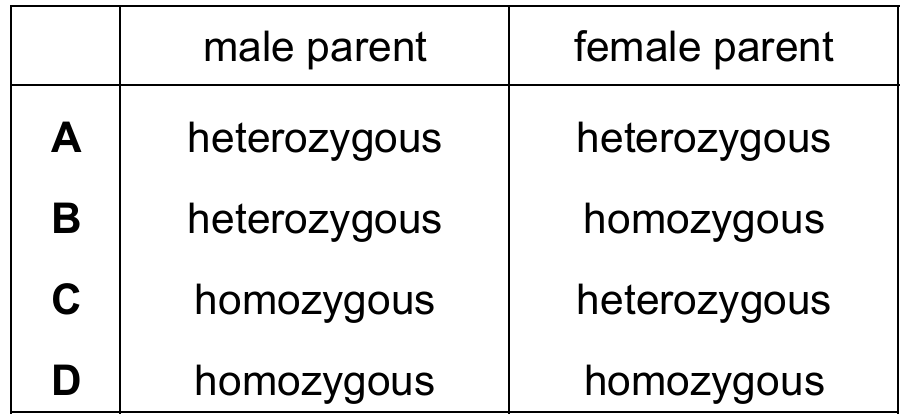
If both unaffected parents in the pedigree have an affected child, both parents must carry the recessive allele while showing the unaffected phenotype.
This means both parents are heterozygous, i.e. carriers, for the cystic fibrosis allele.
✅ Answer: (A)
If both unaffected parents in the pedigree have an affected child, both parents must carry the recessive allele while showing the unaffected phenotype.
This means both parents are heterozygous, i.e. carriers, for the cystic fibrosis allele.
✅ Answer: (A)