
CIE iGCSE Co-Ordinated Science B17.1 Variation Exam Style Questions Paper 4
Question
Most-appropriate topic codes (Cambridge IGCSE Co-ordinated Sciences 0654):
• Topic B17.1 — Variation (Part (a))
• Topic B17.2 — Selection / Natural selection (Part (b))
• Topic B18.2 — Food chains and food webs / Decomposers (Part (c)(i))
• Topic B18.2 — Energy transfer between trophic levels (Part (c)(ii))
▶️ Answer/Explanation
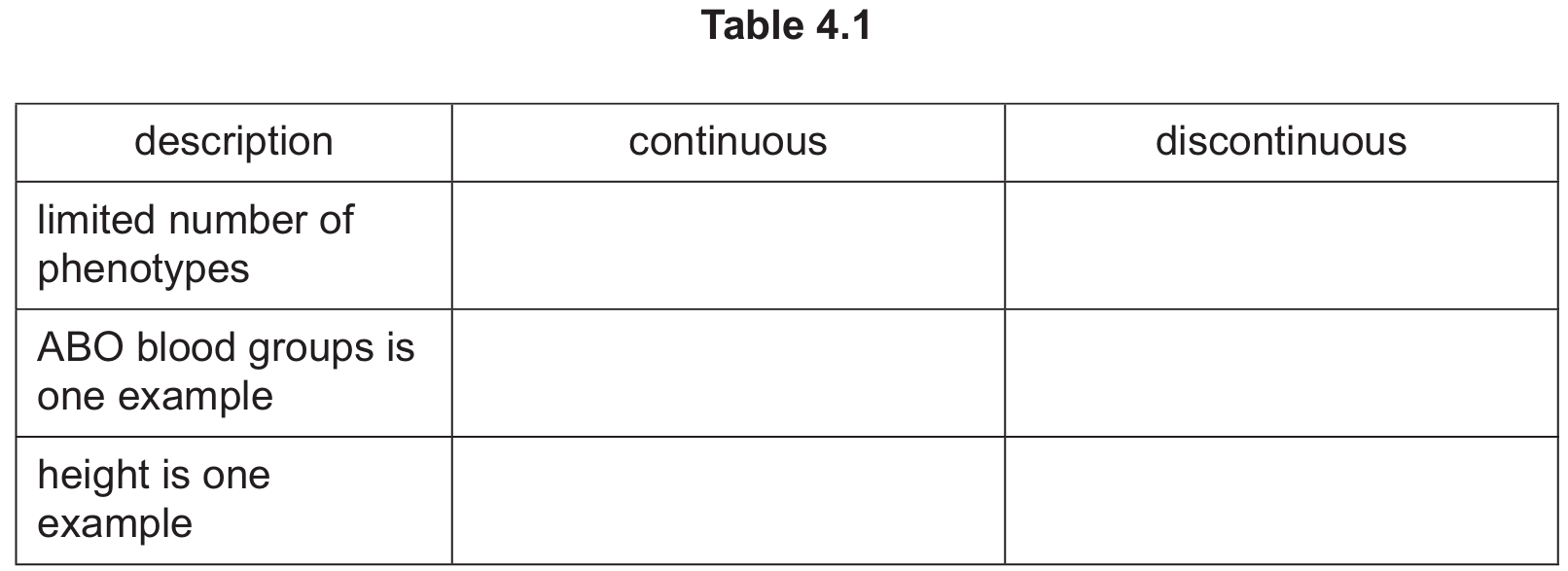
(a) Table 4.1 completed:
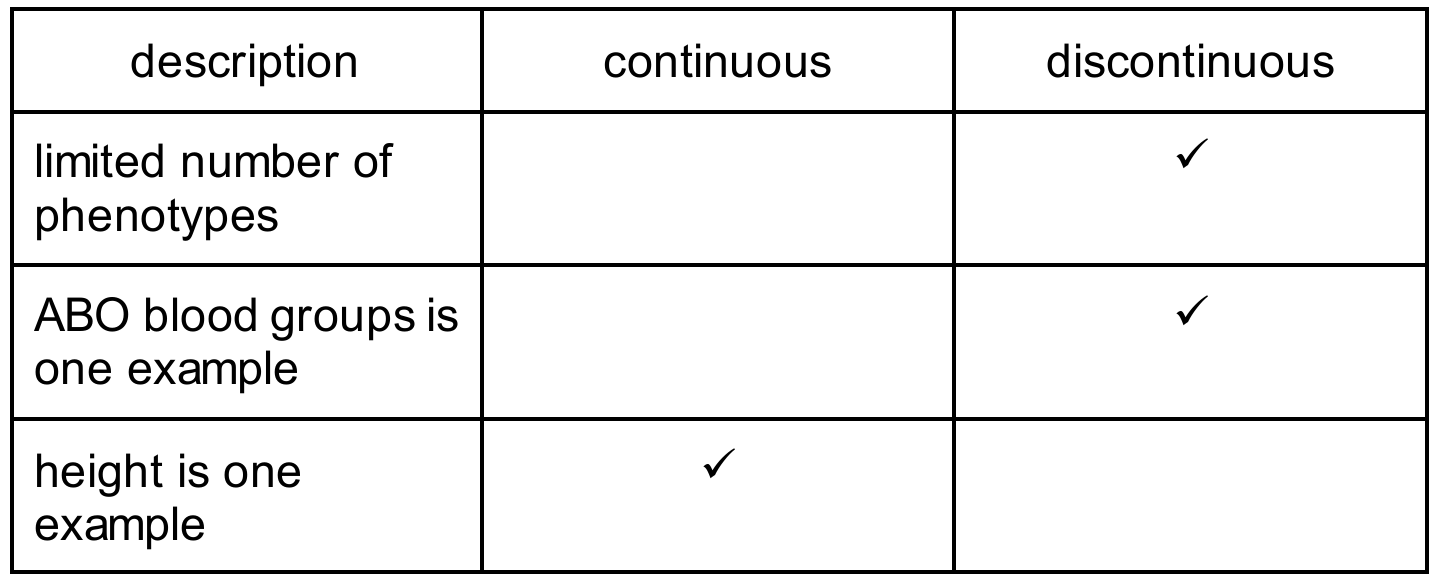
Discontinuous variation has a limited number of phenotypes with no intermediates (like blood groups); continuous variation shows a range between extremes (like height).
(b) Some bacteria mutate and become resistant to antibiotics. These resistant bacteria survive and reproduce, passing on their alleles for resistance to offspring, increasing the frequency of resistance in the population.
Antibiotics act as a selective pressure, killing non-resistant bacteria. The resistant ones survive and multiply, so the resistant trait becomes more common over generations.
(c)(i) A decomposer is an organism that gets its energy from dead or waste organic material.
Decomposers like bacteria and fungi break down dead organisms and waste, recycling nutrients back into the ecosystem.
(c)(ii) 1. Egestion (faeces / indigestible material) ; 2. Respiration (heat loss).
Energy is lost as heat during respiration, and in uneaten or indigestible parts like bones and teeth. Other losses include movement and excretion.
Question
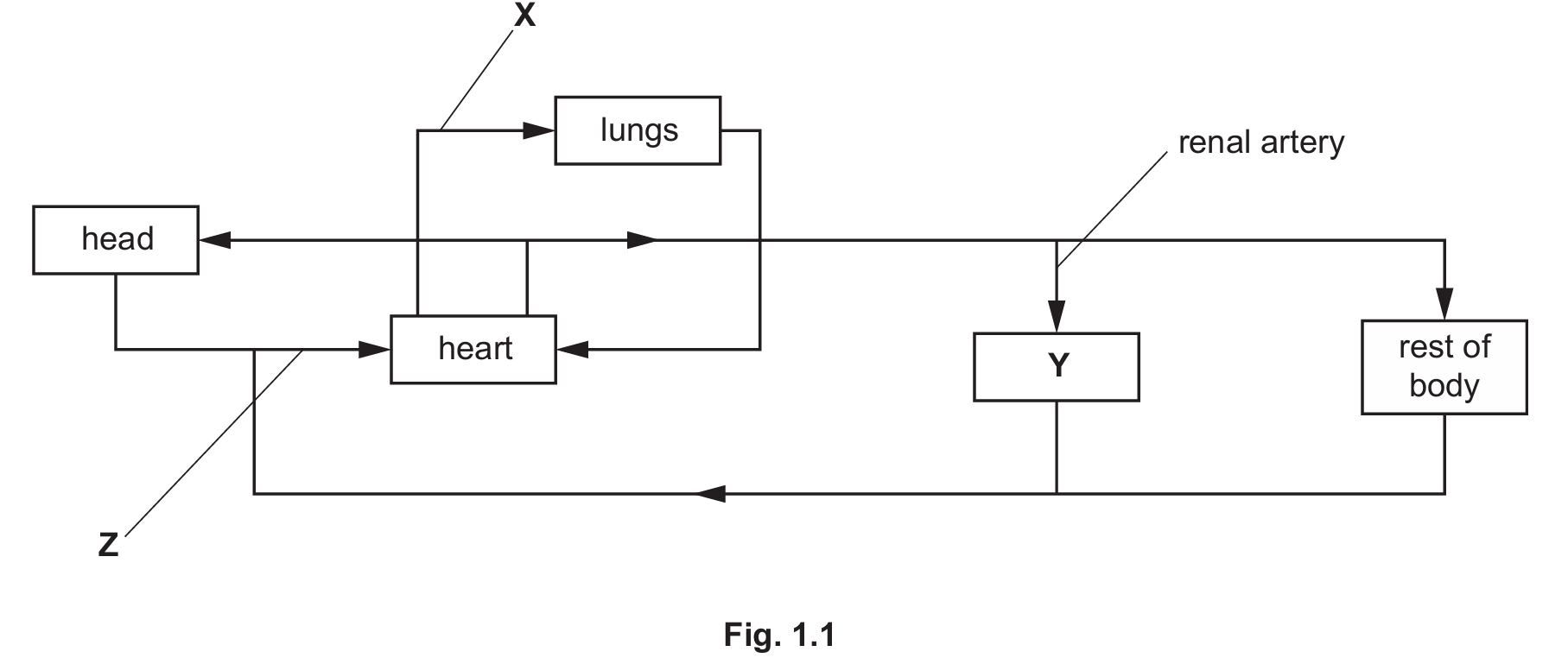
Fig. 1.1 is a simplified diagram of the circulatory system in horses.
The arrows represent the direction of blood flow.
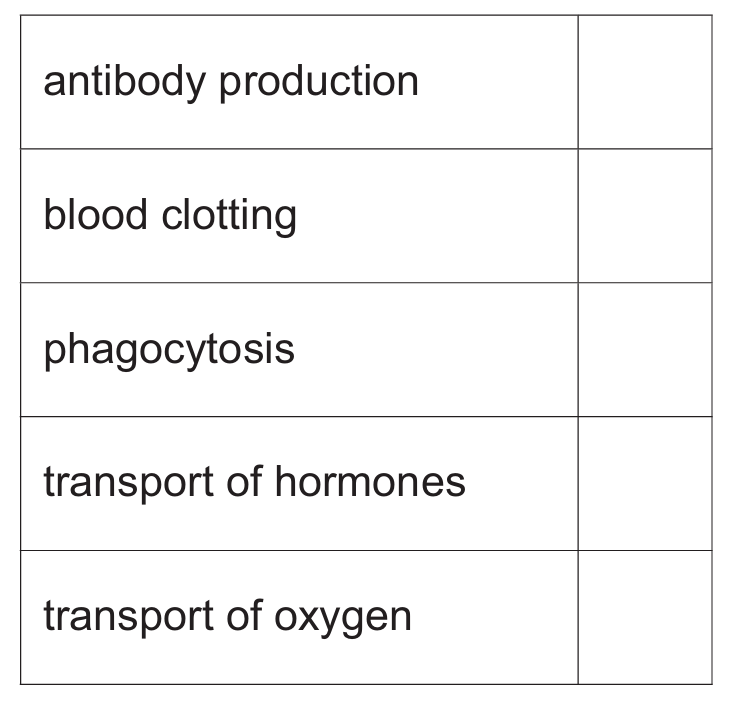
Tick (✓) all the boxes that show the correct functions of white blood cells.
Most-appropriate topic codes (Cambridge IGCSE Co-ordinated Sciences 0654, 2025–2027 syllabus):
• Topic B9.1/B9.3 — Circulatory systems & blood vessels (Part (a))
• Topic B17.1 — Variation (ABO blood groups) (Part (b)(i))
• Topic B9.4 — Blood (Part (b)(ii))
• Topic B9.3 — Blood vessels (Part (c))
▶️ Answer/Explanation
(a)(i) X = pulmonary artery; Y = kidney; Z = vena cava
\(X\) carries blood from the heart to the lungs, so it is the pulmonary artery.
\(Y\) receives blood from the renal artery, so it must be the kidney.
\(Z\) returns blood from the head to the heart, so it is the vena cava.
(a)(ii) Two separate loops through the heart
The diagram shows blood passing through the heart twice in one full circuit.
One loop goes heart → lungs → heart (oxygenation).
The second loop goes heart → rest of body/head/kidney → heart (delivery to tissues), confirming a double circulation.
(b)(i) Any two of: A, B, AB, O
Human blood is classified into the ABO blood group system.
This is an example of discontinuous variation with no intermediate phenotypes.
Any two of the four groups (A, B, AB, O) are acceptable.
(b)(ii) 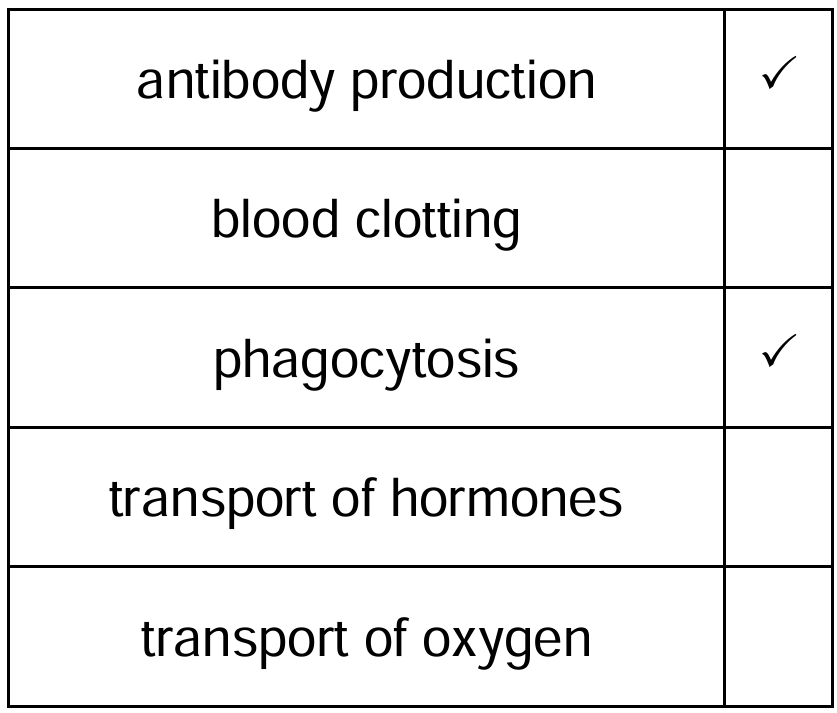
White blood cells defend the body against pathogens.
Lymphocytes produce antibodies, while phagocytes engulf and digest pathogens.
Blood clotting, hormone transport, and oxygen transport are not functions of white blood cells (these belong to platelets, plasma, and red blood cells respectively).
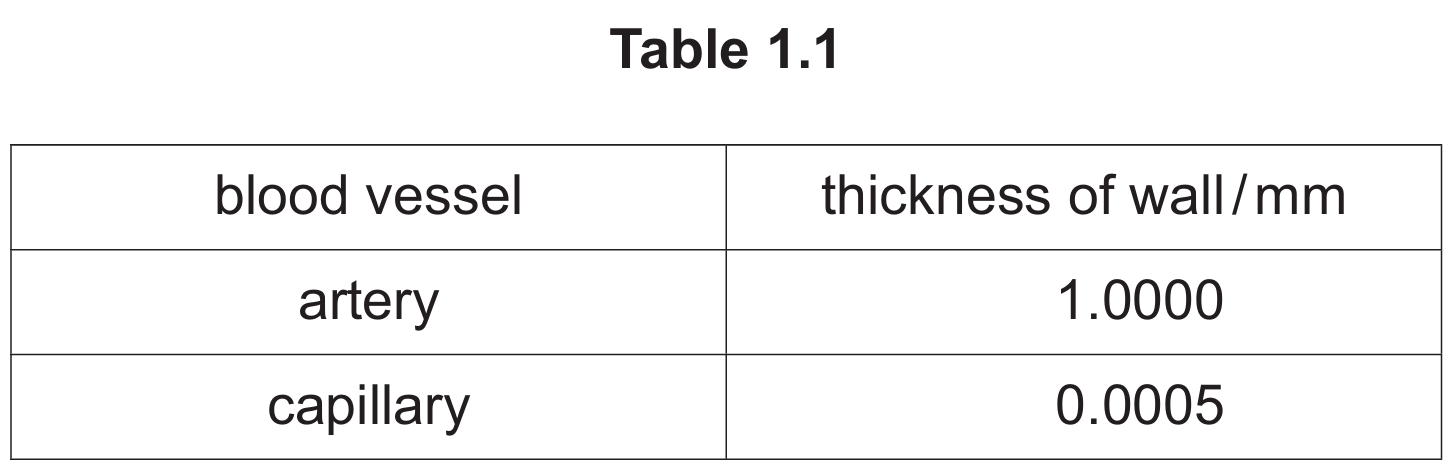
(c)(i) 2000 times
\( \dfrac{1.0000}{0.0005} = 2000 \)
The artery wall is 2000 times thicker than the capillary wall.
(c)(ii) Different functions require different wall thickness
The artery wall is thick (and muscular/elastic) to withstand and maintain the high pressure of blood leaving the heart.
The capillary wall is only one cell thick to provide the shortest possible diffusion distance for the exchange of substances such as oxygen, carbon dioxide, and nutrients between blood and tissues.