

▶️ Answer/Explanation
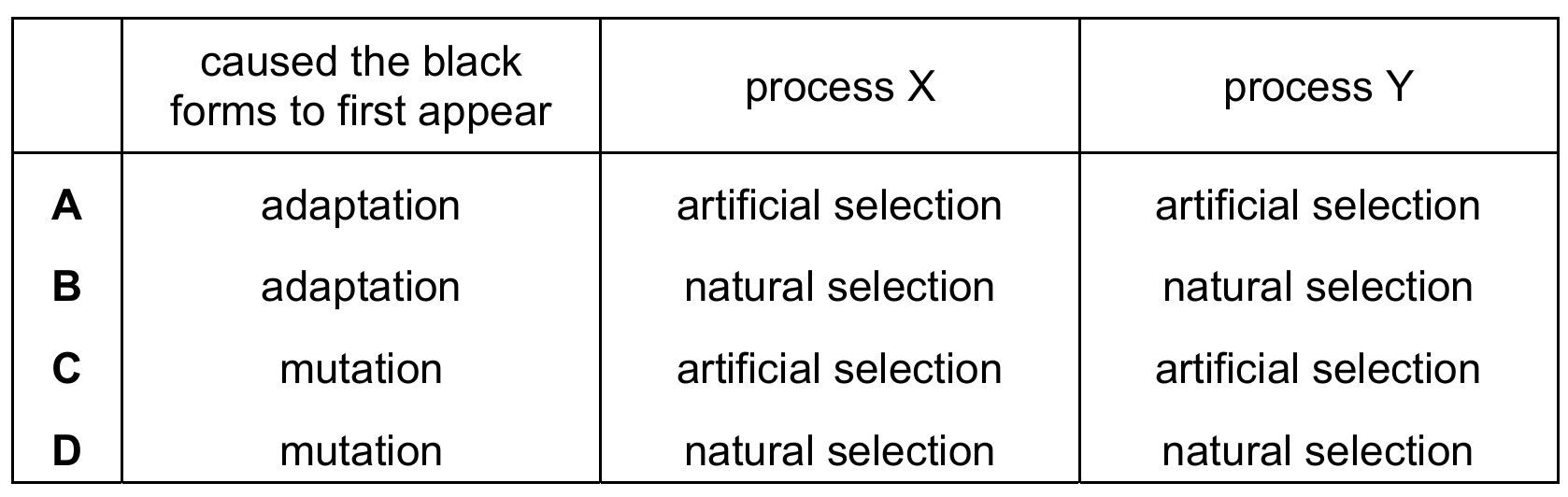
The black form of the moth first appeared as the result of a mutation, a random genetic change producing a new allele.
No human breeding programme selected the moths, so the shift in proportions is due to natural selection, not artificial selection.
Black moths were better camouflaged and survived better on polluted, darker tree bark, and pale moths survived better once pollution decreased.
✅ Answer: (D)
No human breeding programme selected the moths, so the shift in proportions is due to natural selection, not artificial selection.
Black moths were better camouflaged and survived better on polluted, darker tree bark, and pale moths survived better once pollution decreased.
✅ Answer: (D)
▶️ Answer/Explanation
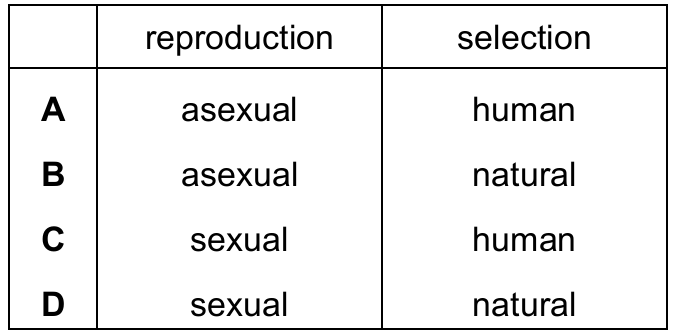
Producing new combinations of alleles for humans to select from requires sexual reproduction, since asexual reproduction gives genetically identical offspring.
Farmers deliberately choosing and breeding the best egg-laying chickens is an example of human (artificial) selection, not natural selection.
Together this means sexual reproduction combined with human selection is needed, matching option C.
✅ Answer: (C)
Farmers deliberately choosing and breeding the best egg-laying chickens is an example of human (artificial) selection, not natural selection.
Together this means sexual reproduction combined with human selection is needed, matching option C.
✅ Answer: (C)
Question
The boxes show the steps involved in artificial selection of an animal species.

Which sequence of steps is correct?
(A) 2 → 1 → 4 → 3
(B) 2 → 4 → 3 → 1
(C) 4 → 3 → 2 → 1
(D) 4 → 2 →1 → 3
▶️Answer/Explanation
Ans : D