
CIE iGCSE Co-Ordinated Science B17.2 Selection Exam Style Questions Paper 4
Question
Most-appropriate topic codes (Cambridge IGCSE Co-ordinated Sciences 0654):
• Topic B17.1 — Variation (Part (a))
• Topic B17.2 — Selection / Natural selection (Part (b))
• Topic B18.2 — Food chains and food webs / Decomposers (Part (c)(i))
• Topic B18.2 — Energy transfer between trophic levels (Part (c)(ii))
▶️ Answer/Explanation
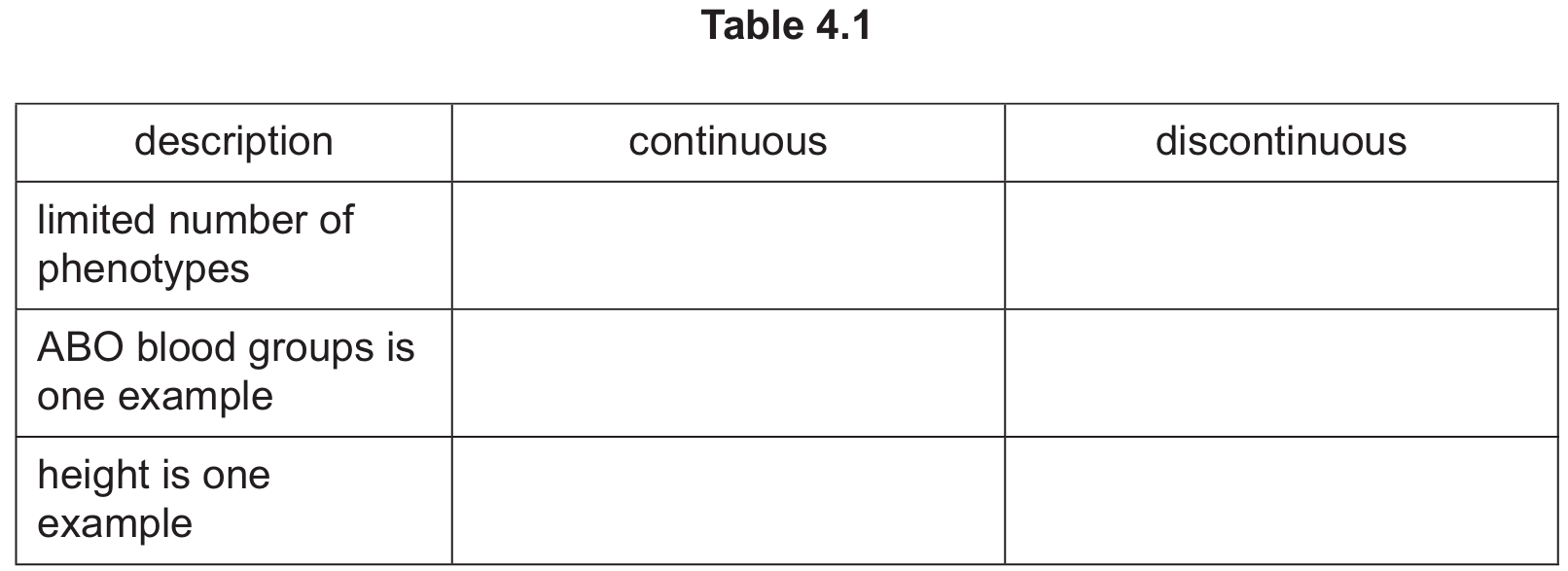
(a) Table 4.1 completed:
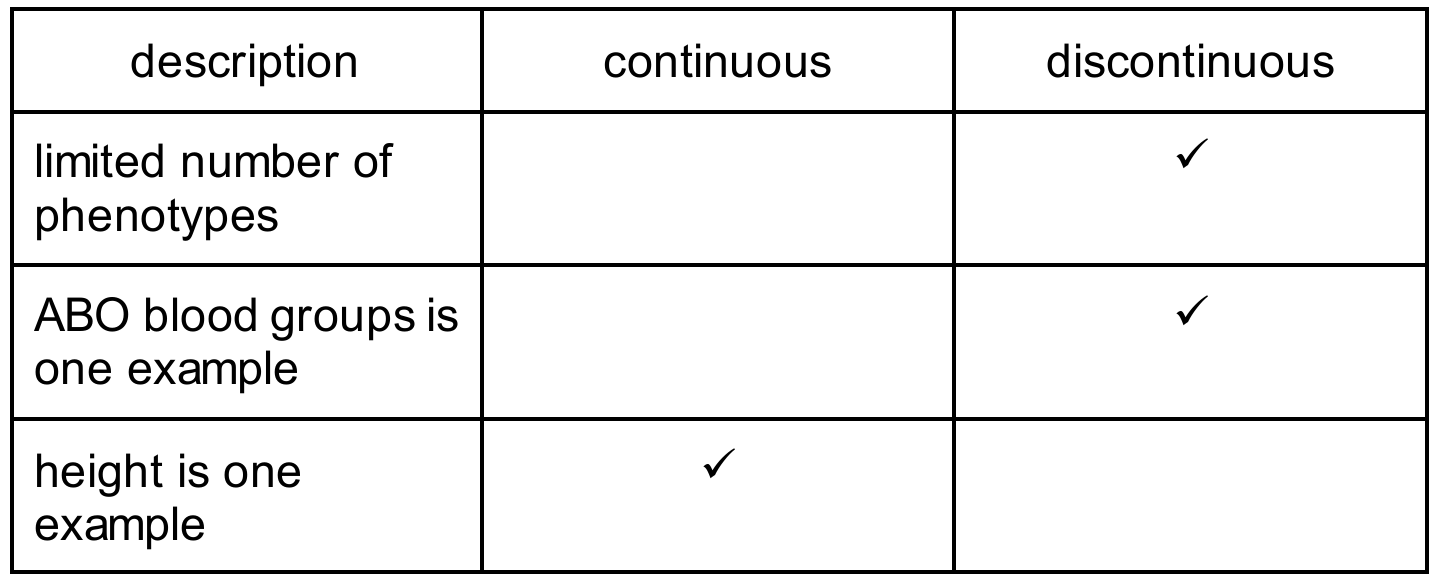
Discontinuous variation has a limited number of phenotypes with no intermediates (like blood groups); continuous variation shows a range between extremes (like height).
(b) Some bacteria mutate and become resistant to antibiotics. These resistant bacteria survive and reproduce, passing on their alleles for resistance to offspring, increasing the frequency of resistance in the population.
Antibiotics act as a selective pressure, killing non-resistant bacteria. The resistant ones survive and multiply, so the resistant trait becomes more common over generations.
(c)(i) A decomposer is an organism that gets its energy from dead or waste organic material.
Decomposers like bacteria and fungi break down dead organisms and waste, recycling nutrients back into the ecosystem.
(c)(ii) 1. Egestion (faeces / indigestible material) ; 2. Respiration (heat loss).
Energy is lost as heat during respiration, and in uneaten or indigestible parts like bones and teeth. Other losses include movement and excretion.
Question
Most-appropriate topic codes (Cambridge IGCSE Co-ordinated Sciences 0654, 2025–2027 syllabus):
• Topic B6.1 — Photosynthesis (Parts (a), (e))
• Topic B13.1 — Coordination and response (Part (b))
• Topic B17.2 — Selection (Part (c))
• Topic B15.3 — Sexual reproduction in plants (Part (d))
▶️ Answer/Explanation
(a) Provides oxygen for germination
Air spaces in the soil allow oxygen to reach the seed.
This oxygen is required for aerobic respiration during germination, releasing the energy needed for growth.
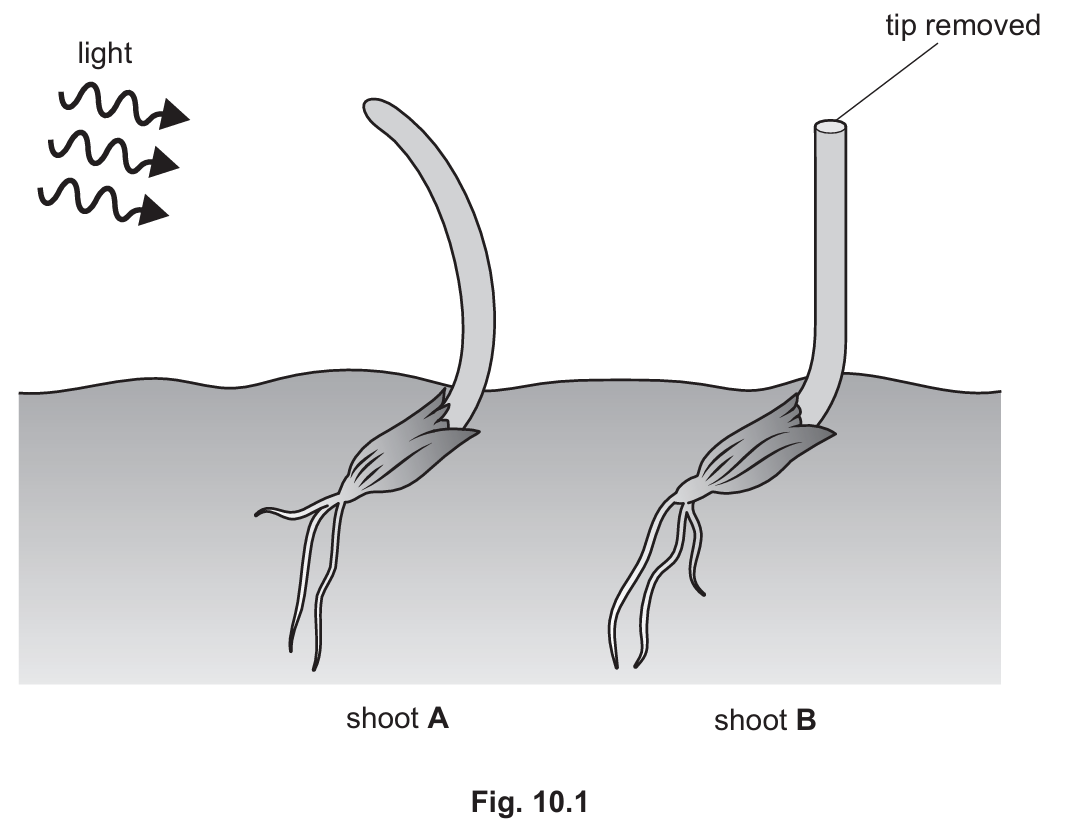
(b)(i) Phototropism
Shoot A bends towards the light source, which is the definition of a positive phototropic response.
(b)(ii) No auxin reaches the growing region
Auxin (the growth hormone) is produced in the tip of the shoot.
Since the tip of shoot B has been removed, no auxin is made, so no unequal cell elongation is stimulated and the shoot does not bend towards the light.
(c) Artificial selection
Artificial selection is the process where a farmer deliberately breeds plants with desirable characteristics to improve crop quality.
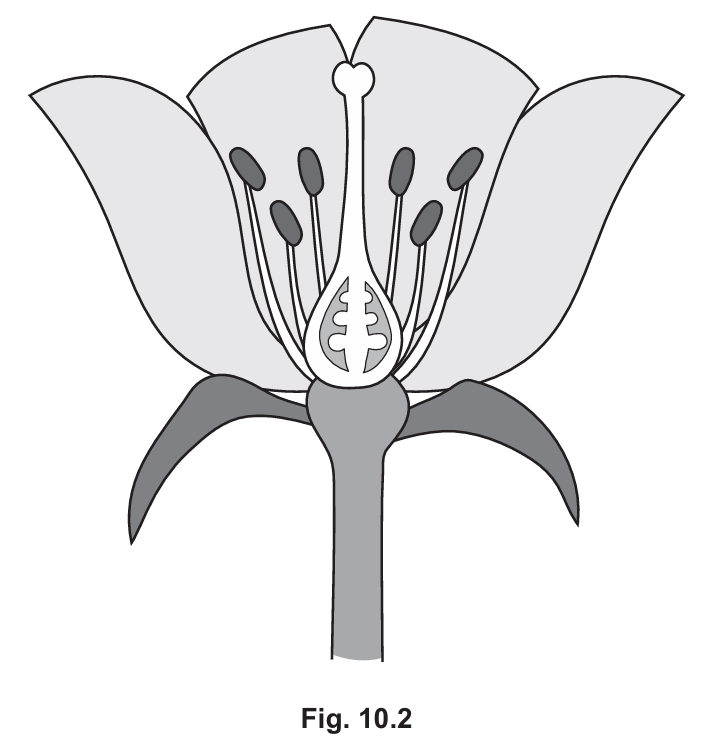
(d)(i) Sepal
The outermost part that encloses and protects the flower bud before it opens is the sepal.
(d)(ii) Large, brightly coloured petals (or anther/stigma positioned inside the flower)
Insect-pollinated flowers typically have large, conspicuous petals to attract insects.
The reproductive parts (anther and stigma) are usually located inside the flower so insects brush against them.
(e) Less chlorophyll is made, causing yellow leaves
Magnesium is needed to synthesise chlorophyll.
A deficiency means less (or no) chlorophyll can be made.
This results in the leaves appearing yellow rather than green.