
CIE iGCSE Co-Ordinated Science B18.1 Energy flow Exam Style Questions Paper 3
Question
Most-appropriate topic codes (Cambridge IGCSE Co-ordinated Sciences 0654):
• Topic B18.1 — Energy flow (Part (a))
• Topic B18.2 — Food chains and food webs (Part (b), (c), (d), (e))
• Topic B13.1 — Coordination and response (Part (f))
▶️ Answer/Explanation
(a) Sun
The Sun is the principal source of energy input to all food webs. Plants capture light energy from the Sun and convert it into chemical energy through photosynthesis.
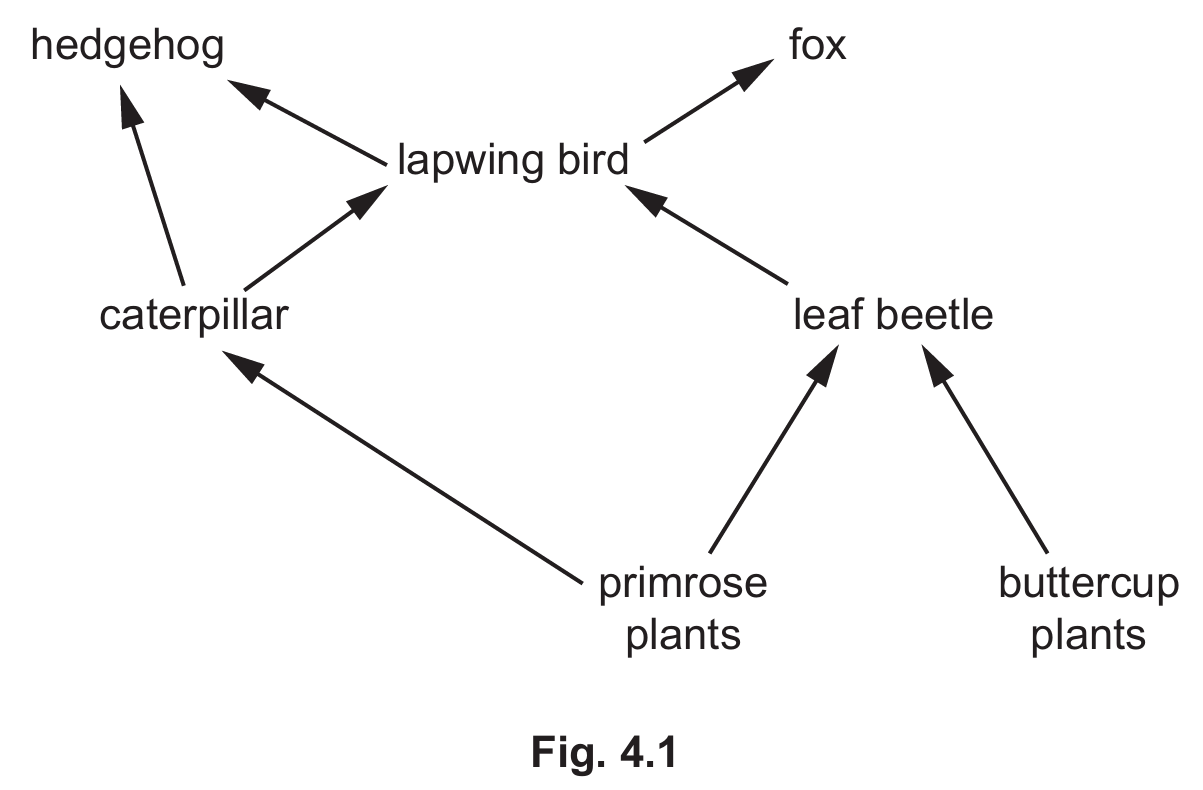
(b) caterpillar and leaf beetle
The lapwing bird eats both caterpillars and leaf beetles, as shown by the arrows pointing from these organisms to the lapwing bird in the food web.
(c) Primrose plants and buttercup plants
Producers are organisms that make their own food by photosynthesis. In this food web, the primrose plants and buttercup plants are the producers at the base of the food web.
(d) Hedgehogs cause the population of lapwing birds to decrease.
Hedgehogs directly eat lapwing birds, reducing their numbers. Additionally, hedgehogs eat caterpillars, which are also a food source for lapwing birds. This increases competition for food, further reducing the lapwing population.
(e) Decomposer
Decomposers such as earthworms, bacteria and fungi obtain their energy from dead or waste organic material, breaking it down and releasing nutrients back into the ecosystem.
(f) Hedgehogs use their sense of smell to detect chemicals in the air.
Their nose contains groups of receptor cells which detect the smell.
Receptor cells are specialised cells that detect specific stimuli such as chemicals (for smell), light, or sound. In the nose, chemoreceptors detect chemical molecules in the air.
Question
☐ decomposer
☐ herbivore
☐ primary consumer
☐ producer
☐ secondary consumer
Topic codes:
• Topic B18.1 — Energy flow (Part (a))
• Topic B18.2 — Food chains and food webs (Part (a))
• Topic B19.1 — Habitat destruction (Part (c)(ii))
• Topic B19.2 — Conservation (Part (b), (c)(i), (d)(i), (d)(ii) & (d)(iii))
▶️ Answer/Explanation
(a) Herbivore and primary consumer
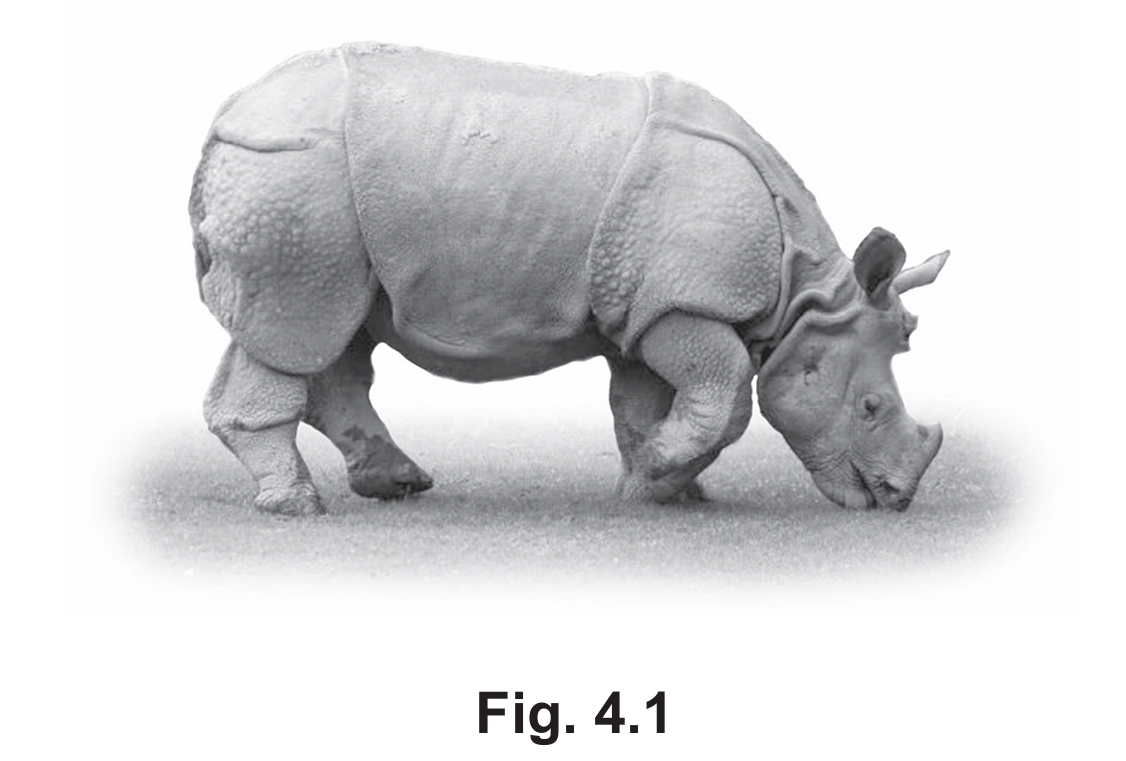
Rhinos eat only plants, making them herbivores. In a food chain, herbivores that feed directly on producers (plants) are primary consumers. Producers make their own food through photosynthesis, while carnivores and secondary consumers eat other animals.
(b) A species is a group of organisms that can reproduce to produce fertile offspring.
Organisms belong to the same species if they can interbreed and produce viable offspring that can also reproduce. Individuals of different species cannot produce fertile offspring due to reproductive barriers.
(c)(i) Two other reasons why rhinos are endangered:
- Hunting/poaching – Rhinos are killed for their horns, which are valued in some cultures for traditional medicine or as status symbols.
- Climate change – Changes in temperature and rainfall patterns can affect the availability of food and water sources for rhinos.
- Pollution – Contamination of water sources and habitats with chemicals can harm rhino health and reduce their food supply.
- Competition from introduced species – Non-native species may compete with rhinos for food and water resources.
(c)(ii) Habitats are destroyed due to:
Land being cleared for housing, industry, crop plant production, livestock production, or extraction of natural resources such as mining and logging. Pollution can also contaminate and destroy habitats.
(d)(i) White rhino
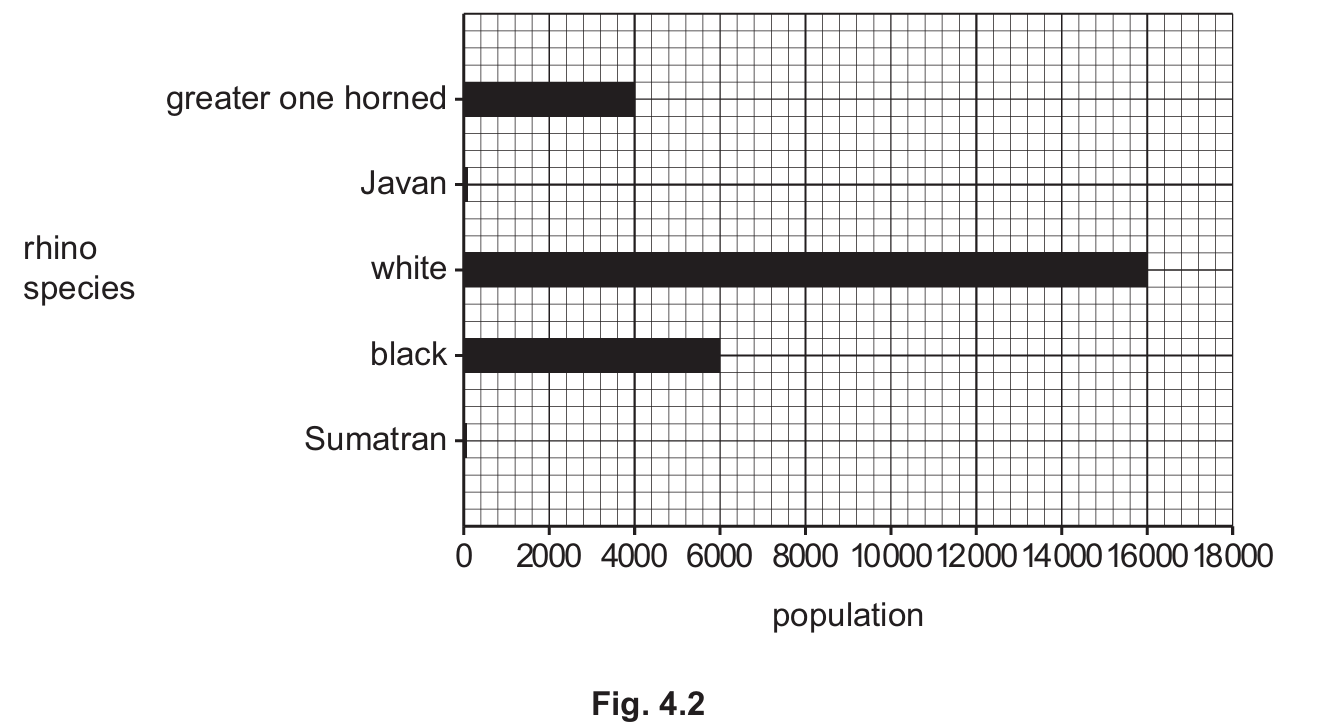
From Fig. 4.2, the white rhino population is approximately 16,000, which is the highest among all rhino species.
(d)(ii) White rhino population = 16,000; Black rhino population = 6,000
\(\frac{16,000}{6,000} = 2.7\)
The white rhino population is 2.7 times bigger than the black rhino population.
(d)(iii) Captive breeding programmes
For critically endangered species like Sumatran and Javan rhinos with very small populations, captive breeding programmes can be used. These involve breeding rhinos in controlled environments to increase their numbers before releasing them back into protected areas. Education programmes can also help raise awareness and reduce demand for rhino products.