
CIE iGCSE Co-Ordinated Science B18.1 Energy flow Exam Style Questions Paper 4
Question
State two advantages of asexual reproduction.
Most-appropriate topic codes (Cambridge IGCSE Co-ordinated Sciences 0654):
• Topic B19.1 — Habitat destruction (Parts (a)(i), (a)(ii))
• Topic B18.1 — Energy flow (Parts (b), (c))
• Topic B15.1 — Asexual reproduction (Part (d))
▶️ Answer/Explanation
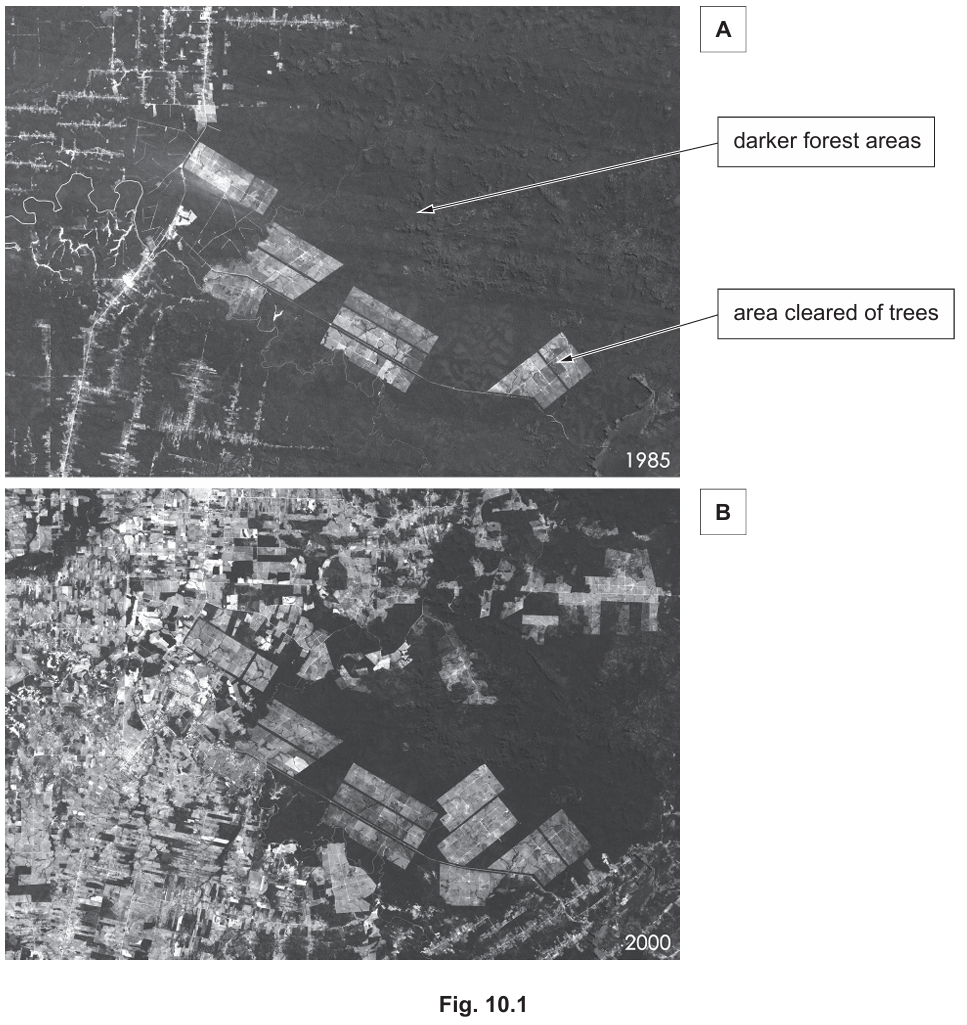
(a)(i) Fewer trees means less photosynthesis, so less carbon dioxide is removed from the atmosphere
Deforestation reduces the number of trees available for photosynthesis.
Since fewer trees are absorbing carbon dioxide, more carbon dioxide remains in the atmosphere.
(a)(ii) Any three effects, such as: extinction, migration, or destruction of habitats and food sources
Deforestation destroys habitats, shelter, and breeding grounds for animal species.
It also removes food sources, disrupting food chains and food webs in the area.
This can lead to species migrating elsewhere or, in severe cases, becoming extinct.
(b) A unit containing all of the organisms and their environment, interacting together in a given area
An ecosystem includes both the living organisms (biotic factors) and the non-living environment (abiotic factors).
These components interact together within a defined area.
(c) The Sun
The Sun is the principal source of energy that enters an ecosystem.
This energy is captured by producers through photosynthesis and passed along food chains.
(d) Any two advantages, such as speed and preservation of favourable traits
Asexual reproduction is faster and requires less energy than sexual reproduction.
It also preserves favourable genetic traits exactly, and allows reproduction even if a plant is isolated from others.
Question

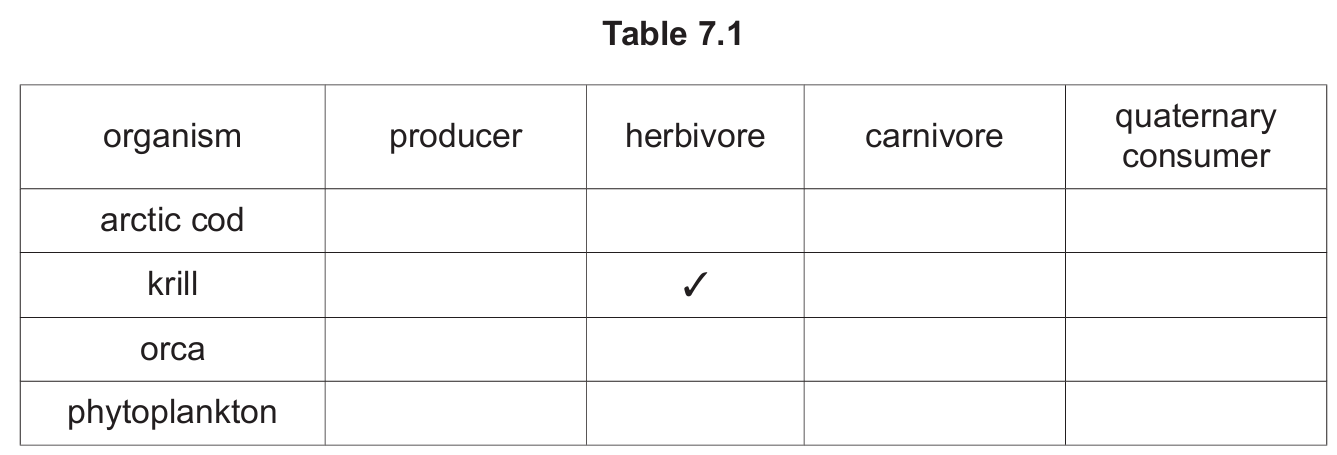
Put ticks (✓) in Table 7.1 to show all the terms used to describe each organism.
One has been done for you.
Some organisms are better adapted to the ……… than others.
These organisms survive and breed, passing on their ……… .
This process takes many ……… .
List two features of gas exchange surfaces.
Most-appropriate topic codes (Cambridge IGCSE Co-ordinated Sciences 0654):
• Topic B18.2 — Food chains and food webs (Part (a))
• Topic B6.1 — Photosynthesis (Part (b))
• Topic B18.1 — Energy flow (Part (c))
• Topic B17.2 — Selection (Part (d)(i))
• Topic B11 — Gas exchange in humans (Part (d)(ii))
▶️ Answer/Explanation
(a) Arctic cod: carnivore, quaternary consumer; Krill: herbivore; Orca: carnivore, quaternary consumer; Phytoplankton: producer

Phytoplankton is a producer, forming the base of the food web.
Krill feeds directly on phytoplankton, making it a herbivore.
Arctic cod and orca both feed on other consumers, so they are carnivores and, following the food chain to the top, quaternary consumers.
(b) Photosynthesis, using light energy, carbon dioxide and water
Producers absorb light energy using chlorophyll.
This energy converts carbon dioxide and water into glucose during photosynthesis.
Glucose can then be built into other carbohydrates such as starch and cellulose.
(c) Heat lost through respiration; energy lost in excretion/egestion; energy used for movement/metabolism
Some energy is lost as heat during respiration.
Some energy is lost in waste products, such as faeces and urea.
Some energy is used for movement and other metabolic processes, and not all parts of an organism are eaten or digested by the next trophic level.
(d)(i) Selection; environment; alleles; generations
Adaptation results from the process of natural selection.
Organisms best suited to their environment are more likely to survive and reproduce.
These organisms pass on their advantageous alleles to offspring, and this process occurs gradually over many generations.
(d)(ii) Large surface area; thin walls (short diffusion distance)
Gas exchange surfaces have a large surface area to maximise the rate of diffusion.
They also have thin walls to keep the diffusion distance short, along with a good blood supply and good ventilation.