Home / iGCSE / Coordinated Sciences / B18.2 Food chains and food webs Paper 2

CIE iGCSE Co-Ordinated Science B18.2 Food chains and food webs Exam Style Questions Paper 2

Question

In the food chain shown, \(10\%\) of the energy is transferred between each trophic level.

grass → grasshopper → frog → snake → buzzard

How much energy is transferred to the tertiary consumer for every \(100\,\text{kJ}\) of energy in the herbivore?

A. \(0.1\,\text{kJ}\)
B. \(1\,\text{kJ}\)
C. \(10\,\text{kJ}\)
D. \(100\,\text{kJ}\)

▶️ Answer/Explanation
The herbivore is the grasshopper (primary consumer). The tertiary consumer is the snake (fourth trophic level, after grasshopper, frog). Energy transfer: grasshopper (100 kJ) → frog (10 kJ) → snake (1 kJ). So 1 kJ is transferred to the tertiary consumer. Answer: 1 kJ.
Answer: (B)

Question

What is the most energy efficient resource for humans to eat?

A. herbivores
B. primary consumers
C. producers
D. secondary consumers

▶️ Answer/Explanation
Producers (plants) are the most energy efficient food source for humans because they convert light energy from the Sun into chemical energy through photosynthesis. When humans eat producers directly, they obtain energy that has not been lost through other trophic levels. Energy transfer between trophic levels is inefficient because energy is lost through respiration, movement, heat, and undigested materials at each level of the food chain.
Answer: (C)

Question

Rabbits are herbivores.

Which trophic levels can the rabbit occupy?

A. 1 only
B. 2 and 3
C. 2 only
D. 3 and 4

▶️ Answer/Explanation
In a food chain, trophic level 1 consists of producers (plants) that make their own food. Trophic level 2 consists of primary consumers (herbivores) that eat producers. Since rabbits are herbivores that feed on plants, they occupy trophic level 2 only. They cannot be secondary or tertiary consumers as those are carnivores that eat other animals.
Answer: (C)

Question

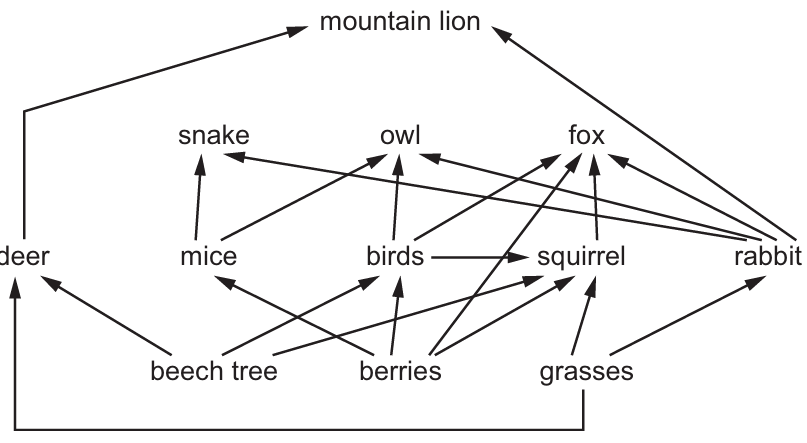
The diagram shows a North American food web.

Which organism is both a primary and secondary consumer?

A. birds
B. owl
C. snake
D. squirrel

▶️ Answer/Explanation
A primary consumer eats producers directly, and a secondary consumer eats primary consumers.
The squirrel eats the beech tree/berries directly (primary consumer role) and is also eaten as prey by other consumers while itself preying on lower-level organisms in some food webs of this type.
Based on the food web links, the squirrel is the organism that occupies both feeding levels.
Answer: (D)

Question

Which statement explains why food chains usually have fewer than five trophic levels?

A. All the carnivores consume herbivores.
B. The energy passed on decreases from one trophic level to the next.
C. There is less protein in each individual higher up the chain.
D. There is only one producer in each chain.

▶️ Answer/Explanation
Only about 10% of energy is transferred from one trophic level to the next. The energy lost becomes too little to support another trophic level beyond four or five, limiting the length of food chains.
Answer: (B)
Scroll to Top