
CIE iGCSE Co-Ordinated Science B18.2 Food chains and food webs Exam Style Questions Paper 4
Question
Most-appropriate topic codes (Cambridge IGCSE Co-ordinated Sciences 0654):
• Topic B17.1 — Variation (Part (a))
• Topic B17.2 — Selection / Natural selection (Part (b))
• Topic B18.2 — Food chains and food webs / Decomposers (Part (c)(i))
• Topic B18.2 — Energy transfer between trophic levels (Part (c)(ii))
▶️ Answer/Explanation
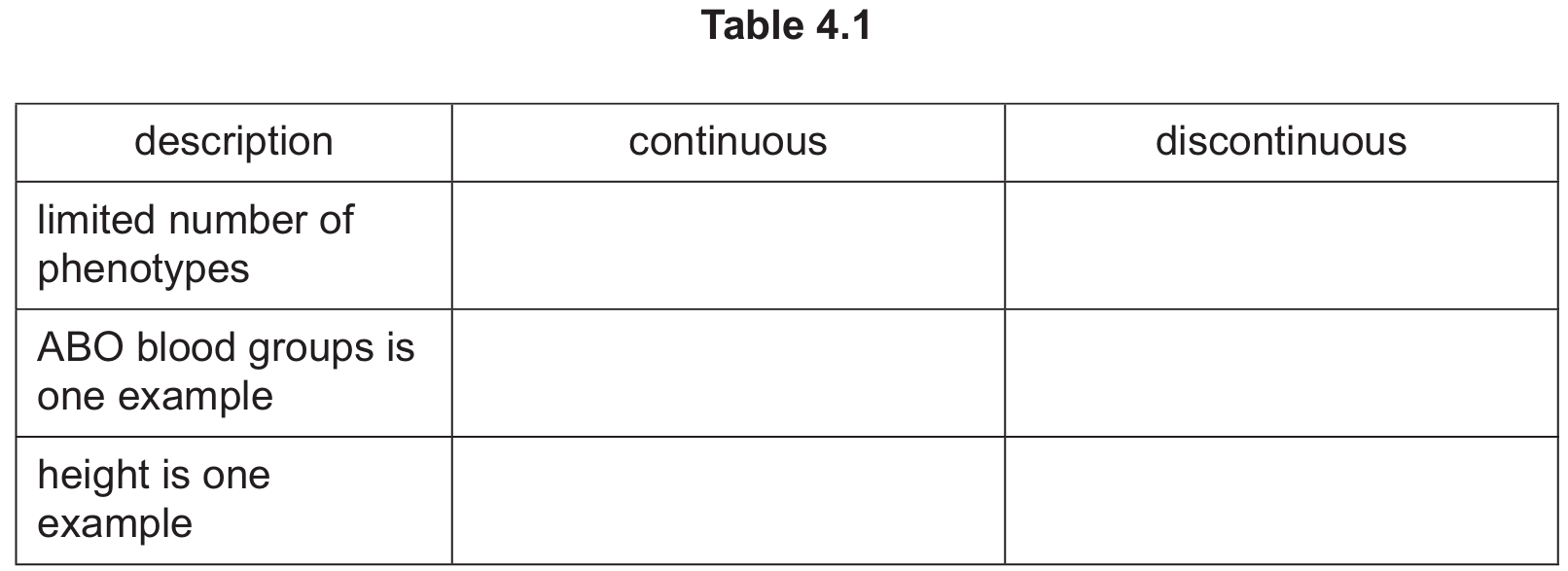
(a) Table 4.1 completed:
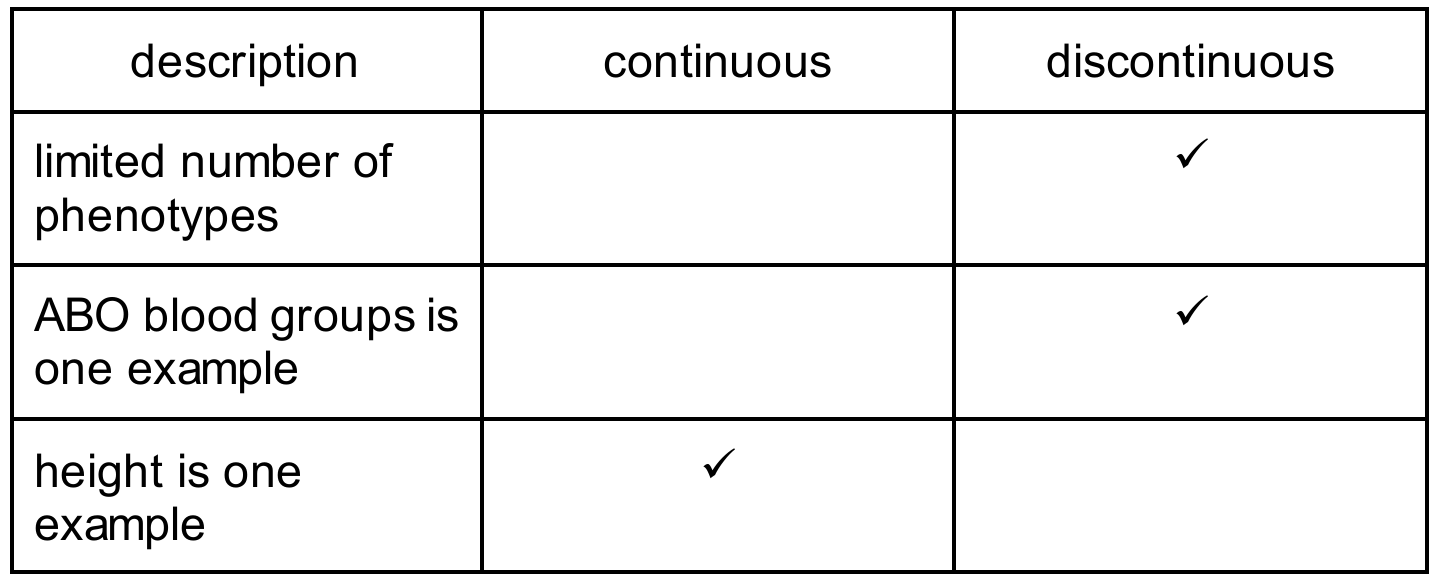
Discontinuous variation has a limited number of phenotypes with no intermediates (like blood groups); continuous variation shows a range between extremes (like height).
(b) Some bacteria mutate and become resistant to antibiotics. These resistant bacteria survive and reproduce, passing on their alleles for resistance to offspring, increasing the frequency of resistance in the population.
Antibiotics act as a selective pressure, killing non-resistant bacteria. The resistant ones survive and multiply, so the resistant trait becomes more common over generations.
(c)(i) A decomposer is an organism that gets its energy from dead or waste organic material.
Decomposers like bacteria and fungi break down dead organisms and waste, recycling nutrients back into the ecosystem.
(c)(ii) 1. Egestion (faeces / indigestible material) ; 2. Respiration (heat loss).
Energy is lost as heat during respiration, and in uneaten or indigestible parts like bones and teeth. Other losses include movement and excretion.
Question
Most-appropriate topic codes (Cambridge IGCSE Co-ordinated Sciences 0654):
• Topic B18.2 — Food chains and food webs
• Topic B19.1 — Habitat destruction
▶️ Answer/Explanation
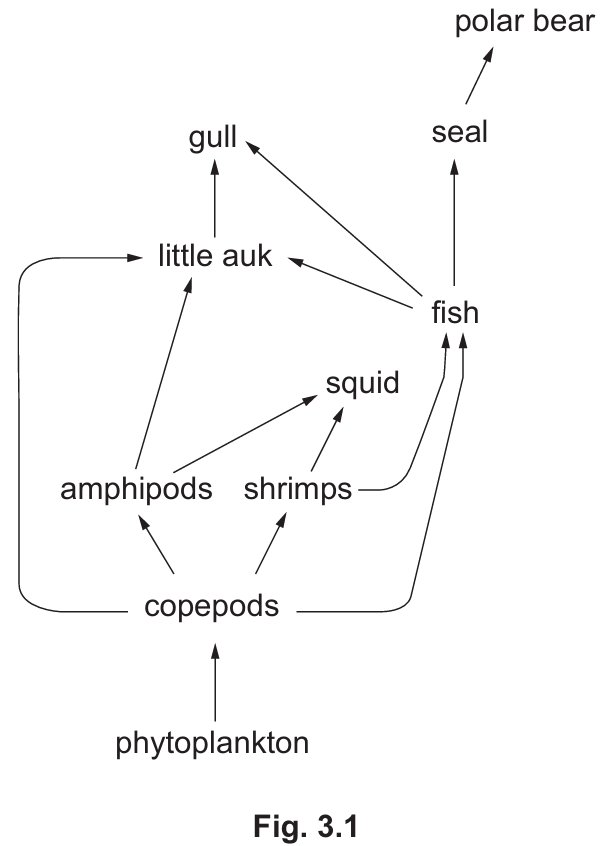
(a)(i) food web
A food web is a network of interconnected food chains showing the feeding relationships between organisms in an ecosystem.
(a)(ii) phytoplankton
Phytoplankton are photosynthetic organisms that convert sunlight energy into chemical energy through photosynthesis, forming the base of the food web.
(a)(iii) copepods
The second trophic level consists of primary consumers that feed directly on producers. Copepods consume phytoplankton.
(a)(iv) (little) auk / fish
Secondary consumers feed on primary consumers, while tertiary consumers feed on secondary consumers. Both the little auk and fish occupy multiple trophic levels as they consume organisms from different levels.
(a)(v) an animal that gets its energy by eating other animals
Carnivores are consumers that obtain their energy and nutrients by consuming the flesh of other animals rather than plants.
(a)(vi) Any two from:
• egestion / faeces / indigestible material
• respiration / heat loss
• movement / muscle contraction
• excretion
• inedible parts / bones / teeth
Not all energy consumed is transferred to the next trophic level. Energy is lost through metabolic processes like respiration (released as heat), in excretory materials, and as undigested matter (faeces).
(b)(i) Any two from:
• no or less absorption of carbon dioxide (because fewer trees)
• no photosynthesis / less photosynthesis
• carbon dioxide released by combustion / burning / decomposition (of trees)
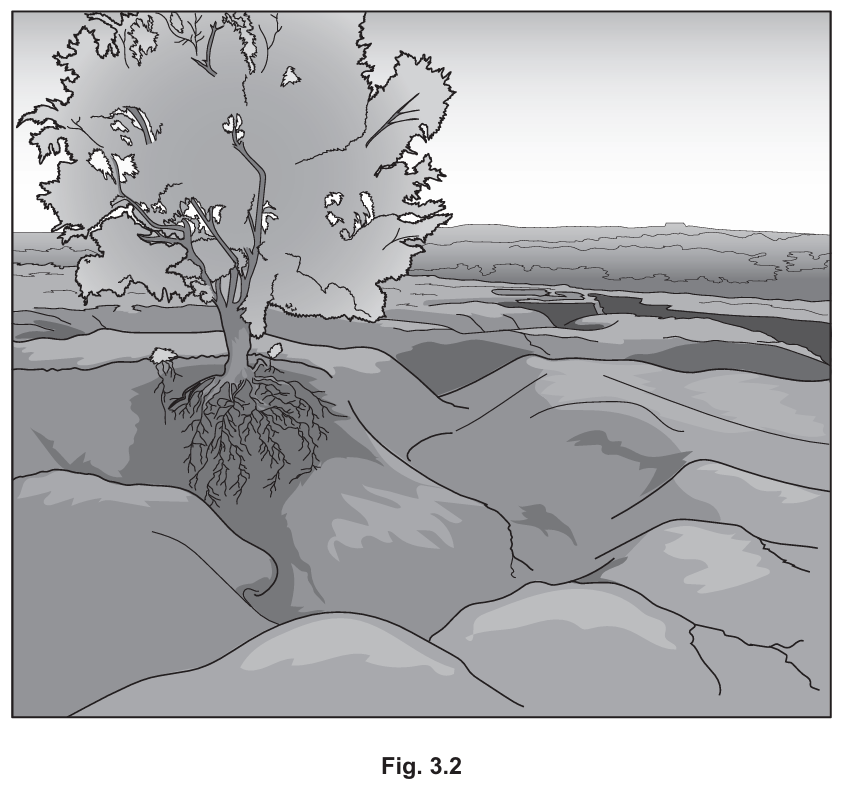
Trees absorb carbon dioxide during photosynthesis. When trees are removed, this carbon sink is lost, and the stored carbon is released through burning or decomposition of the wood.
(b)(ii) Any two from:
• no or less roots or trees to hold or bind soil
• no or less water absorbed by roots, increasing runoff
• deposition of soil into rivers
Trees intercept rainfall and their roots absorb water from the soil. Without trees, water runs off the surface more quickly, carrying soil with it and increasing the volume of water entering rivers.