

▶️ Answer/Explanation
In the carbon cycle diagram, process X shows an arrow from atmospheric \(\text{CO}_2\) into plants/organic compounds; this is photosynthesis — the only process that removes \(\text{CO}_2\) from the atmosphere and fixes it into organic molecules.
Respiration, combustion, and decomposition all release \(\text{CO}_2\) back into the atmosphere (arrows pointing in the opposite direction), so X must be photosynthesis.
✅ Answer: (C)
Respiration, combustion, and decomposition all release \(\text{CO}_2\) back into the atmosphere (arrows pointing in the opposite direction), so X must be photosynthesis.
✅ Answer: (C)
▶️ Answer/Explanation
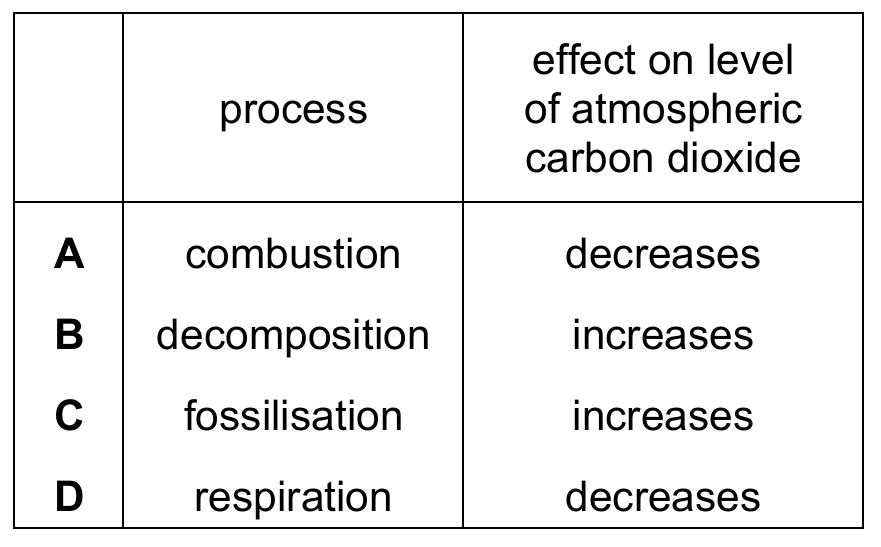
Photosynthesis removes carbon dioxide from the air, while respiration and combustion both release carbon dioxide into the air.
Decomposition releases carbon dioxide as decomposers respire while breaking down dead matter.
Only one row correctly states both the process named and whether it adds or removes atmospheric carbon dioxide.
✅ Answer: (B)
Decomposition releases carbon dioxide as decomposers respire while breaking down dead matter.
Only one row correctly states both the process named and whether it adds or removes atmospheric carbon dioxide.
✅ Answer: (B)
▶️ Answer/Explanation
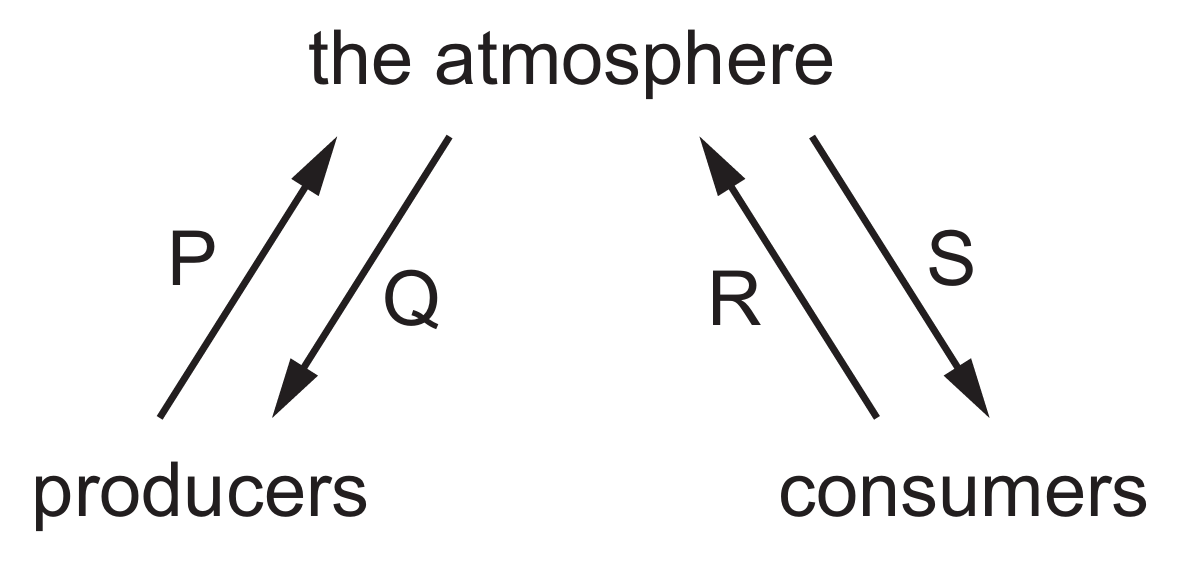
In darkness, plants cannot photosynthesise, so both plants and animals only respire.
Respiration takes in oxygen and releases carbon dioxide, so the carbon cycle gas involved is carbon dioxide, not oxygen.
Identifying the arrows that represent carbon dioxide being released by both groups of organisms gives the gases that are part of the carbon cycle.
✅ Answer: (B)
Respiration takes in oxygen and releases carbon dioxide, so the carbon cycle gas involved is carbon dioxide, not oxygen.
Identifying the arrows that represent carbon dioxide being released by both groups of organisms gives the gases that are part of the carbon cycle.
✅ Answer: (B)