
CIE iGCSE Co-Ordinated Science B18.3 Carbon cycle Exam Style Questions Paper 3
Question
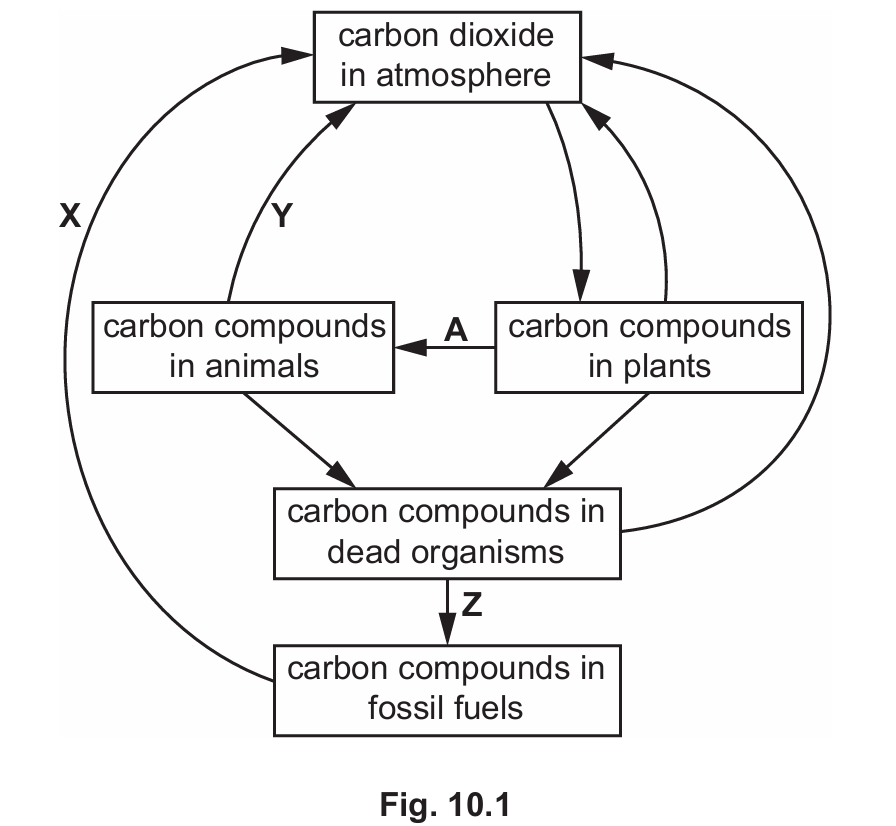
Use Fig. 10.1 to state two ways humans could increase the removal of carbon dioxide from the atmosphere.
Complete the sentences to define the term food chain.
A food chain is the transfer of ……………… from one organism to the next, beginning with a ……………… .
State two sources of water pollution.
Most-appropriate topic codes (Cambridge IGCSE Co-ordinated Sciences 0654):
• Topic B18.3 — Carbon cycle (Parts (a), (b))
• Topic B18.2 — Food chains and food webs (Part (c))
• Topic B19.1 — Habitat destruction / water pollution (Part (d))
▶️ Answer/Explanation
(a) X = combustion; Y = respiration; Z = fossilisation.
X represents combustion — burning of fossil fuels or organic matter releases \(\text{CO}_2\) from carbon compounds in animals back to the atmosphere.
Y represents respiration — animals and plants release \(\text{CO}_2\) back into the atmosphere through aerobic respiration: \(\text{C}_6\text{H}_{12}\text{O}_6 + 6\text{O}_2 \rightarrow 6\text{CO}_2 + 6\text{H}_2\text{O}\).
Z represents fossilisation — over millions of years, dead organisms are compressed and transformed into fossil fuels (coal, oil, natural gas).
(b) Any two from: plant more trees (reforestation / afforestation); prevent deforestation.
Planting more trees increases the number of plants carrying out photosynthesis, which removes \(\text{CO}_2\) from the atmosphere.
Preventing deforestation stops the loss of trees that are currently absorbing \(\text{CO}_2\) through photosynthesis.
Both methods increase the uptake of carbon dioxide by plants, reducing atmospheric concentrations.
(c) energy; producer.
A food chain shows the transfer of energy from one organism to the next, beginning with a producer.
Producers are photosynthetic organisms (usually plants or algae) that convert light energy into chemical energy stored in organic molecules.
Energy is transferred along the food chain as organisms eat and are eaten, but some energy is lost at each stage as heat.
(d) Any two from: chemical waste; discarded rubbish; untreated sewage; fertilisers (nitrates/phosphates causing eutrophication).
Untreated sewage introduces harmful bacteria and excess nutrients into water bodies, reducing oxygen levels and harming aquatic life.
Fertilisers washed from agricultural land cause eutrophication — algal blooms deplete oxygen when they decompose, killing fish.
Industrial chemical waste and rubbish (plastics) also contaminate water, making it toxic to aquatic organisms and unsafe for drinking.
Question
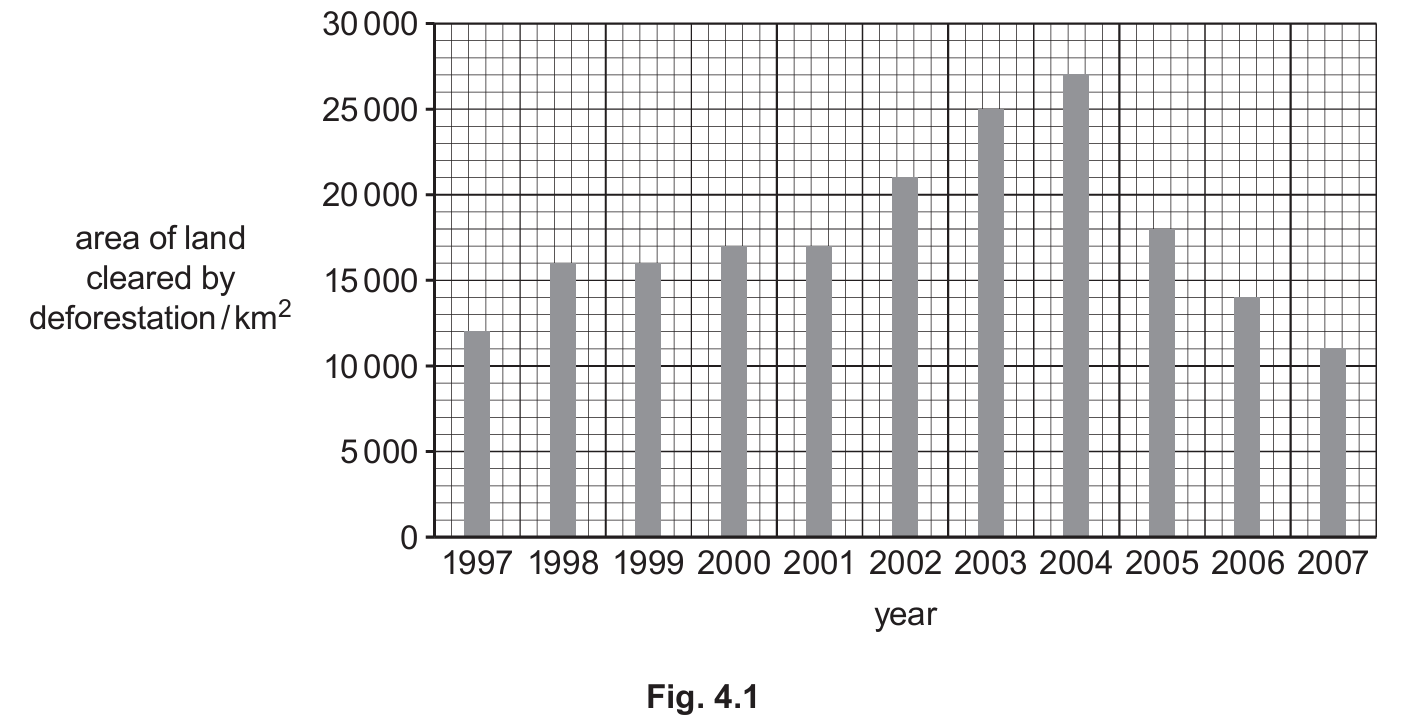
Give your answer to the nearest whole number.
Use ideas about the carbon cycle to explain why.
List three other undesirable effects of deforestation on the environment.
Most-appropriate topic codes (Cambridge IGCSE Co-ordinated Sciences 0654):
• Topic B19.1 — Habitat destruction (Part (a)(iii))
• Topic B18.3 — Carbon cycle (Parts (a)(ii), (b))
• Mathematical skills — Data handling (Part (a)(i))
▶️ Answer/Explanation
(a)(i) 2004 = 27000 km², 2007 = 11000 km², percentage change ≈ 59%
Reading the bar chart gives values of \(27000 \, \text{km}^2\) in 2004 and \(11000 \, \text{km}^2\) in 2007.
Percentage decrease \( = \dfrac{27000 – 11000}{27000} \times 100 = 59.3\% \).
Rounded to the nearest whole number, this is \(59\%\).
(a)(ii) increase in carbon dioxide; less photosynthesis
Between 1997 and 2004, the area cleared by deforestation increased.
Fewer trees means less photosynthesis occurring, so less carbon dioxide is removed from the atmosphere.
This causes carbon dioxide concentration in the atmosphere to increase.
(a)(iii) habitat destruction; extinction; soil erosion; flooding (any three)
Removing trees destroys habitats, which can lead to species extinction.
Without tree roots to bind the soil, soil erosion increases.
Loss of trees can also increase the risk of flooding, since less water is absorbed by roots.
(b) feeding; respiration (any two)
Animals transfer carbon by feeding, since carbon compounds pass along the food chain when animals eat plants or other animals.
Animals also transfer carbon through respiration, releasing carbon dioxide back into the atmosphere.