
CIE iGCSE Co-Ordinated Science B18.3 Carbon cycle Exam Style Questions Paper 4
Question
Most-appropriate topic codes (Cambridge IGCSE Co-ordinated Sciences 0654):
• Topic B18.3 — Carbon cycle (Part (a))
• Topic B19.1 — Habitat destruction (Parts (b), (c))
▶️ Answer/Explanation
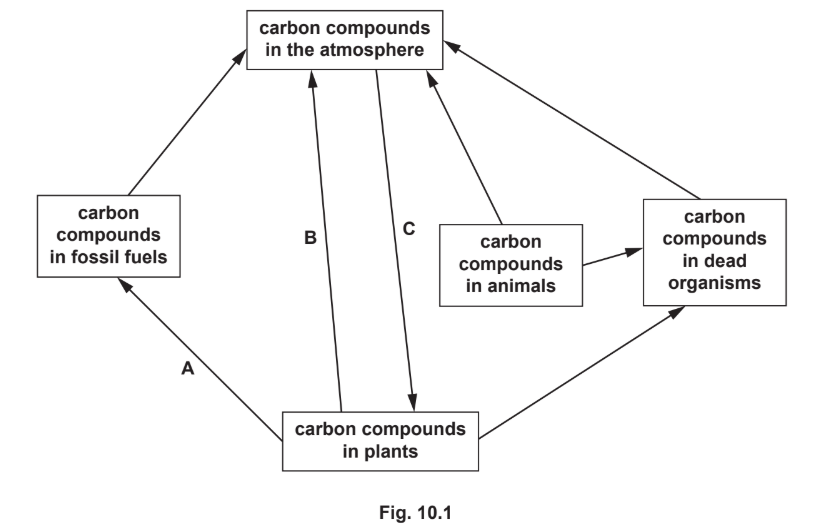
(a)(i) Fossilisation
Carbon compounds in dead organisms can, over millions of years under heat and pressure, be converted into fossil fuels — this process is fossilisation.
(a)(ii) \(C_6H_{12}O_6 + 6O_2 \rightarrow 6CO_2 + 6H_2O\)
Process B represents respiration, releasing carbon dioxide from plants back into the atmosphere as glucose is broken down using oxygen.
(a)(iii) An arrow drawn from “carbon compounds in plants” to “carbon compounds in animals”
Feeding transfers carbon compounds from plants into animals when animals eat plant material.
(a)(iv) Chloroplast
Process C represents photosynthesis, which takes place inside the chloroplasts of plant cells.
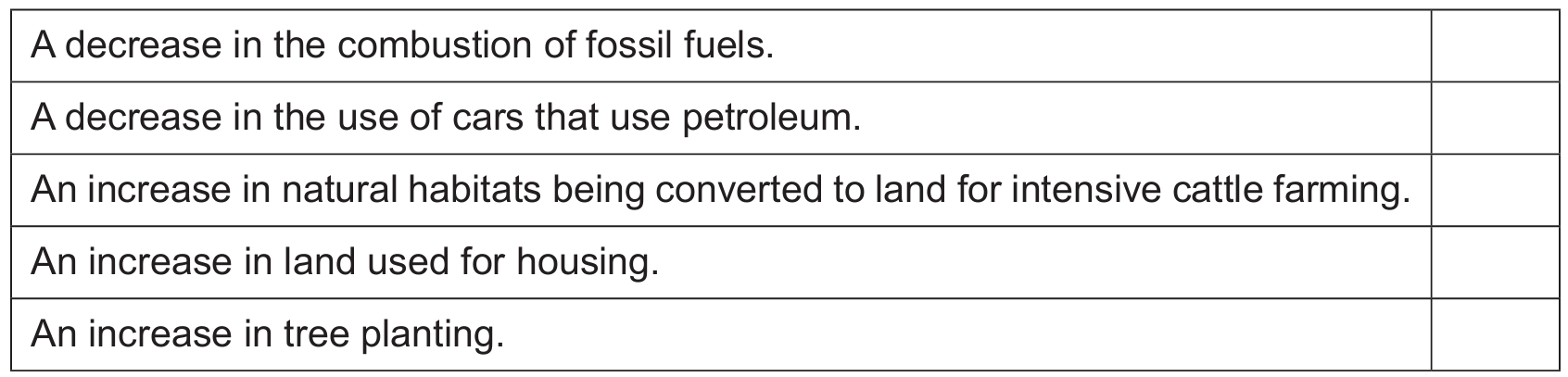
(b) 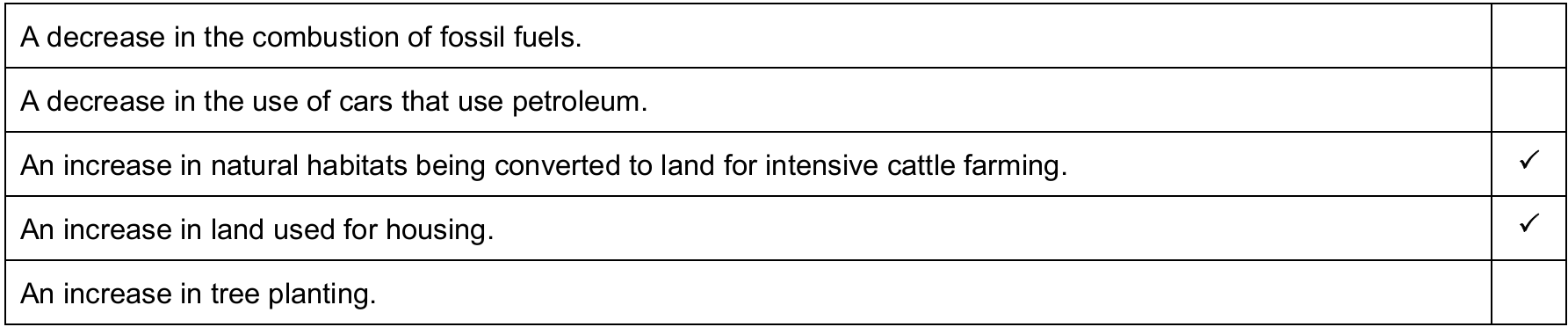
Converting natural habitats to farmland or housing usually involves burning or removing vegetation, releasing stored carbon and reducing the number of plants available to absorb \(CO_2\), so atmospheric \(CO_2\) rises.
The other statements (decreased fossil fuel combustion, decreased car use, increased tree planting) all act to lower atmospheric \(CO_2\), so they are not ticked.
(c) Any two from: removal of habitat/shelter/breeding grounds; removal of food source
Deforestation destroys the shelter and breeding sites animals depend on, and removes the plants many animals rely on for food.
Both effects can reduce population sizes to the point where species can no longer survive, leading to extinction.
Question

Most-appropriate topic codes (Cambridge IGCSE Co-ordinated Sciences 0654):
• Topic B18.3 — Carbon cycle (Parts (a)(i)–(iv))
• Topic B7.1 — Diet (Part (b)(i))
• Topic B4 — Biological molecules (Part (b)(ii))
▶️ Answer/Explanation
(a)(i) fossilisation
Process E shows carbon from dead organisms being converted into fossil fuels.
This long-term burial and transformation process is called fossilisation.
(a)(ii) Arrow drawn from “carbon in plants” to “carbon in animals”.
Feeding represents animals eating plants (or other animals), transferring carbon compounds from the food source to the consumer.
(a)(iii) \( 6CO_2 + 6H_2O \xrightarrow{\text{light, chlorophyll}} C_6H_{12}O_6 + 6O_2 \)
Process A is photosynthesis, converting atmospheric carbon dioxide into glucose in plants.
Light energy and chlorophyll are required for this reaction.
(a)(iv) Name: combustion (of fossil fuels)
Burning fossil fuels releases stored carbon back into the atmosphere as carbon dioxide.
This increases the concentration of carbon dioxide in the atmosphere.
(b)(i) kwashiorkor / marasmus
Both are diseases resulting from insufficient protein and/or energy intake, common where diets lack adequate nutrition.
(b)(ii) amino acids
Proteins are polymers made up of chains of amino acid monomers joined by peptide bonds.