
CIE iGCSE Co-Ordinated Science B19.1 Habitat destruction Exam Style Questions Paper 4
Question
Most-appropriate topic codes (Cambridge IGCSE Co-ordinated Sciences 0654):
• Topic B18.2 — Food chains and food webs
• Topic B19.1 — Habitat destruction
▶️ Answer/Explanation
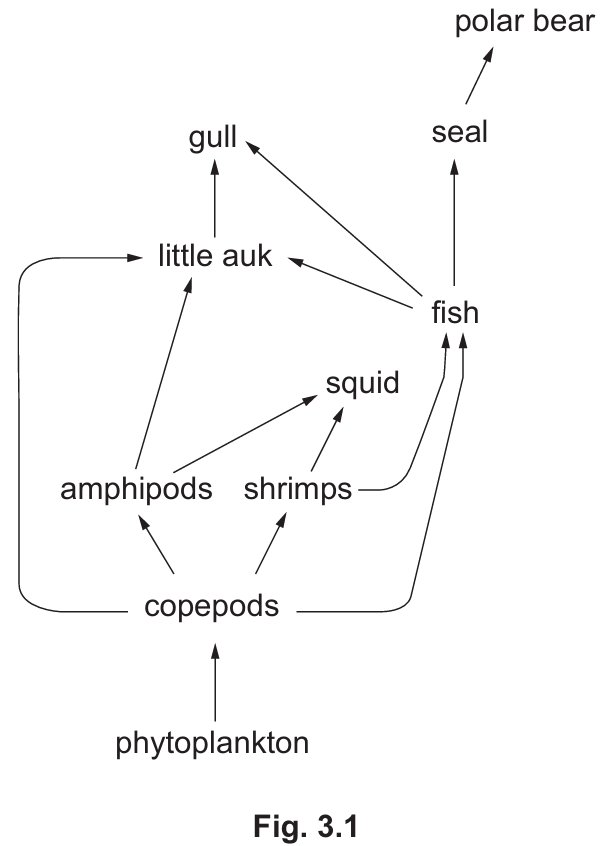
(a)(i) food web
A food web is a network of interconnected food chains showing the feeding relationships between organisms in an ecosystem.
(a)(ii) phytoplankton
Phytoplankton are photosynthetic organisms that convert sunlight energy into chemical energy through photosynthesis, forming the base of the food web.
(a)(iii) copepods
The second trophic level consists of primary consumers that feed directly on producers. Copepods consume phytoplankton.
(a)(iv) (little) auk / fish
Secondary consumers feed on primary consumers, while tertiary consumers feed on secondary consumers. Both the little auk and fish occupy multiple trophic levels as they consume organisms from different levels.
(a)(v) an animal that gets its energy by eating other animals
Carnivores are consumers that obtain their energy and nutrients by consuming the flesh of other animals rather than plants.
(a)(vi) Any two from:
• egestion / faeces / indigestible material
• respiration / heat loss
• movement / muscle contraction
• excretion
• inedible parts / bones / teeth
Not all energy consumed is transferred to the next trophic level. Energy is lost through metabolic processes like respiration (released as heat), in excretory materials, and as undigested matter (faeces).
(b)(i) Any two from:
• no or less absorption of carbon dioxide (because fewer trees)
• no photosynthesis / less photosynthesis
• carbon dioxide released by combustion / burning / decomposition (of trees)
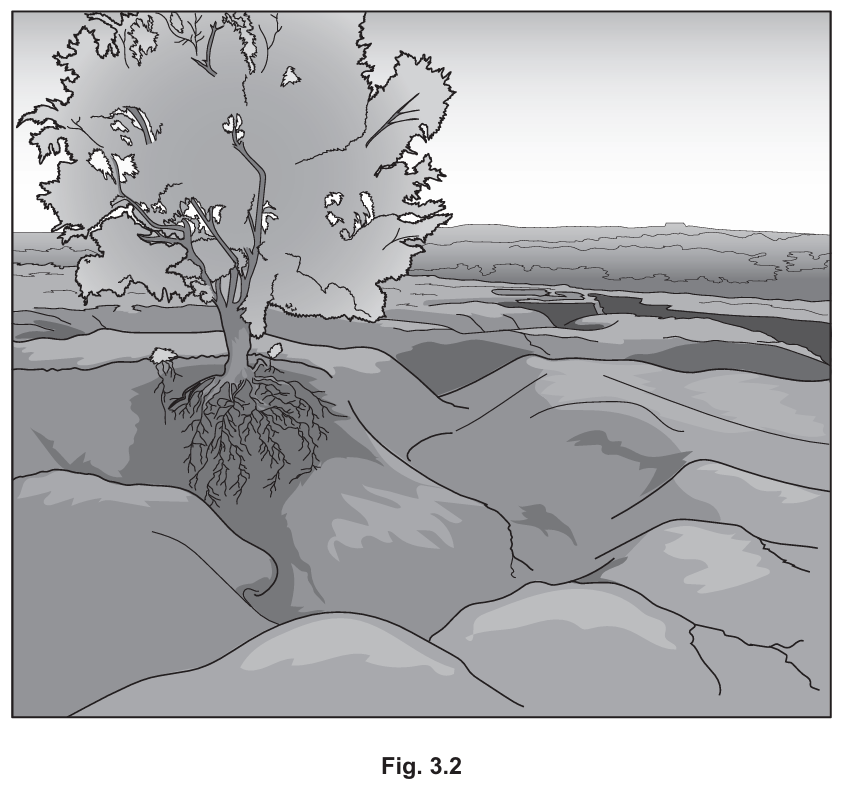
Trees absorb carbon dioxide during photosynthesis. When trees are removed, this carbon sink is lost, and the stored carbon is released through burning or decomposition of the wood.
(b)(ii) Any two from:
• no or less roots or trees to hold or bind soil
• no or less water absorbed by roots, increasing runoff
• deposition of soil into rivers
Trees intercept rainfall and their roots absorb water from the soil. Without trees, water runs off the surface more quickly, carrying soil with it and increasing the volume of water entering rivers.
Question
Most-appropriate topic codes (Cambridge IGCSE Co-ordinated Sciences 0654):
• Topic B15.4 — Sexual reproduction in humans (Part (a))
• Topic B18.2 — Food chains and food webs (Part (b))
• Topic B19.1 — Habitat destruction / B19.2 — Conservation (Part (c))
▶️ Answer/Explanation
(a) Two adaptive features of egg cells:
1. Egg cells contain energy stores (food reserves) to provide nutrients for the developing embryo after fertilisation.
2. The jelly coat (zona pellucida) changes after fertilisation, forming a fertilisation membrane that prevents entry of further sperm cells.
3. Egg cells are relatively large, providing space for the developing embryo.
4. Egg cells contain cortical granules that release enzymes to harden the jelly coat after fertilisation.
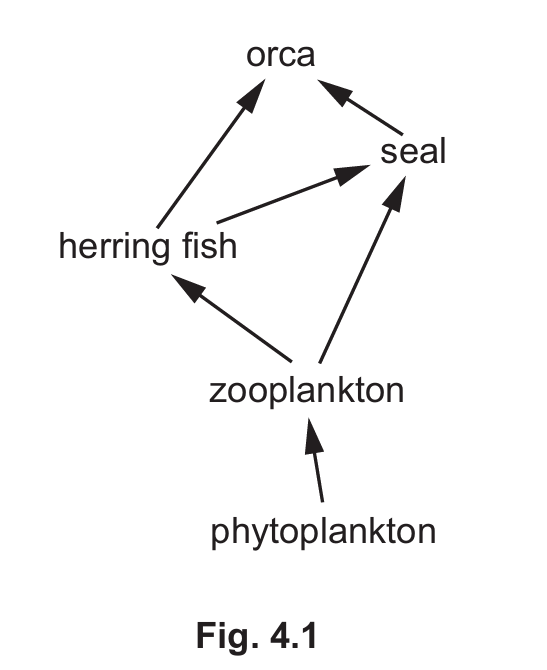
(b)(i) Tertiary consumer
The orca feeds at the tertiary consumer level in the food web shown. The trophic levels shown are: phytoplankton (producer) → zooplankton (primary consumer) → herring (secondary consumer) → orca (tertiary consumer).
(b)(ii) Arrow from herring pointing to a label for humans
Humans feeding on herring would be placed at the same trophic level as seals and orcas (tertiary consumer). The arrow should point from herring to a label reading “humans”.
(c) How human activity is causing orca population decrease:
1. Fishing nets physically entangle and kill orcas (bycatch).
2. Overfishing reduces the availability of prey species (such as herring and seals).
3. Chemical pollutants (PCBs) bioaccumulate in the marine food web, reaching high concentrations in orcas (top predators) and impairing their reproduction.
4. Boat traffic and noise pollution disturb orca migration and communication.
5. Habitat destruction from coastal development reduces their feeding grounds.