
CIE iGCSE Co-Ordinated Science B19.2 Conservation Exam Style Questions Paper 4
Question
Complete the flowchart in Fig. 10.1.

Suggest why deforestation causes an increase in eutrophication.
State the term used to describe organisms that make their own nutrients.
Most-appropriate topic codes (Cambridge IGCSE Co-ordinated Sciences 0654):
• Topic B19.1 — Parts (a), (d), (e)
• Topic B19.2 — Parts (b), (c)
▶️ Answer/Explanation
(a) nitrate / photosynthesise / decomposed / oxygen
Excess fertiliser increases nitrate ion concentration in the water.
Blocked light means submerged plants can no longer photosynthesise and die.
Dead plants are decomposed by bacteria, which then respire aerobically and reduce the dissolved oxygen concentration.
(b) Increased soil erosion washes more nutrients into water
Trees and their roots normally hold soil in place and reduce runoff.
Without trees, rain washes away topsoil (erosion) more easily.
This soil carries nitrate ions into water bodies, triggering eutrophication.
(c) Loss of habitat; disruption of food chain
Removing trees destroys the habitat animals rely on for shelter and breeding.
It also disrupts food chains/webs, since food sources are lost.
This can lead to migration, population decline, or local extinction of species.
(d) Producers
Organisms that synthesise their own organic nutrients from simple inorganic substances are called producers.
Trees do this through photosynthesis, forming the base of most food chains.
(e) Carbon dioxide, water, chlorophyll
Carbon dioxide and water are the raw materials combined during photosynthesis.
Chlorophyll is the pigment needed to absorb light energy for the reaction.
(Light energy and mineral ions, e.g. nitrate, are also acceptable additional factors.)
Question
Auxin is a hormone that is responsible for the chemical control of shoot growth.
Complete the sentences to describe how auxin causes shoots to grow towards the light.
It collects on the ……………………………………….. side of the shoot.
Auxin stimulates cell ………………………………………..so this side will grow more.
This results in the shoot bending towards the light.
This growth response to light is called ……………………………………….. .
Most-appropriate topic codes (Cambridge IGCSE Co-ordinated Sciences 0654):
• Topic B19.1 — Human influences on ecosystems (Part (a)(i))
• Topic B19.2 — Conservation (Part (a)(ii), (a)(iii))
• Topic B19.2 — Conservation (Part (b))
▶️ Answer/Explanation
(a)(i)
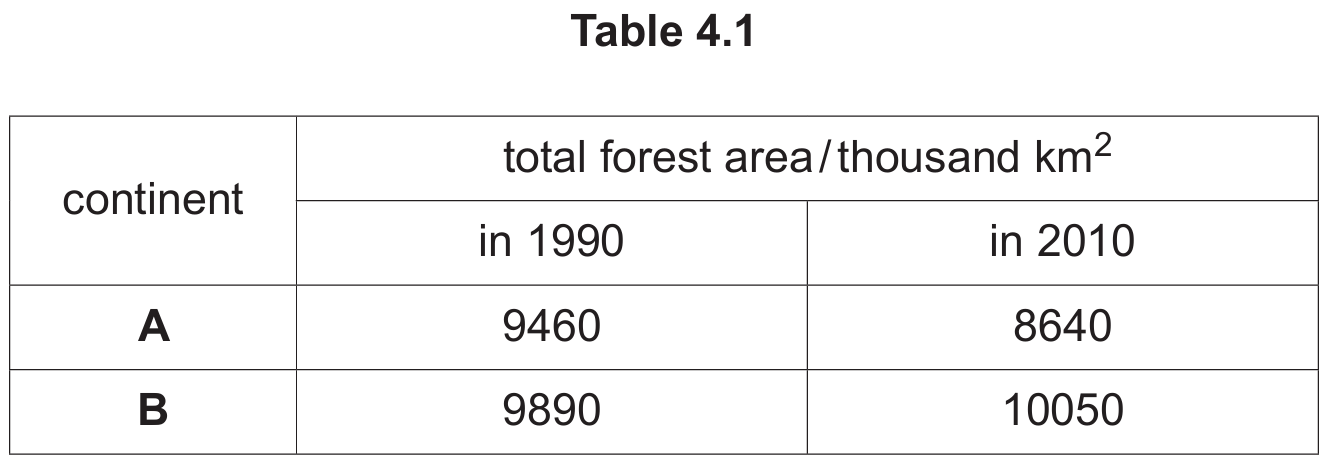
Forest area in continent A decreased from 9460 to 8640 thousand \(\text{km}^2\) between 1990 and 2010.
Forest area in continent B increased from 9890 to 10050 thousand \(\text{km}^2\) over the same period.
Continent B had a greater forest area than continent A in both years, and the gap widened over time.
(a)(ii)
Loss of habitat, as animals lose the shelter and living space the forest provided.
Disruption to food chains/webs, as food sources become scarcer.
Increased risk of extinction or forced migration to other areas in search of resources.
(a)(iii)
Fewer trees means less photosynthesis, so less carbon dioxide is removed from the atmosphere.
Cut trees are often burned (combustion), which releases the carbon stored in them as carbon dioxide.
(b)
Auxin is made in the shoot tip(s) and spreads through the plant.
It collects on the shaded side of the shoot.
Auxin stimulates cell elongation, so this side grows more.
This growth response to light is called phototropism.