
▶️ Answer/Explanation
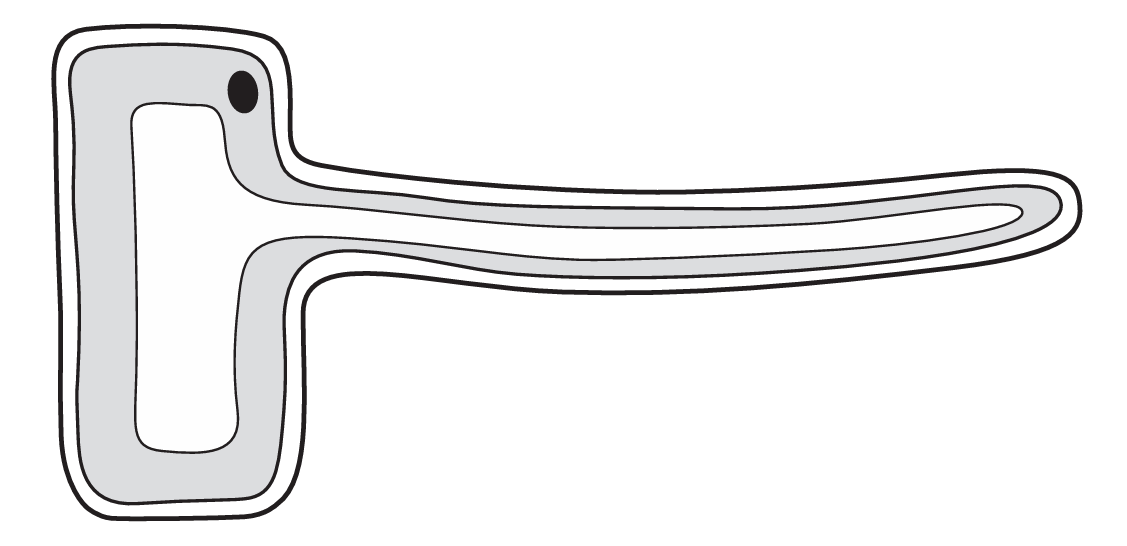
The diagram shows a cell with a long, thin extension projecting from its main body. This is characteristic of a root hair cell, which has this elongated structure to greatly increase the surface area for the absorption of water and mineral ions from the soil. The other options do not match this appearance as ciliated cells have hair-like projections (cilia), palisade cells are columnar and packed with chloroplasts, and sperm cells have a flagellum and distinct head region.
✅ Answer: (C)
✅ Answer: (C)
▶️ Answer/Explanation
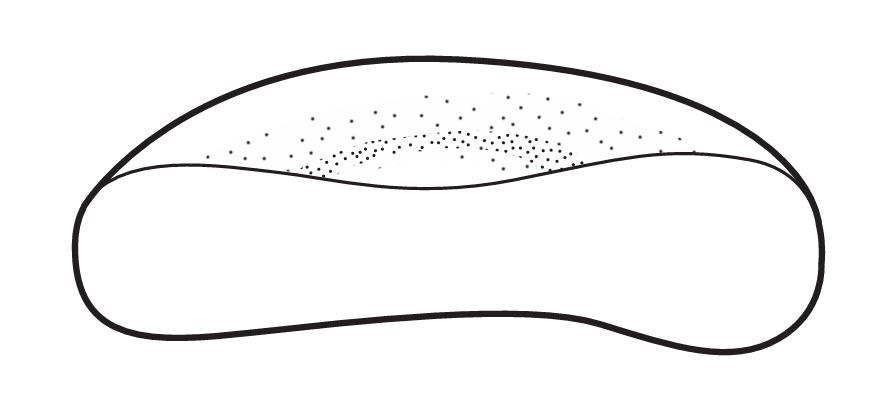
The cytoplasm of a red blood cell is packed with haemoglobin, which binds oxygen.
The absence of a nucleus increases (not minimises) space for oxygen binding, so A is wrong.
The biconcave shape gives a large surface area to volume ratio and is not related to travel through arteries.
✅ Answer: (C)
The absence of a nucleus increases (not minimises) space for oxygen binding, so A is wrong.
The biconcave shape gives a large surface area to volume ratio and is not related to travel through arteries.
✅ Answer: (C)
▶️ Answer/Explanation
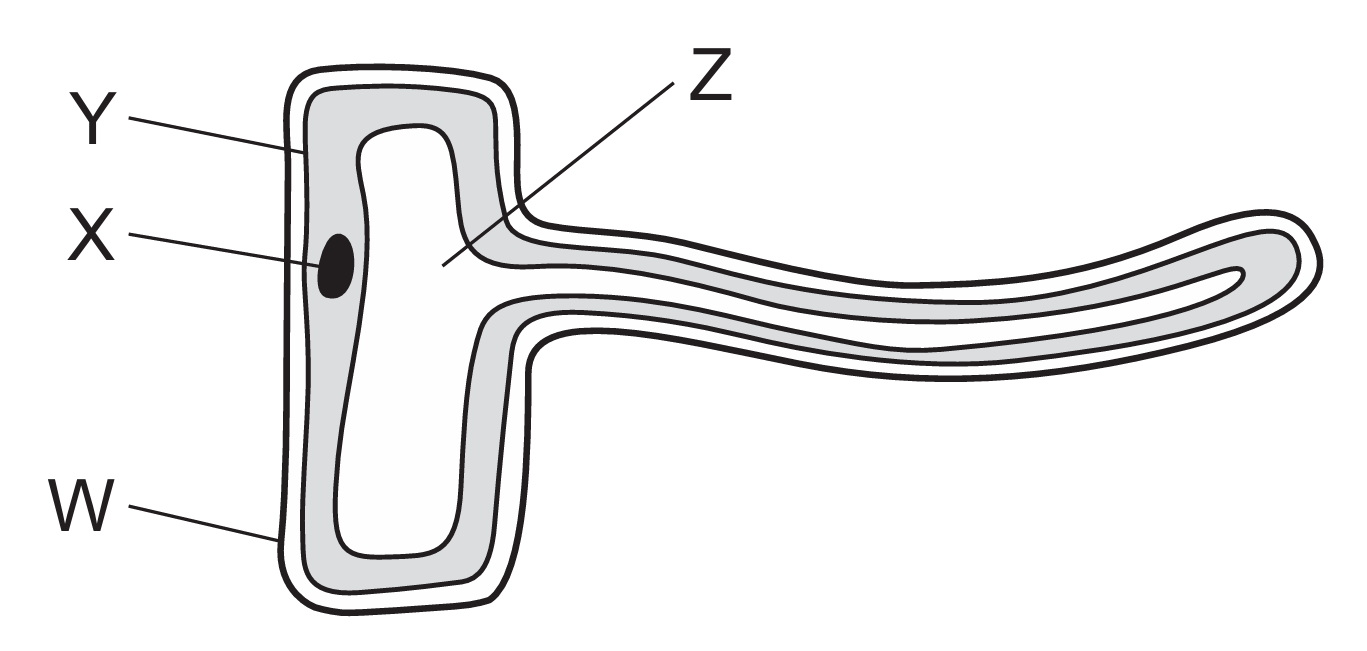
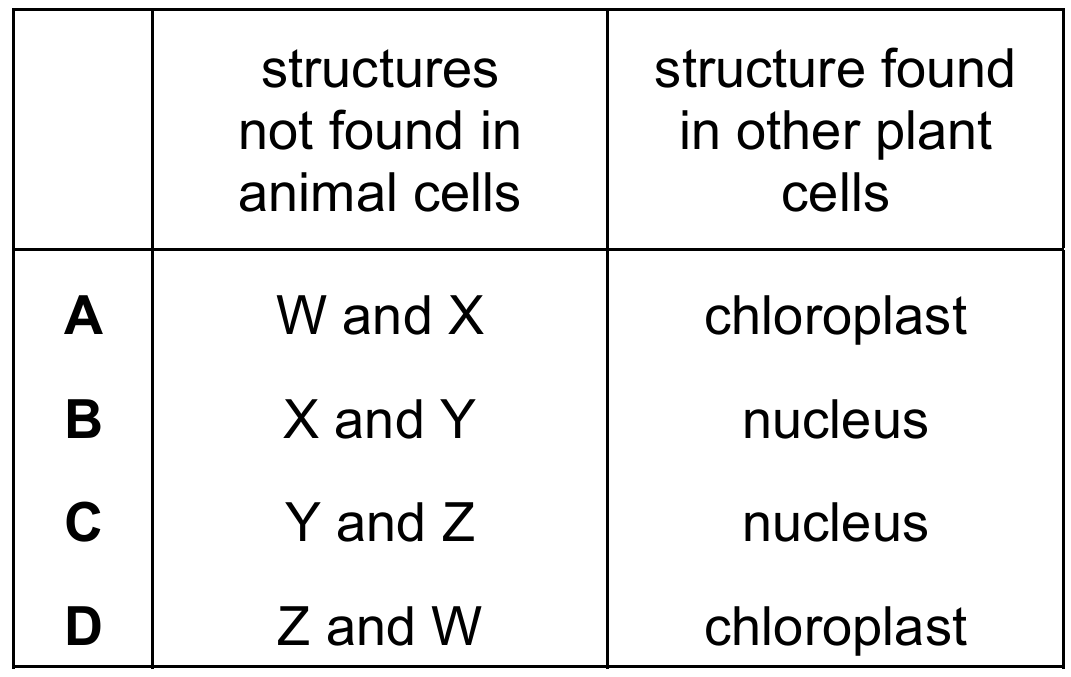
Structures unique to plant cells (not in animal cells) include the cell wall, chloroplast, and permanent vacuole.
In this cell, the labelled structures Z and W correspond to plant-specific structures, while the nucleus (a structure common to both plant and animal cells) is missing from those labelled but present in other plant cells.
✅ Answer: (D)
In this cell, the labelled structures Z and W correspond to plant-specific structures, while the nucleus (a structure common to both plant and animal cells) is missing from those labelled but present in other plant cells.
✅ Answer: (D)

▶️ Answer/Explanation
Cells specialised for diffusion (such as root hair cells and alveolar cells) are flattened, elongated, or have projections that increase their surface area relative to volume.
Cells 1 and 4 in the diagram show this type of shape, unlike the more compact/rounded cells 2 and 3.
A larger surface area speeds up the rate of diffusion of substances into and out of the cell.
✅ Answer: (B)
Cells 1 and 4 in the diagram show this type of shape, unlike the more compact/rounded cells 2 and 3.
A larger surface area speeds up the rate of diffusion of substances into and out of the cell.
✅ Answer: (B)
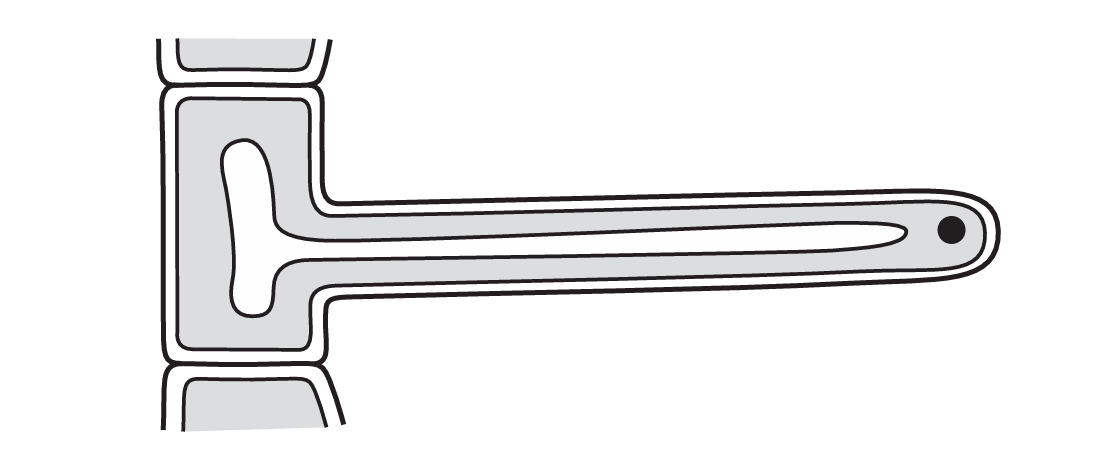
▶️ Answer/Explanation
Root hair cells are adapted for absorption of water and mineral ions. Their long, thin extension increases the surface area, allowing for more efficient uptake from the soil. The other options do not describe a function-related adaptation.
✅ Answer: (C)
✅ Answer: (C)