
CIE iGCSE Co-Ordinated Science B2.2 Size of specimens Exam Style Questions Paper 4
Question
Most-appropriate topic codes (Cambridge IGCSE Co-ordinated Sciences 0654):
• Topic B2.2 — Size of specimens / B9.4 — Blood (Part (a))
• Topic B10.1 — Diseases and immunity (Part (b), (c), (d))
▶️ Answer/Explanation
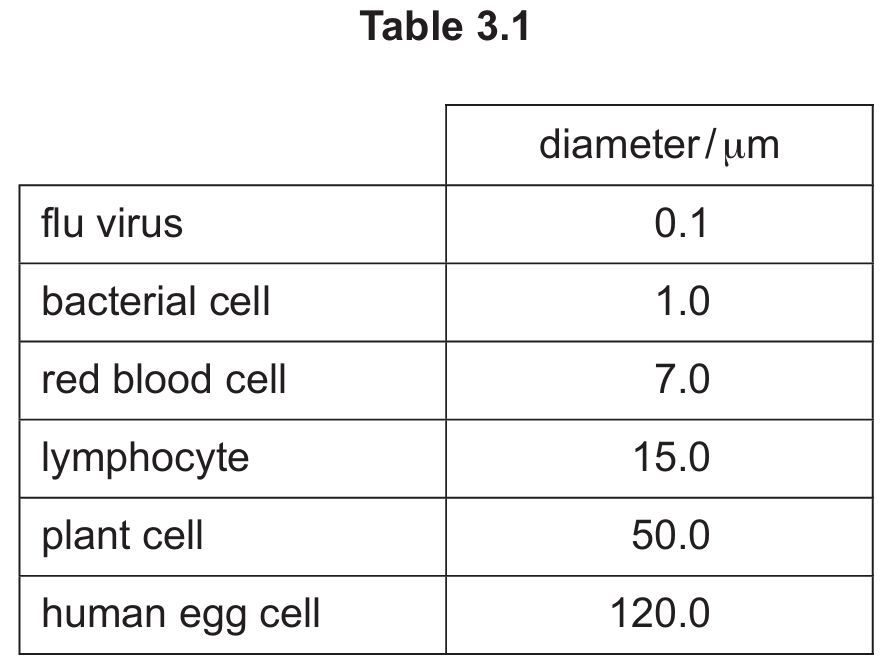
(a)(i) 113 μm
Largest animal cell: human egg cell = 120.0 μm
Smallest animal cell: red blood cell = 7.0 μm
Difference = 120.0 – 7.0 = 113.0 μm
(a)(ii) Red blood cell
Haemoglobin is the iron-containing protein found in red blood cells that transports oxygen from the lungs to body tissues.
(b) Completed sentences:
The flu virus has antigens on its surface. Proteins with a specific shape bind to antigens. These proteins are called antibodies. This causes the virus to be destroyed or marked for engulfing by phagocytes. After the infection, a human has active immunity to the flu virus.
(c) How the vaccine gives protection:
• The vaccine contains weakened/dead pathogens or antigens from the flu virus.
• These antigens stimulate an immune response.
• Lymphocytes produce specific antibodies that bind to the antigens.
• Memory cells are produced, providing long-term active immunity.
• If the person is infected with the flu virus later, memory cells rapidly produce antibodies to destroy the virus.
(d) Why a new vaccine is developed every year:
• The flu virus mutates frequently, causing changes in the shape of its surface antigens.
• Existing antibodies may no longer bind effectively to the new antigens.
• New antibodies with complementary shapes are required to match the new antigens.
• Therefore, the vaccine must be updated annually to match the circulating strains.
Question
Topic codes:
• Topic B2.2 — Size of specimens (Part (a))
• Topic B2.1 — Cell structure / Specialised cells (Part (b))
• Topic B16.2 — Cell division: Mitosis (Part (c))
• Topic B15.3 — Sexual reproduction in plants (Part (d))
• Topic B16.2 — Cell division: Meiosis (Part (d)(ii))
▶️ Answer/Explanation
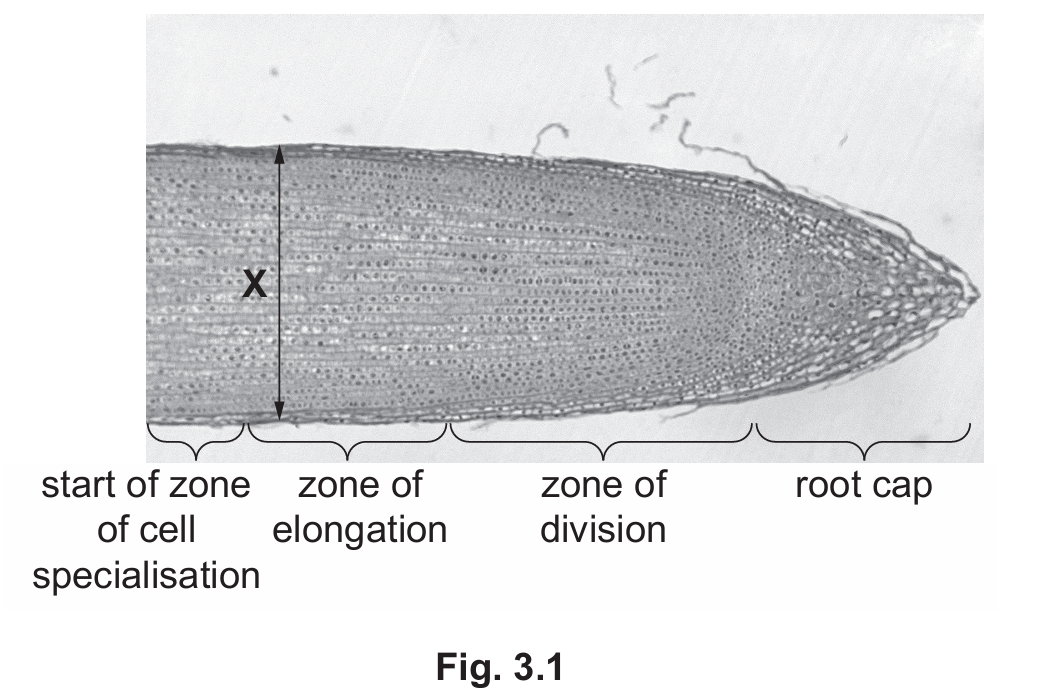
(a) Average cell size = Actual width ÷ Number of cells
= \(1.2\text{ mm} \div 37 = 0.0324\text{ mm}\)
= \(0.0324 \times 1000 = 32.4\ \mu\text{m}\)
(b) ☑ phloem cells
Phloem cells are specialised cells that transport sucrose and amino acids in plants. They are formed from meristem tissue in the root tip.
(c)(i) Mitosis is the type of cell division needed for growth.
(c)(ii) Two processes that maintain the chromosome number:
1. Replication of DNA / chromosomes occurs before division begins.
2. Separation of chromosomes into two identical sets, with each daughter cell receiving one complete set.
Alternative: cells only divide once / splits into two daughter cells with the same chromosome number.
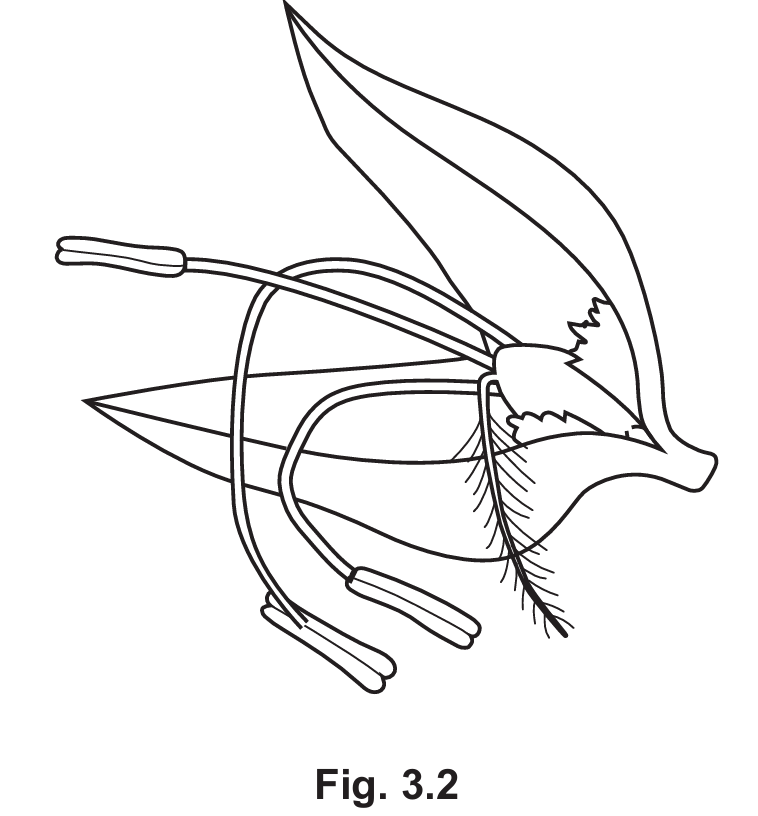
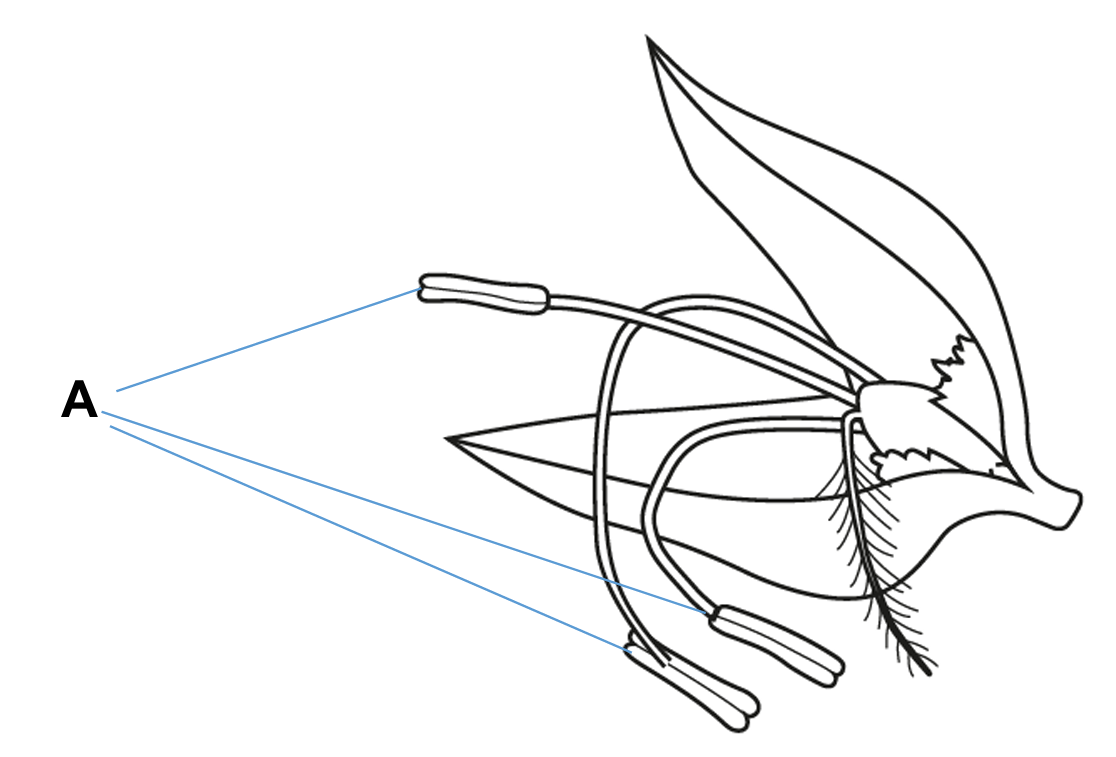
(d)(i) The anther should be labelled on Fig. 3.2. In a wind-pollinated flower, anthers are typically found hanging outside the flower on long filaments.
(d)(ii) Male gametes in plants are called pollen grains.
During production of male gametes, the chromosome number is halved from diploid to haploid.
Male gametes produced are all genetically different.
A nucleus of a male gamete will fuse with the nucleus of an ovule. This process is called fertilisation.
(d)(iii) One advantage of sexual reproduction to a population of plants in the wild:
Sexual reproduction produces genetic variation among offspring. This allows the population to adapt to changes in the environment and increases the chances of survival if conditions change.
Alternative: spreads offspring through dispersal of pollen / seeds.