Home / iGCSE / Coordinated Sciences / B4. Biological molecules Paper 2

CIE iGCSE Co-Ordinated Science B4. Biological molecules Exam Style Questions Paper 2

Question

Which reagent is used to test for the presence of protein in a food sample?

A. Benedict’s solution
B. biuret
C. ethanol
D. iodine

▶️ Answer/Explanation
Each food test uses a specific reagent that gives a distinctive colour change.
Benedict’s solution tests for reducing sugars, ethanol for fats, and iodine for starch.
The biuret test is the correct reagent for protein, giving a purple/violet colour when protein is present.
✅ Answer: (B)

Question

Which result with the biuret test shows that protein is present?

A. blue
B. green
C. orange
D. purple

▶️ Answer/Explanation
The biuret test detects peptide bonds in proteins. A positive result is indicated by a colour change from blue (the original reagent) to purple/violet. Thus, the correct observation is purple.
✅ Answer: (D)

Question

Which molecule is a component of proteins?

A. \(\mathrm{C_2H_5NO_2}\)
B. \(\mathrm{C_3H_8O_3}\)
C. \(\mathrm{C_6H_{12}O_6}\)
D. \(\mathrm{C_{10}H_{20}O_2}\)

▶️ Answer/Explanation
Proteins are composed of amino acids, which contain the elements carbon, hydrogen, oxygen, and nitrogen. The presence of nitrogen in the molecular formula is key to identifying an amino acid. Among the given options, only \(\mathrm{C_2H_5NO_2}\) contains nitrogen, which is the amino acid glycine. The other molecules are carbohydrates and fats which lack nitrogen.
✅ Answer: (A)

Question

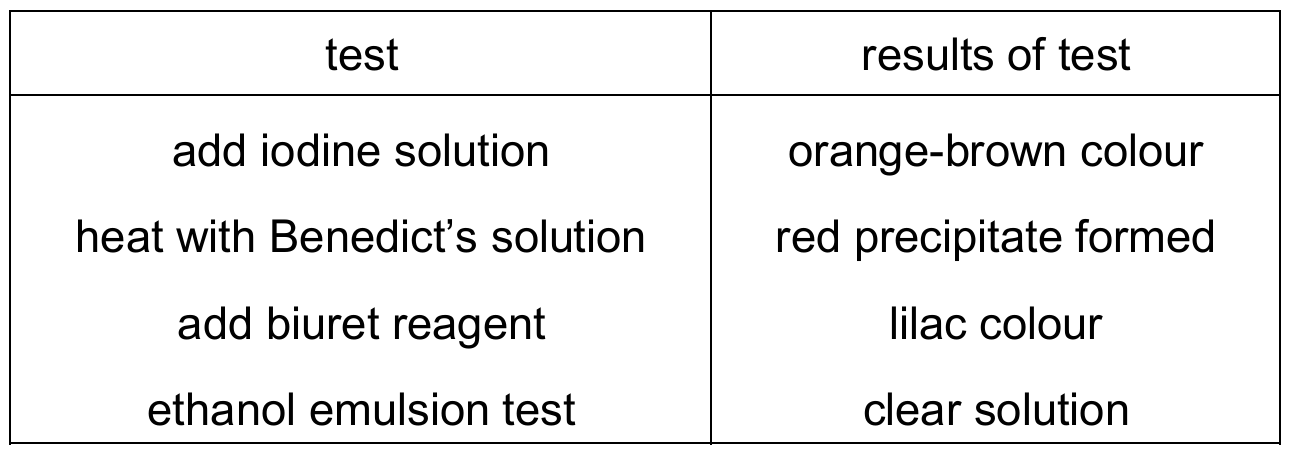
A student tests a sample of food for the presence of different biological molecules. The results of the tests are shown.

Which biological molecules are present in the food?

A. fat and starch
B. reducing sugars and protein
C. reducing sugars and starch
D. starch and protein

▶️ Answer/Explanation
Iodine turning orange-brown (negative) shows no starch. Red precipitate with Benedict’s shows reducing sugars are present. Lilac with biuret shows protein is present. Clear solution with ethanol shows no fat is present.
✅ Answer: (B)

Question

Which biological molecule contains the elements carbon, hydrogen, nitrogen and oxygen?

A. carbohydrate
B. fat
C. oil
D. protein

▶️ Answer/Explanation
Carbohydrates, fats, and oils all contain only carbon (C), hydrogen (H), and oxygen (O); they do not contain nitrogen.
Proteins are built from amino acids which all contain an amino group \((-NH_2)\), meaning they contain carbon, hydrogen, oxygen, and nitrogen (and sometimes sulfur).
✅ Answer: (D)
Scroll to Top