CIE iGCSE Co-Ordinated Science B4. Biological molecules Exam Style Questions Paper 3
Question
- protein
- glycogen
Most-appropriate topic codes (Cambridge IGCSE Co-ordinated Sciences 0654):
• Topic B4.1 — Biological molecules (Part (a)(i), (a)(ii) & (a)(iii))
• Topic B5.1 — Enzymes (Part (b)(i) & (b)(ii))
▶️ Answer/Explanation
(a)(i)
Protein: carbon, hydrogen, oxygen, nitrogen
Glycogen: carbon, hydrogen, oxygen
Proteins are built from amino acid monomers, which all contain C, H, O, and N in their basic structure. Glycogen is a polysaccharide made from glucose monomers, which contain only carbon, hydrogen, and oxygen — the same three elements found in all carbohydrates.
(a)(ii)
glycerol and fatty acids
A fat molecule (triglyceride) is formed when one glycerol molecule bonds to three fatty acid molecules through condensation reactions. Each bond formed is an ester linkage, releasing a water molecule, and the three fatty acids attached may be the same or different depending on the type of fat.
(a)(iii)
Test: Biuret test — add dilute copper(II) sulfate solution followed by sodium hydroxide solution.
Positive result: purple / violet colour
The Biuret reagent reacts with peptide bonds present in all proteins and polypeptides, producing the characteristic purple colour. A negative result (no protein present) leaves the solution blue, which is the colour of the copper(II) sulfate alone.
(b)(i)
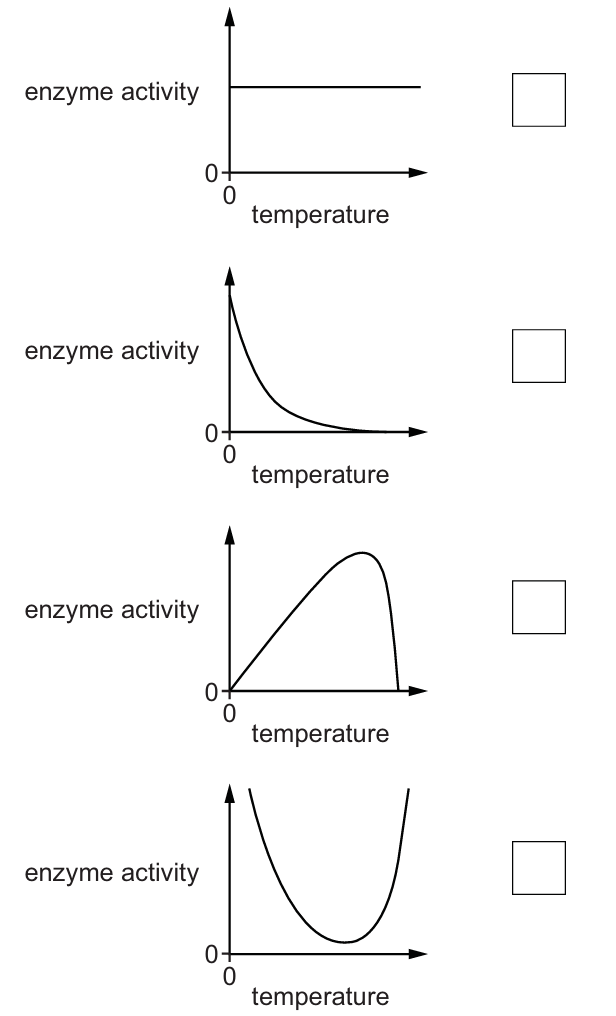
Enzymes are proteins that are involved in all metabolic reactions, where they function as biological catalysts.
Enzymes speed up metabolic reactions by lowering the activation energy required, without being consumed or permanently altered in the process. Their specificity comes from the complementary shape of their active site, which fits only particular substrate molecules.
(b)(ii)
Graph A $(\checkmark)$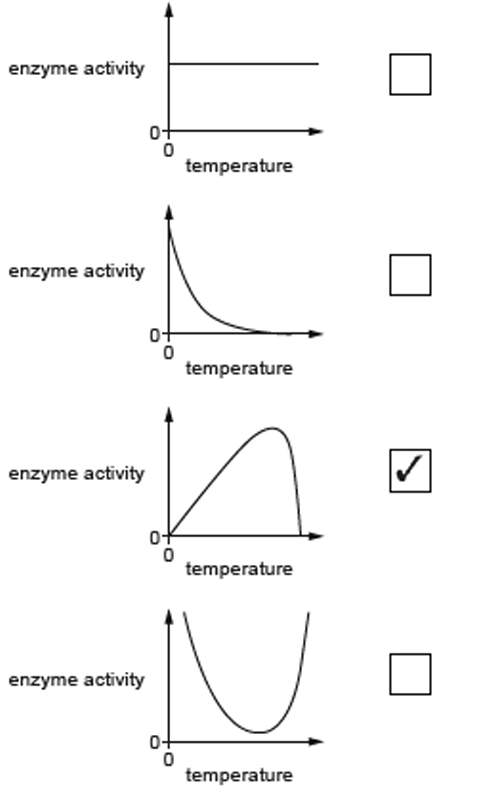
As temperature rises, increased kinetic energy leads to more frequent enzyme–substrate collisions, raising reaction rate up to the optimum temperature. Beyond the optimum, the enzyme’s active site is distorted as hydrogen bonds break down in a process called denaturation, causing an irreversible loss of activity and a sharp decline in reaction rate.
Question
Most-appropriate topic codes (Cambridge IGCSE Coordinated Sciences 0654):
• Topic B7.2 — Digestive system (Part (a)(i), (a)(ii), (a)(iii))
• Topic B4.1 — Biological molecules (Part (b)(i))
• Topic B6.1 — Photosynthesis (Part (b)(ii))
• Topic B3.1 — Diffusion (Part (b)(iii))
▶️ Answer/Explanation
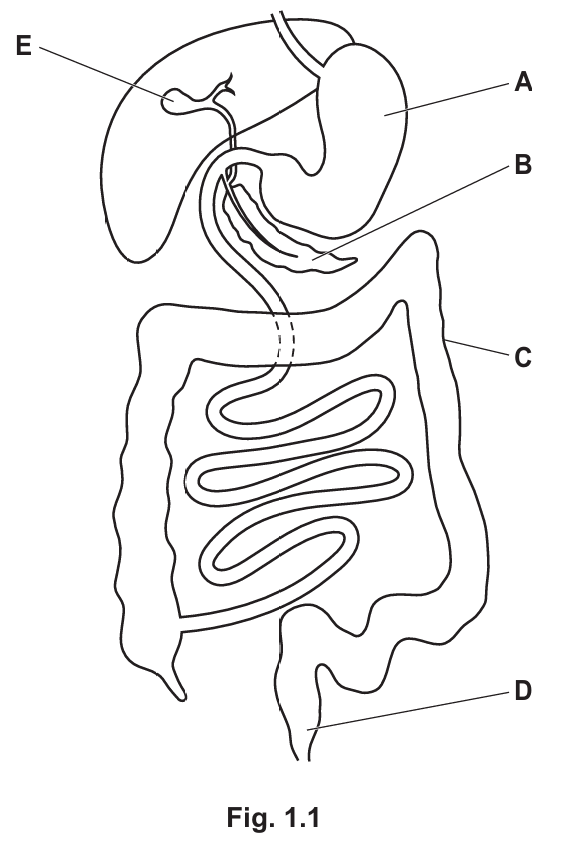
(a)(i) A – stomach; C – large intestine; E – gall bladder
The stomach (A) is a muscular organ that churns food and secretes digestive juices. The large intestine (C) is responsible for absorbing water and forming faeces. The gall bladder (E) stores bile produced by the liver.
(a)(ii) Egestion is the removal of undigested food from the body as faeces
Egestion refers to the elimination of waste material that has not been absorbed during digestion. This is different from excretion, which removes metabolic waste products.
(a)(iii) Insulin
The pancreas (B) produces the hormone insulin, which regulates blood glucose concentration by promoting the uptake of glucose into cells and its conversion to glycogen in the liver.
(b)(i) Test: Heat with Benedict’s solution; Starting colour: Blue; Final colour: Red/orange/yellow/green
Benedict’s solution is a blue reagent that changes colour in the presence of reducing sugars. The final colour depends on the concentration, ranging from green (low) through yellow and orange to red (high concentration).
(b)(ii) Water + carbon dioxide → oxygen + glucose
Photosynthesis uses water and carbon dioxide as raw materials. In the presence of light and chlorophyll, these are converted into glucose (a carbohydrate) and oxygen gas is released as a by-product.
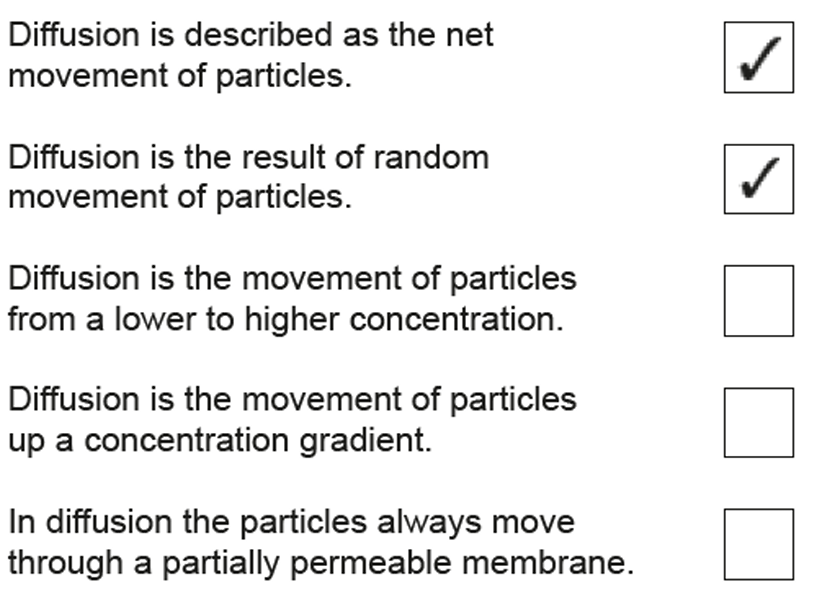
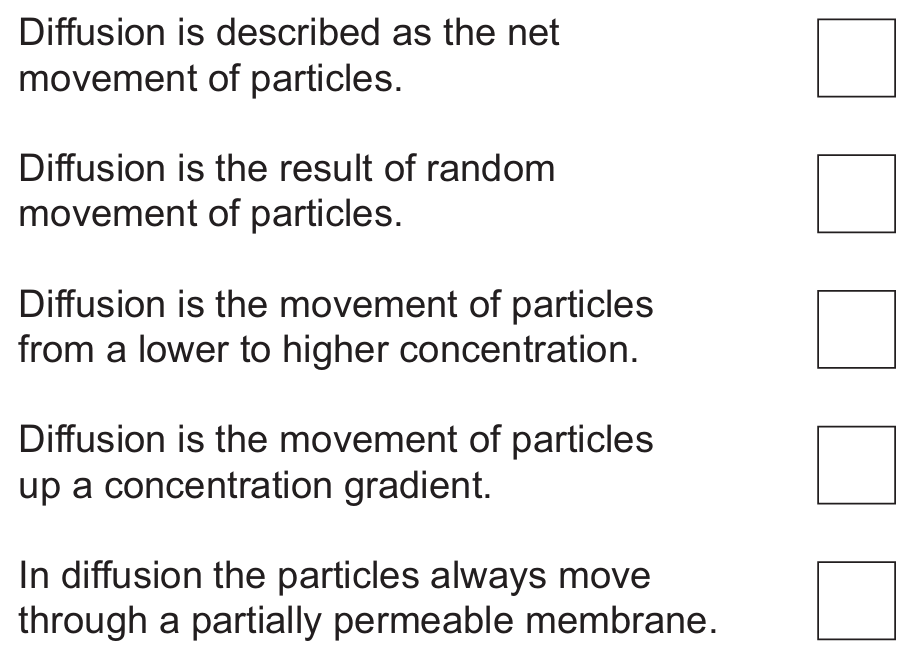
(b)(iii) Ticks in boxes: “Diffusion is the net movement of particles” and “Diffusion is the result of random movement of particles”
Diffusion is the net movement of particles from an area of higher concentration to an area of lower concentration. This occurs because of the random, continuous motion of particles. The other statements describe movement against a concentration gradient (which requires energy) or involve partially permeable membranes (which describes osmosis).