
CIE iGCSE Co-Ordinated Science B4. Biological molecules Exam Style Questions Paper 4
Question
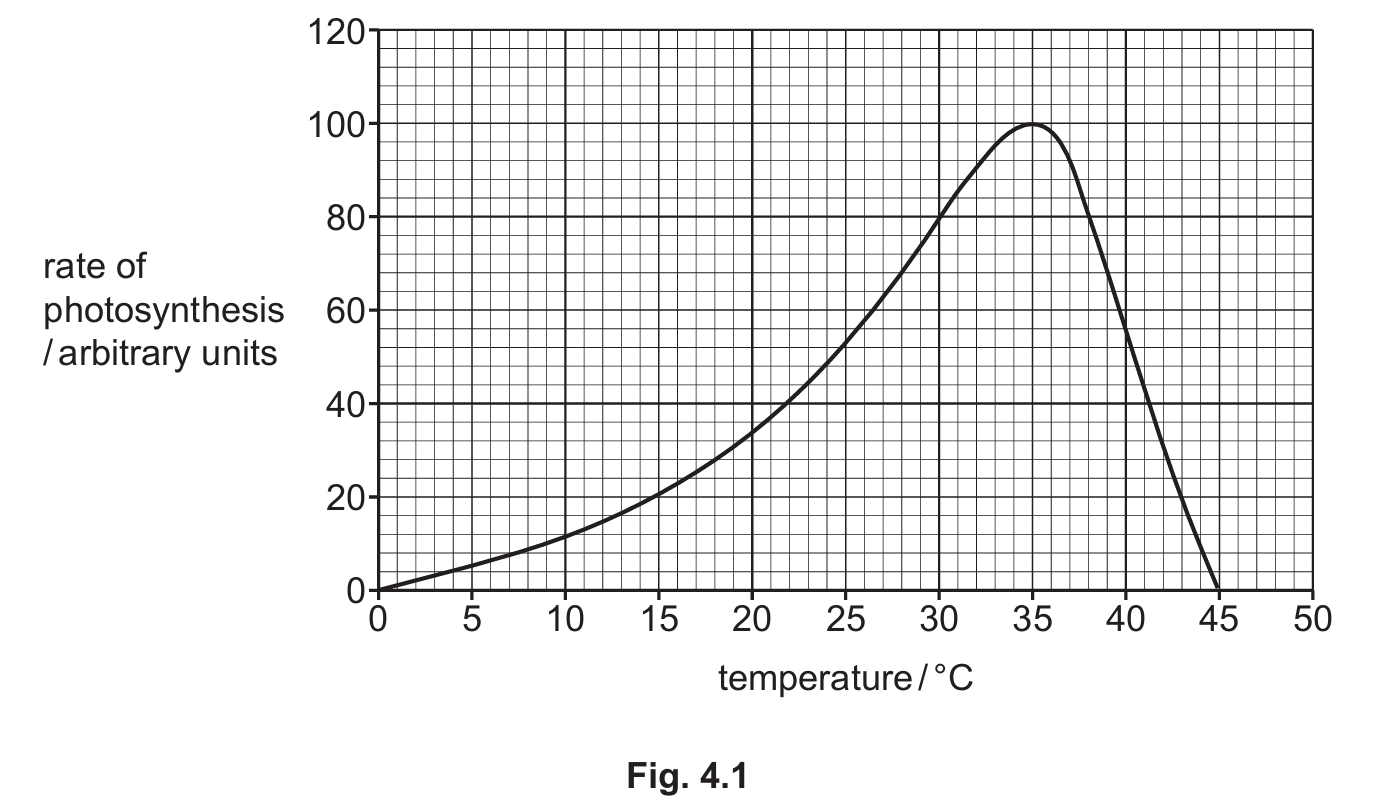
The rate increases because the particles gain more ____ energy causing more ____ collisions.
At 45°C the enzymes are ____. Photosynthesis stops because the ____ of the enzyme has changed shape so the substrate can no longer fit.
During photosynthesis chlorophyll transfers ____ energy into ____ energy.
State the name of the carbohydrate in plants that is used for storage and for transport.
State the name of the cells
- in the leaf that are adapted for efficient photosynthesis
- that are adapted for absorption of water from the soil.
Most-appropriate topic codes (Cambridge IGCSE Co-ordinated Sciences 0654, 2025–2027 syllabus):
• Topic B6.1 — Photosynthesis (Parts (a) and (c))
• Topic B5.1 — Enzymes (Part (b))
• Topic B4.1 — Biological molecules / Topic B8 — Transport in plants (Part (d))
• Topic B2.1 — Cell structure (Part (e))
▶️ Answer/Explanation
(a) \(6CO_2 + 6H_2O \rightarrow C_6H_{12}O_6 + 6O_2\)
Carbon dioxide and water are the reactants, combined using light energy absorbed by chlorophyll.
Glucose and oxygen are the products, and the equation must be balanced on both sides.
(b) 35; kinetic; successful/frequent; denatured; active site
The rate of photosynthesis is highest at the optimum temperature of \(35\,^{\circ}C\), as read from the peak of the graph.
Increasing temperature gives particles more kinetic energy, causing more frequent/successful collisions between enzyme and substrate.
At \(45\,^{\circ}C\) the enzymes are denatured, because the shape of the active site has changed permanently so the substrate can no longer bind.
(c) Light energy into chemical energy
Chlorophyll absorbs light energy from sunlight.
This light energy is converted into chemical energy, stored in the bonds of glucose molecules.
(d) Storage = starch; Transport = sucrose
Glucose made in photosynthesis is converted to starch for storage, since starch is insoluble and does not affect water potential.
Glucose is converted to sucrose for transport around the plant in the phloem, as sucrose is more soluble and stable for translocation.
(e) Palisade mesophyll cells; root hair cells
Palisade mesophyll cells are packed with chloroplasts and are positioned near the top of the leaf for efficient photosynthesis.
Root hair cells have a large surface area, adapting them for efficient absorption of water (and mineral ions) from the soil.
Question
Most-appropriate topic codes (Cambridge IGCSE Co-ordinated Sciences 0654, 2025–2027 syllabus):
• Topic B7.2 — Digestive system (Parts (a), (b))
• Topic B7.1 — Diet (Part (c)(i))
• Topic B4 — Biological molecules (Part (c)(ii))
• Topic B7.3 — Digestion (Part (d))
▶️ Answer/Explanation
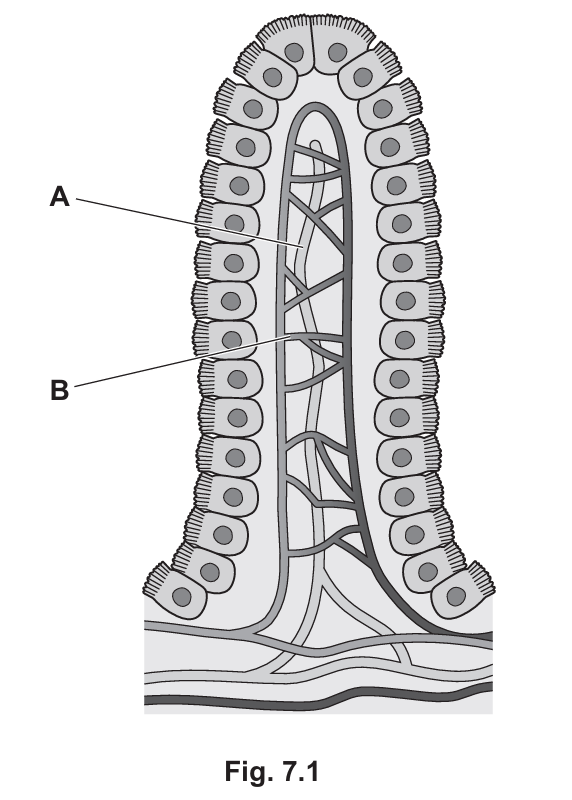
(a)(i) Lacteal — absorption/transport of fat
The structure labelled A at the centre of the villus is the lacteal.
Its function is the absorption and transport of digested fats away from the small intestine.
(a)(ii) Thin walls give a short diffusion distance
Part B, the villus surface/wall, is only one cell thick.
This gives a short diffusion distance for the transfer of digested nutrients into the bloodstream.
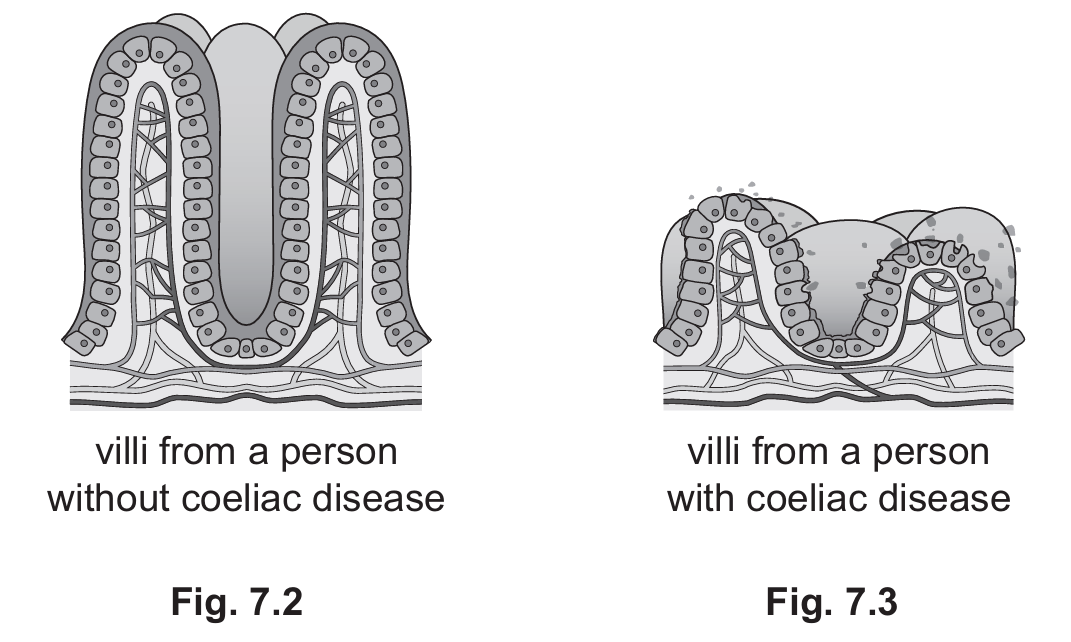
(b)(i) Shorter / flatter / smaller villi
In Fig. 7.3, the villi appear shorter, flatter, and smaller compared to the tall, finger-like villi in Fig. 7.2.
(b)(ii) Less surface area for absorption of nutrients
Flattened villi have a reduced surface area compared to healthy villi.
This decreases the rate of absorption of digested nutrients into the blood, contributing to malnutrition in coeliac disease.
(c)(i) Marasmus / kwashiorkor
Both marasmus and kwashiorkor are diseases caused by protein-energy malnutrition.
(c)(ii) Biuret solution (biuret test)
The biuret test is used to detect the presence of protein in a sample, giving a purple/lilac colour change when protein is present.
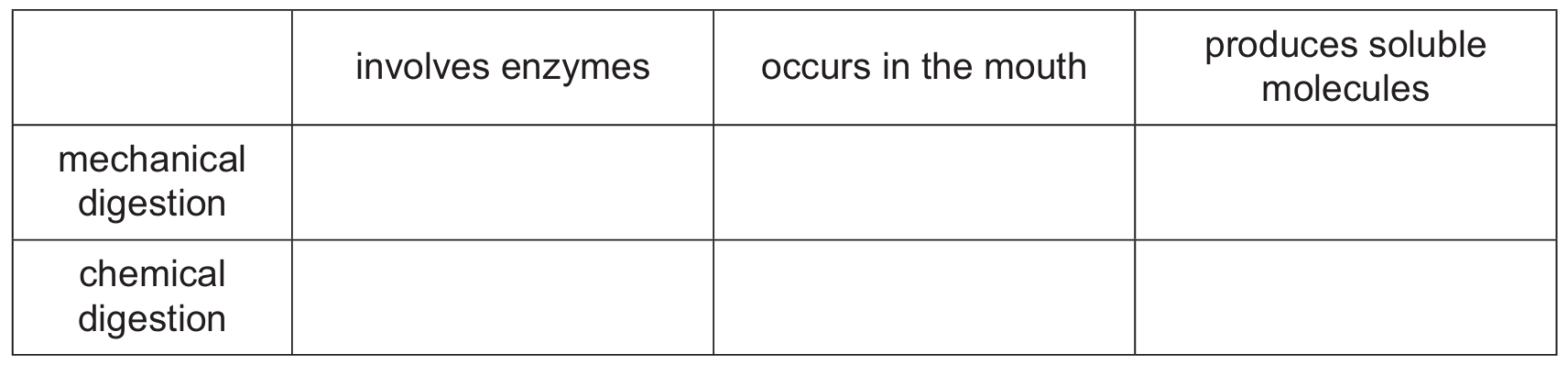
(d) 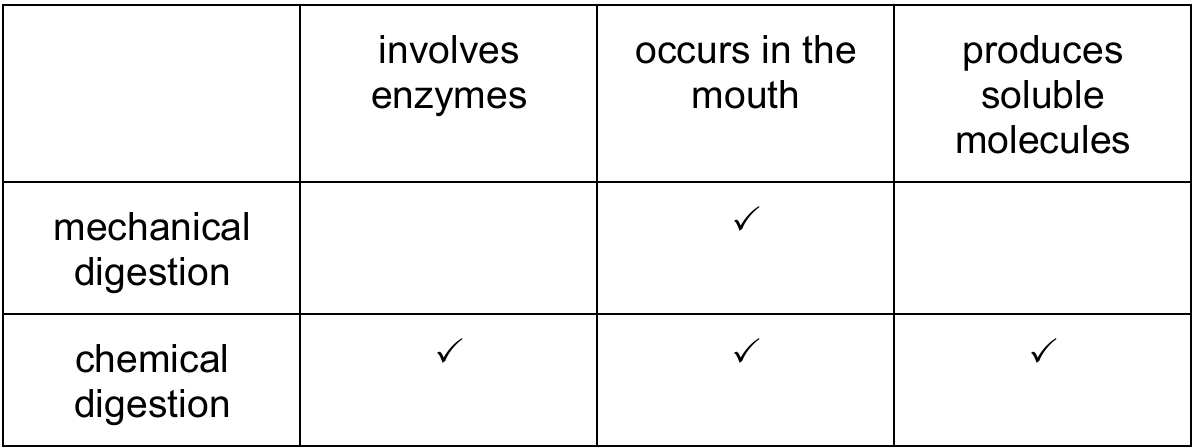
Mechanical digestion (e.g. chewing) physically breaks food into smaller pieces and occurs in the mouth, but does not involve enzymes or directly produce soluble molecules.
Chemical digestion involves enzymes which break down large insoluble molecules into smaller, soluble molecules.