Home / iGCSE / Coordinated Sciences / B5. Enzymes Paper 2

CIE iGCSE Co-Ordinated Science B5. Enzymes Exam Style Questions Paper 2

Question

Which molecule in this reaction has an active site?

A. fat
B. fatty acid
C. glycerol
D. lipase

 
▶️ Answer/Explanation
An active site is a specific region on an enzyme where the substrate binds during a reaction. In this reaction, lipase is the enzyme that catalyzes the breakdown of fat into fatty acids and glycerol. Therefore, lipase is the molecule that contains the active site. Fat is the substrate, and fatty acids and glycerol are the products.
Answer: (D)

Question

Enzyme action stops due to denaturation.

What causes denaturation?

A. A change in shape of the active site of the enzyme that occurs at a temperature that is lower than the optimum temperature.
B. A change in shape of the active site of the substrate that occurs at a temperature that is lower than the optimum temperature.
C. A change in shape of the active site of the enzyme that occurs at a temperature that is higher than the optimum temperature.
D. A change in shape of the active site of the substrate that occurs at a temperature that is higher than the optimum temperature.

▶️ Answer/Explanation
Denaturation is caused by a change in the shape of the enzyme’s active site when the temperature is above the optimum. This alters the complementary shape, preventing the substrate from binding effectively. The substrate itself does not denature.
Answer: (C)

Question

Enzymes work best at an optimum pH. Protease in the stomach works best at pH 1.6.

What is a reason why the activity of protease decreases at pH values greater than 1.6?

A. The enzyme’s active site changes shape.
B. The kinetic energy of the molecules increases.
C. There are more effective collisions.
D. There is a higher substrate concentration.

▶️ Answer/Explanation
Enzymes have an optimum pH at which their active site has the correct shape to bind with the substrate. At pH values significantly higher or lower than the optimum (in this case, greater than 1.6), the hydrogen and ionic bonds maintaining the enzyme’s specific three-dimensional structure are disrupted. This causes the active site to change shape and become denatured, meaning the substrate can no longer fit, thereby decreasing enzyme activity. Options B, C, and D would all increase the rate of reaction, not decrease it.
Answer: (A)

Question

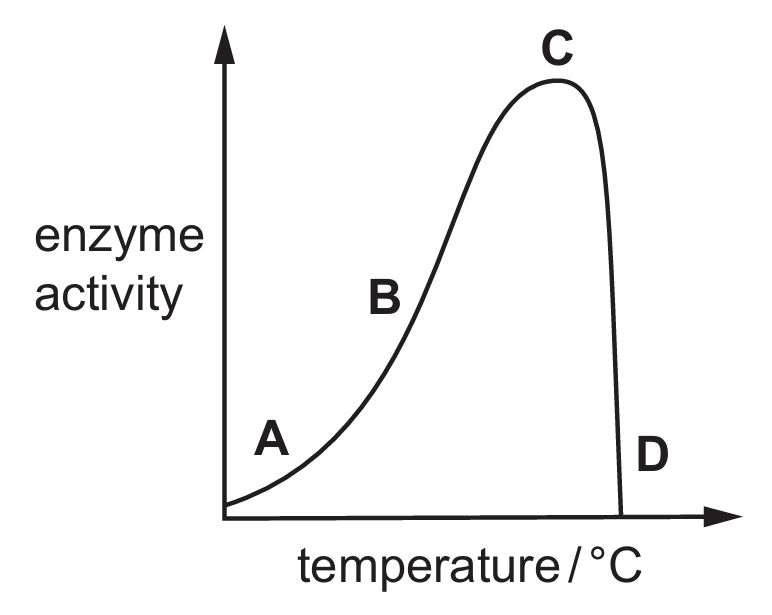
The graph shows the effect of temperature on an enzyme-controlled reaction.

Which point has the highest frequency of effective collisions?

▶️ Answer/Explanation
The frequency of effective collisions is highest at the optimum temperature where enzyme activity is maximal. The graph shows the rate of reaction peaking at point 3. At higher temperatures (point 4), the enzyme denatures and the rate drops despite increased kinetic energy.
Answer: (C)

Question

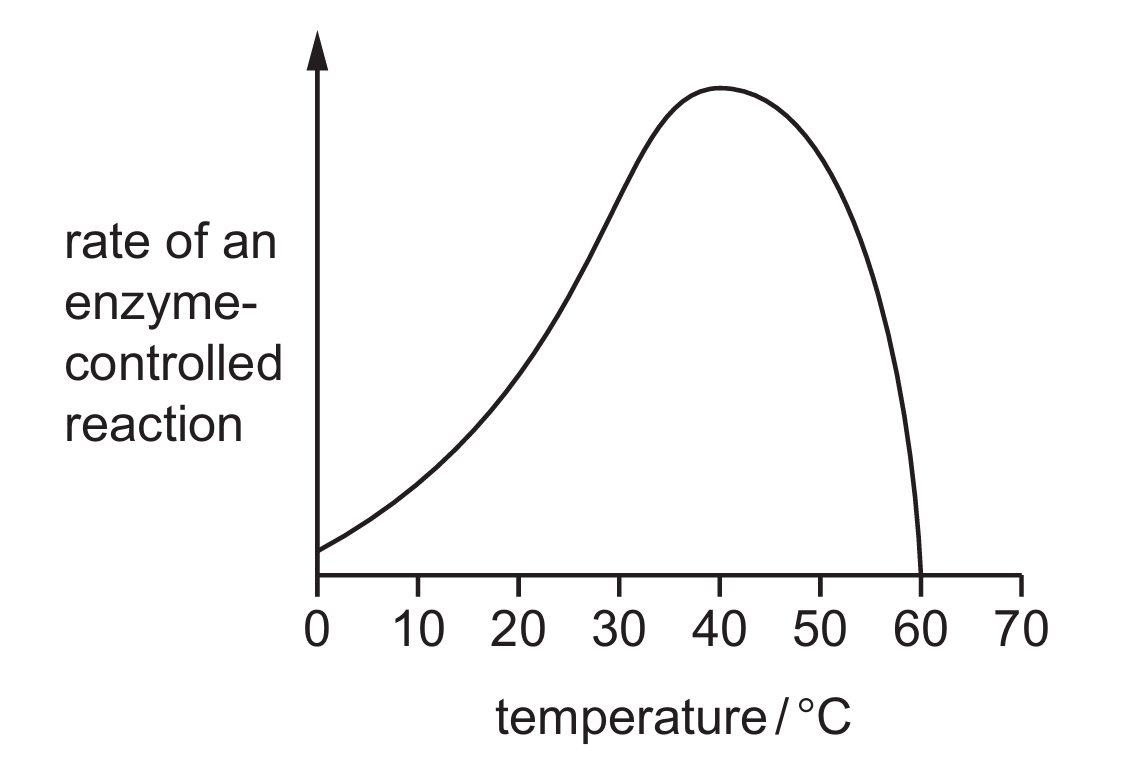
The graph shows the effect of temperature on the rate of an enzyme-controlled reaction.

Which statements are correct?

  1. Enzyme molecules denature above 50 ºC and below 20 ºC.
  2. Increasing the temperature between 10 ºC and 40 ºC increases the kinetic energy of enzyme molecules.
  3. The shape of the active site changes between 40 ºC and 60 ºC.

A. 1, 2 and 3
B. 1 and 2 only
C. 1 and 3 only
D. 2 and 3 only

▶️ Answer/Explanation
Statement 1 is incorrect: the graph shows that the reaction still proceeds below 20 ºC (albeit slowly), so enzymes are not denatured below 20 ºC — they simply have lower kinetic energy and activity.
Statement 2 is correct: increasing temperature gives molecules more kinetic energy, so enzyme-substrate collisions are more frequent between 10 ºC and 40 ºC.
Statement 3 is correct: above 40 ºC the rate falls because heat causes the enzyme’s tertiary structure to break down, changing the shape of the active site (denaturation).
Answer: (D)
Scroll to Top