
CIE iGCSE Co-Ordinated Science B5. Enzymes Exam Style Questions Paper 4
Question
Most-appropriate topic codes (Cambridge IGCSE Co-ordinated Sciences 0654):
• Topic B5.1 — Enzymes (Part (a)(i), (a)(ii), (b)(i), (b)(ii))
• Topic B7.3 — Digestion (Part (c))
▶️ Answer/Explanation
(a)(i) Any two from:
- Salivary glands
- Pancreas
- Small intestine
Amylase is an enzyme that digests starch. It is produced in three main locations: the salivary glands (where it is secreted into the mouth and begins starch digestion), the pancreas (where it is secreted into the small intestine), and the small intestine itself (where it continues starch digestion).
(a)(ii) Amylase breaks down starch to simple reducing sugars.
Amylase catalyses the breakdown of starch (a large insoluble polysaccharide) into smaller soluble molecules called reducing sugars, specifically maltose, which is then further broken down into glucose.
(b)(i) As temperature increases from 15°C to 35°C:
- The enzyme and substrate particles have more kinetic energy.
- This leads to an increased frequency of effective collisions between enzyme and substrate molecules.
- More enzyme-substrate complexes are formed, increasing the rate of reaction.
Increasing temperature from 15°C to 35°C gives enzyme and substrate molecules more kinetic energy. They move faster and collide more frequently. The collisions are more likely to be effective because the molecules have sufficient energy to overcome the activation energy barrier, leading to a higher rate of enzyme-substrate complex formation and faster breakdown of starch.
(b)(ii) At 55°C, the amylase does not break down any starch because:
- The enzyme becomes denatured.
- The active site changes shape and is no longer complementary to the substrate.
- Enzyme-substrate complexes can no longer be formed.
At 55°C, the temperature is too high for the enzyme. The increased kinetic energy causes the weak bonds (hydrogen bonds, ionic bonds) holding the enzyme’s tertiary structure to break. This causes the enzyme to denature, and its active site changes shape. The active site is no longer complementary to the starch substrate, so the enzyme cannot bind to it. No enzyme-substrate complexes form, and therefore no reaction occurs.
(c) Any two roles of bile:
- Neutralises the acidic mixture of food and gastric juices entering the duodenum from the stomach.
- Provides a suitable pH (alkaline) for enzyme action in the small intestine.
- Emulsifies fats / lipids, breaking them into smaller droplets.
- Increases the surface area of fats for lipase to act on during chemical digestion.
Bile is produced by the liver and stored in the gall bladder. It is released into the duodenum. Bile has two main functions: (1) It neutralises the acidic chyme from the stomach, providing the alkaline pH needed for pancreatic enzymes to work optimally. (2) It emulsifies fats by breaking large fat droplets into smaller ones (physical digestion), which greatly increases the surface area available for lipase enzymes to chemically digest the fats.
Question
• sink.
Most-appropriate topic codes (Cambridge IGCSE Co-ordinated Sciences 0654):
• Topic B8.4 — Translocation (Part (a))
• Topic B5.1 — Enzymes (Parts (b) & (c))
▶️ Answer/Explanation
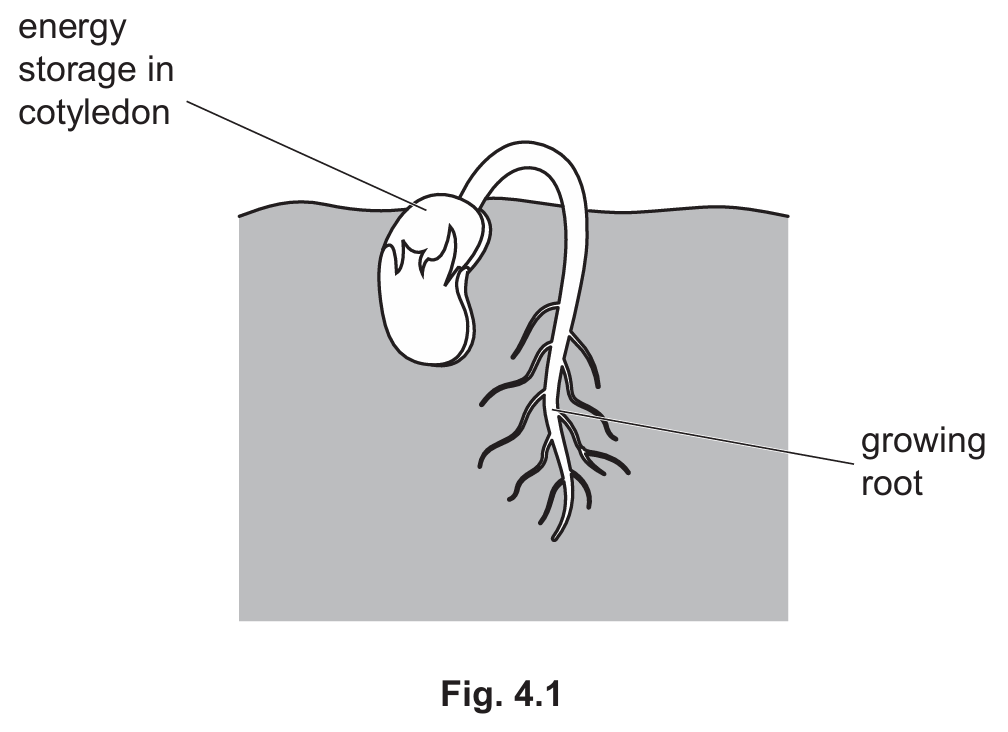
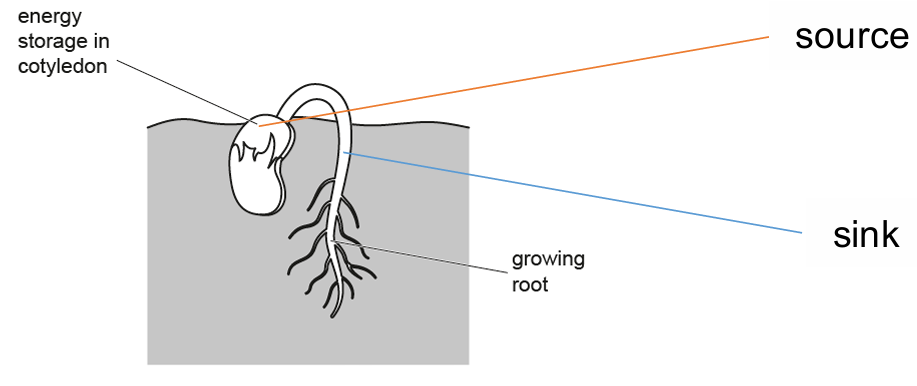
(a) Source label to the cotyledons; Sink label to the roots.
The cotyledons act as the source because they store sucrose and amino acids which are transported away. The growing roots act as the sink because they receive and use these substances for growth and respiration.
(b) Three reasons why seeds need amylase:
• Starch in seeds acts as an energy store for the growing embryo.
• Starch is a large, insoluble molecule and cannot be transported out of the cotyledons.
• Amylase breaks down starch into simple reducing sugars (such as maltose/glucose).
• These sugars are used in respiration to release energy needed for growth of the seedling.
• The soluble sugars can be transported to the growing regions.
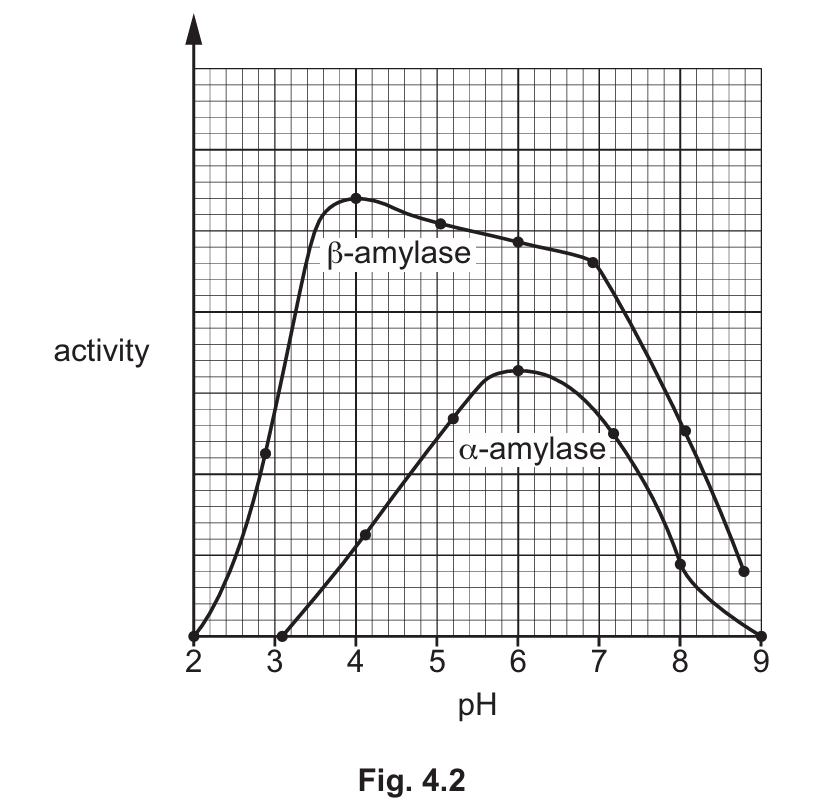
(c)(i) Two comparative differences:
• α-amylase has a narrow, single optimum pH (around pH 7), whereas β-amylase is active across a broader pH range (approximately pH 4–10).
• α-amylase has higher activity at its optimum pH compared to β-amylase at its optimum.
• α-amylase activity drops sharply away from its optimum pH, while β-amylase shows more gradual changes in activity.
(c)(ii) At pH 9, α-amylase shows very low activity or no activity because the enzyme is denatured.
The pH is outside the enzyme’s optimum range, causing the active site to change shape. The active site is no longer complementary in shape to the starch substrate, so enzyme-substrate complexes cannot form effectively.
(c)(iii) β-amylase needs to be active over a wider pH range because it works outside bacterial cells.
In the human body (where α-amylase works), the pH is maintained relatively constant (e.g., in the small intestine). However, outside bacterial cells, the pH of the environment can vary considerably, so β-amylase must function effectively across a wider range of pH values to digest food in different conditions.