Home / iGCSE / Coordinated Sciences / B6.1 Photosynthesis Paper 2

CIE iGCSE Co-Ordinated Science B6.1 Photosynthesis Exam Style Questions Paper 2

Question

Plants do not grow well when they are deficient in magnesium ions.

What is the reason for this?

A. increased water uptake from the soil
B. not able to synthesise proteins from carbohydrates
C. reduced diffusion of carbon dioxide into the leaf
D. reduced production of chlorophyll

▶️ Answer/Explanation
Magnesium ions are a central component of the chlorophyll molecule. Without sufficient magnesium, plants cannot produce enough chlorophyll, leading to yellowing of leaves (chlorosis) and reduced photosynthesis. This directly limits growth, unlike the other options.
Answer: (D)

Question

Plants need magnesium ions and nitrate ions.

Which statements correctly show what the plants make using these ions?

  1. Magnesium ions are needed for making amino acids.
  2. Nitrate ions are needed for making amino acids.
  3. Magnesium ions are needed for making chlorophyll.
  4. Nitrate ions are needed for making chlorophyll.

A. 1 and 4
B. 2 and 3
C. 2 only
D. 4 only

▶️ Answer/Explanation
Nitrate ions provide the nitrogen needed to make amino acids, which are then built into proteins.
Magnesium ions are needed to make chlorophyll, the pigment used in photosynthesis.
So statement 2 (nitrate → amino acids) and statement 3 (magnesium → chlorophyll) are both correct.
Answer: (B)

Question

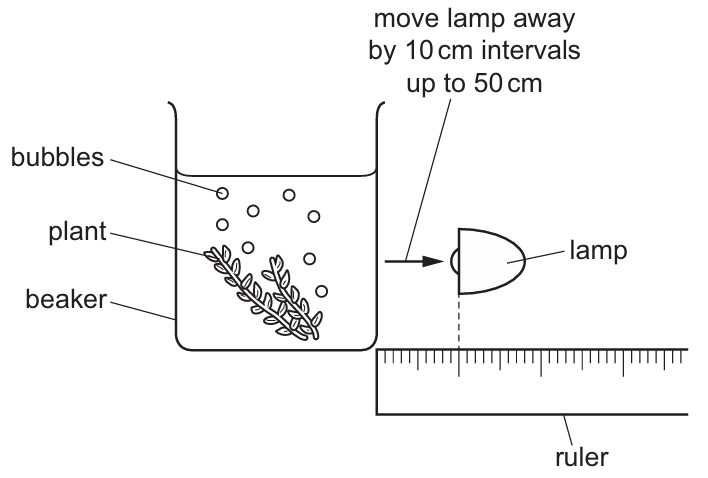
An experiment is set up to investigate the effect of changing the light intensity on the rate of photosynthesis.

The lamp is moved in \(10\text{ cm}\) intervals away from the plant and the number of bubbles of gas recorded in \(60\) seconds.

What will be the result of moving the lamp further away from the beaker containing the plant?

A. The number of bubbles of carbon dioxide will decrease.
B. The number of bubbles of carbon dioxide will increase.
C. The number of bubbles of oxygen will decrease.
D. The number of bubbles of oxygen will increase.

▶️ Answer/Explanation
Photosynthesis follows \(6CO_2 + 6H_2O \xrightarrow{\text{light}} C_6H_{12}O_6 + 6O_2\), and light intensity is a limiting factor for this reaction.
Moving the lamp further away reduces light intensity, so the rate falls and fewer bubbles of \(O_2\) (the gas produced) are released.
Answer: (C)

Question

The graph shows the effect of increasing light intensity on the rate of photosynthesis of a submerged aquatic plant.

Which factor is limiting the rate of photosynthesis at X?

A. carbon dioxide concentration
B. humidity
C. light intensity
D. temperature

▶️ Answer/Explanation
At point X, the rate of photosynthesis is still rising as light intensity increases, showing light is limiting.
Once the graph plateaus at higher light intensities, a different factor (e.g. \(CO_2\)) becomes limiting instead.
Answer: (C)

Question

The diagram shows some of the uses in a plant of the initial carbohydrate made by photosynthesis.

Which statement is correct?

A. X is a magnesium ion.
B. X is iron.
C. Y is starch.
D. Y is an oil molecule.

▶️ Answer/Explanation
Glucose molecules made in photosynthesis can be joined together to form starch, which is the plant’s main storage carbohydrate.
X represents the addition of a nitrogen-containing substance (such as nitrate ions) needed to convert glucose into amino acids, so X is not magnesium or iron.
Y, formed by joining many glucose molecules, is therefore starch and not an oil molecule.
Answer: (C)
Scroll to Top