
CIE iGCSE Co-Ordinated Science B6.1 Photosynthesis Exam Style Questions Paper 4
Question
Most-appropriate topic codes (Cambridge IGCSE Co-ordinated Sciences 0654):
• Topic B3.3 — Active transport (Part (a)(i))
• Topic B6.1 — Photosynthesis / Mineral ions (Part (a)(ii))
• Topic B3.2 — Osmosis (Part (b)(i) & (b)(ii))
▶️ Answer/Explanation
(a)(i) Active transport is the movement of particles through a cell membrane from a region of lower concentration to a region of higher concentration (against the concentration gradient), using energy from respiration.
This process requires energy because substances are moved in the opposite direction to diffusion, from where they are less concentrated to where they are more concentrated.
(a)(ii) Magnesium ions: Required for the production of chlorophyll.
Nitrate ions: Required for the production of amino acids (and proteins / DNA / RNA).
Magnesium is a central component of the chlorophyll molecule, while nitrate ions provide nitrogen needed to build amino acids, the building blocks of proteins.
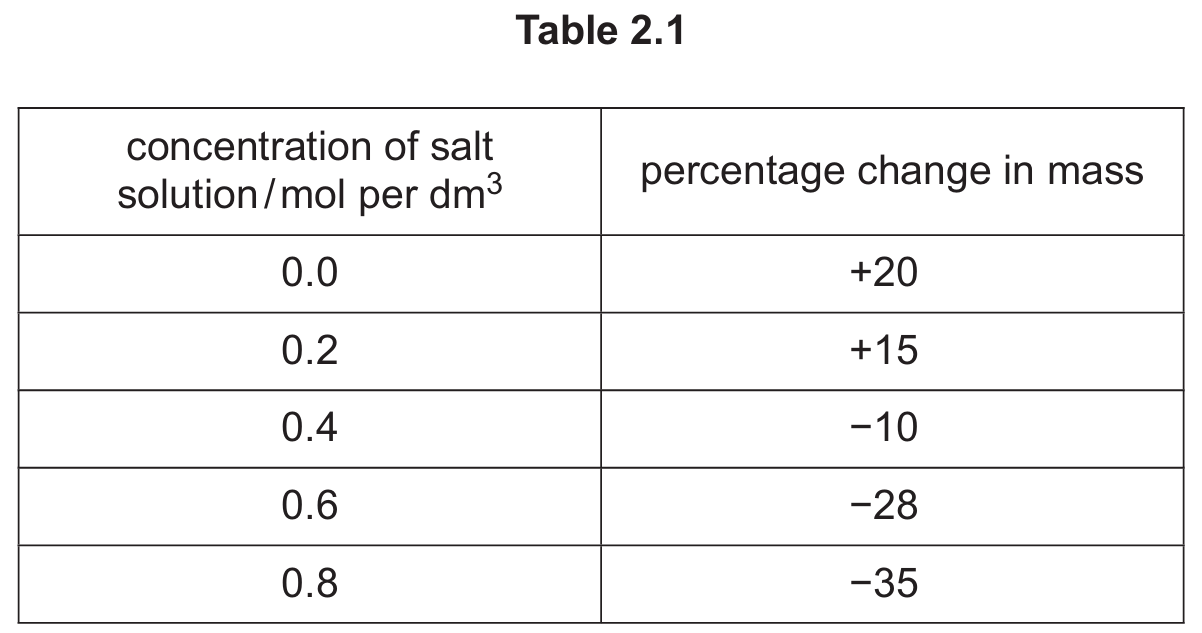
(b)(i) Water enters the carrot cells by osmosis, from a region of higher water potential (pure water outside) to a region of lower water potential (inside the cells), through a partially permeable membrane.
The +20% change in mass shows water has moved into the cells, making them heavier and more turgid because the pure water outside has a higher water potential than the cell sap.
(b)(ii) The cells become flaccid / smaller with a smaller vacuole; they are plasmolysed, meaning the cell membrane has pulled away from the cell wall.
In the concentrated salt solution (0.8 mol/dm³), water leaves the cells by osmosis, causing the protoplast to shrink and pull away from the rigid cell wall.
Question
Topic codes:
• Topic B6.1 — Photosynthesis (Part (a) & (b))
• Topic B5.1 — Enzymes (Part (c))
▶️ Answer/Explanation
(a) \(6\text{CO}_2 + 6\text{H}_2\text{O} \rightarrow \text{C}_6\text{H}_{12}\text{O}_6 + 6\text{O}_2\)
The balanced symbol equation for photosynthesis shows that six molecules of carbon dioxide react with six molecules of water in the presence of light energy and chlorophyll to produce one molecule of glucose and six molecules of oxygen.
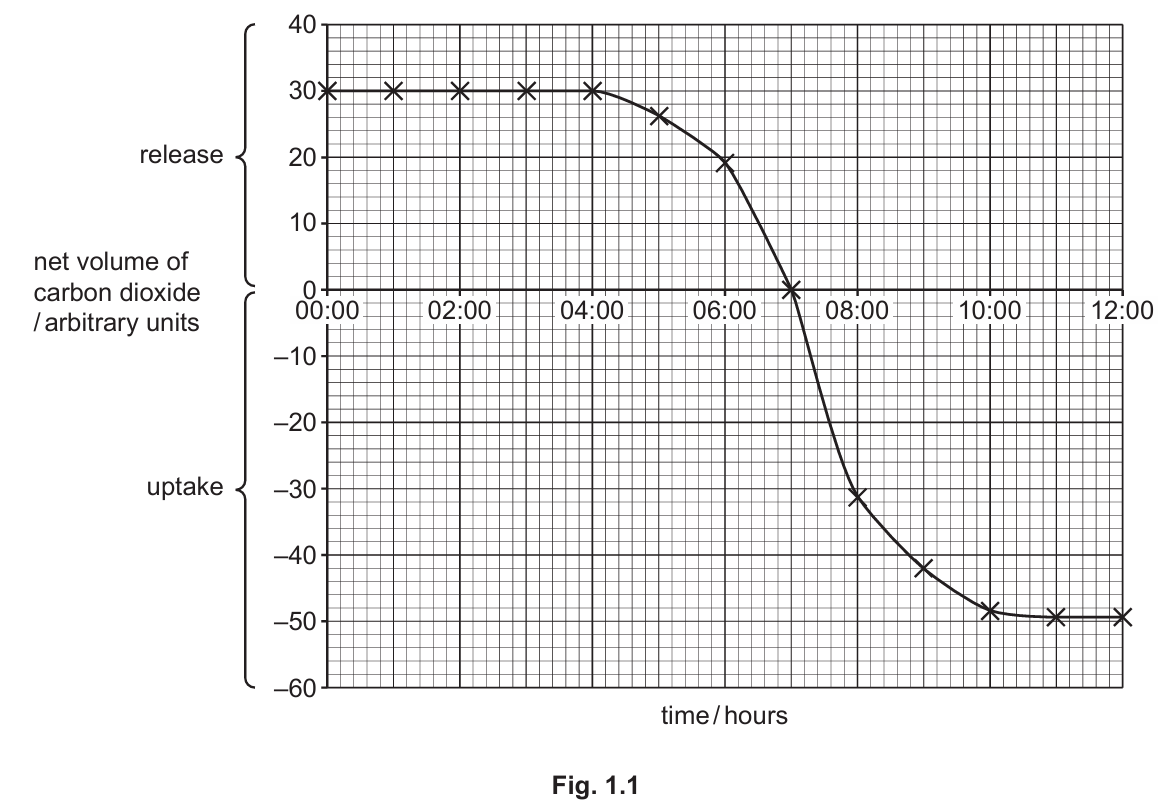
(b) Process X is respiration.
There is no photosynthesis at midnight because there is no light energy available at night.
Between 05:00 – 10:00 hours, the rate of photosynthesis increases as energy becomes available during the day.
The rate of photosynthesis equals the rate of process X at 07:00 hours.
At this time, the net carbon dioxide exchange is zero because the rate of carbon dioxide uptake by photosynthesis exactly matches the rate of carbon dioxide release by respiration.
(c) The lower temperature results in less uptake of carbon dioxide because the rate of photosynthesis is slower / photosynthesis is limited by temperature.
At lower temperatures, the enzyme molecules have less kinetic energy, so they move more slowly.
This leads to a lower frequency of effective / successful collisions between enzyme and substrate molecules, reducing the rate of photosynthesis and therefore the net volume of carbon dioxide
uptake.
The graph levels out at −40 instead of −60 because the maximum rate of photosynthesis is reduced at the lower temperature.