
▶️ Answer/Explanation
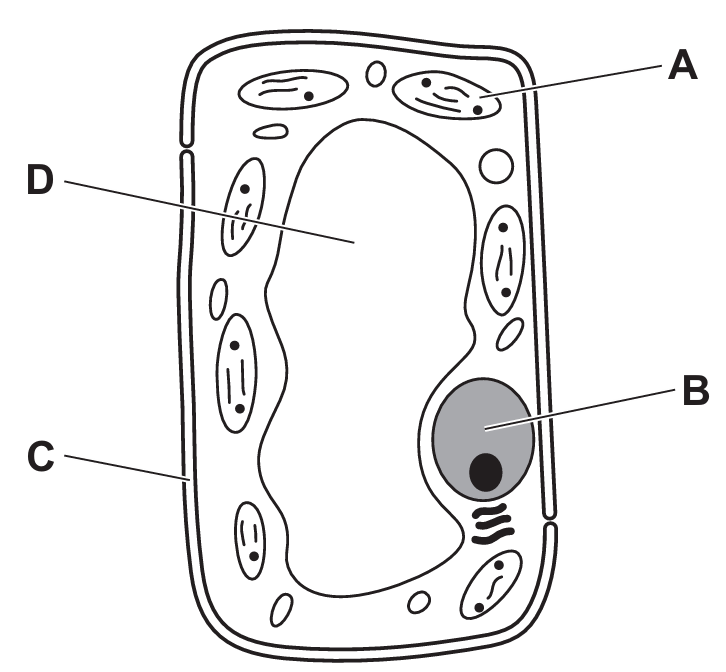
Photosynthesis occurs in the chloroplast, the green organelle found in plant cells that contains the pigment chlorophyll, which absorbs light energy.
The overall equation is \(\text{CO}_2 + \text{H}_2\text{O} \xrightarrow{\text{light}} \text{glucose} + \text{O}_2\); all stages (light-dependent and light-independent reactions) take place within the chloroplast.
✅ Answer: (A)
The overall equation is \(\text{CO}_2 + \text{H}_2\text{O} \xrightarrow{\text{light}} \text{glucose} + \text{O}_2\); all stages (light-dependent and light-independent reactions) take place within the chloroplast.
✅ Answer: (A)
▶️ Answer/Explanation
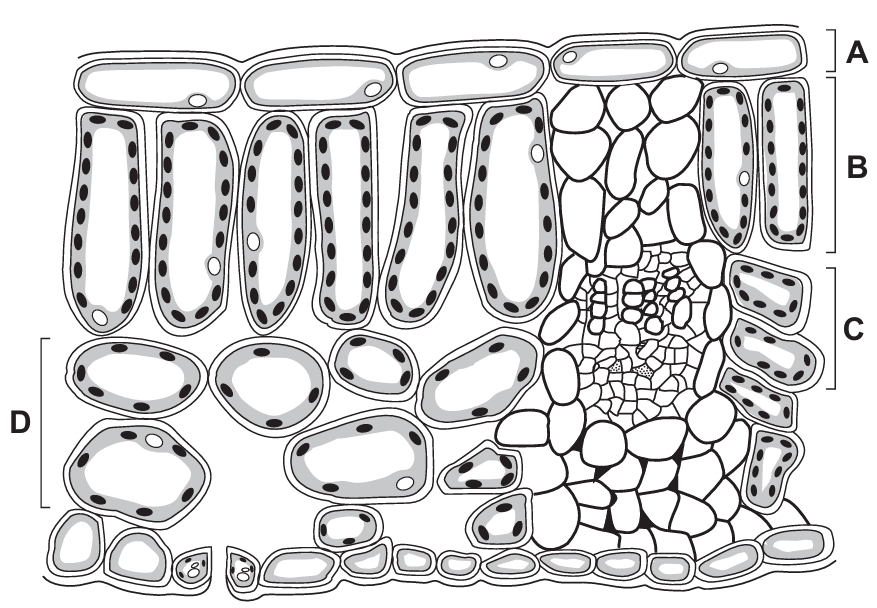
The spongy mesophyll layer contains loosely packed cells with large interconnected air spaces.
These air spaces allow carbon dioxide and oxygen to diffuse easily to and from the mesophyll cells, and out through the stomata.
This makes it the tissue best adapted for gas exchange, labelled D in the diagram.
✅ Answer: (D)
These air spaces allow carbon dioxide and oxygen to diffuse easily to and from the mesophyll cells, and out through the stomata.
This makes it the tissue best adapted for gas exchange, labelled D in the diagram.
✅ Answer: (D)
▶️ Answer/Explanation
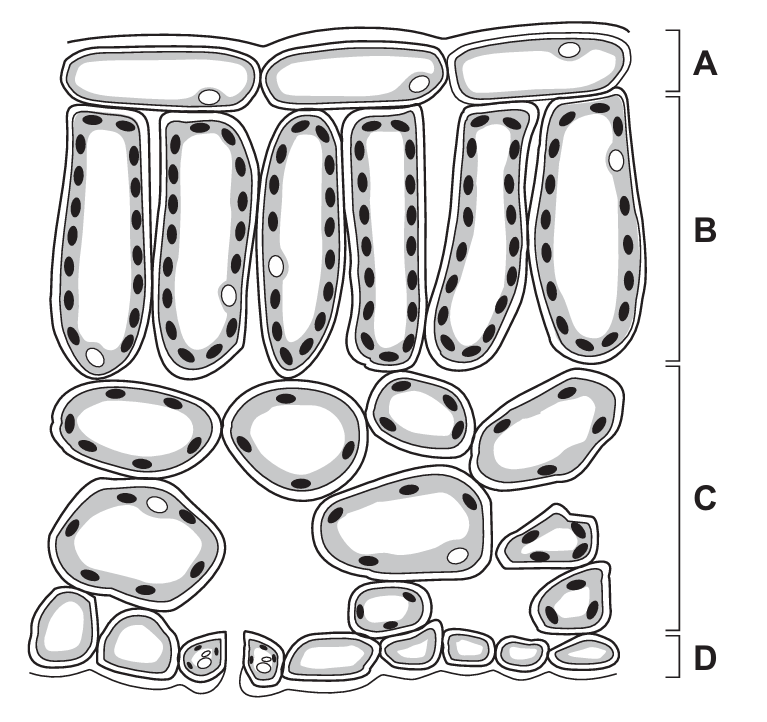
Layer A is the upper epidermis, and layer B shows tall, tightly packed columnar cells — the palisade mesophyll.
Layer C shows loosely packed, irregularly shaped cells with air spaces between them — this is the spongy mesophyll.
Layer D is the lower epidermis.
✅ Answer: (C)
Layer C shows loosely packed, irregularly shaped cells with air spaces between them — this is the spongy mesophyll.
Layer D is the lower epidermis.
✅ Answer: (C)
▶️ Answer/Explanation
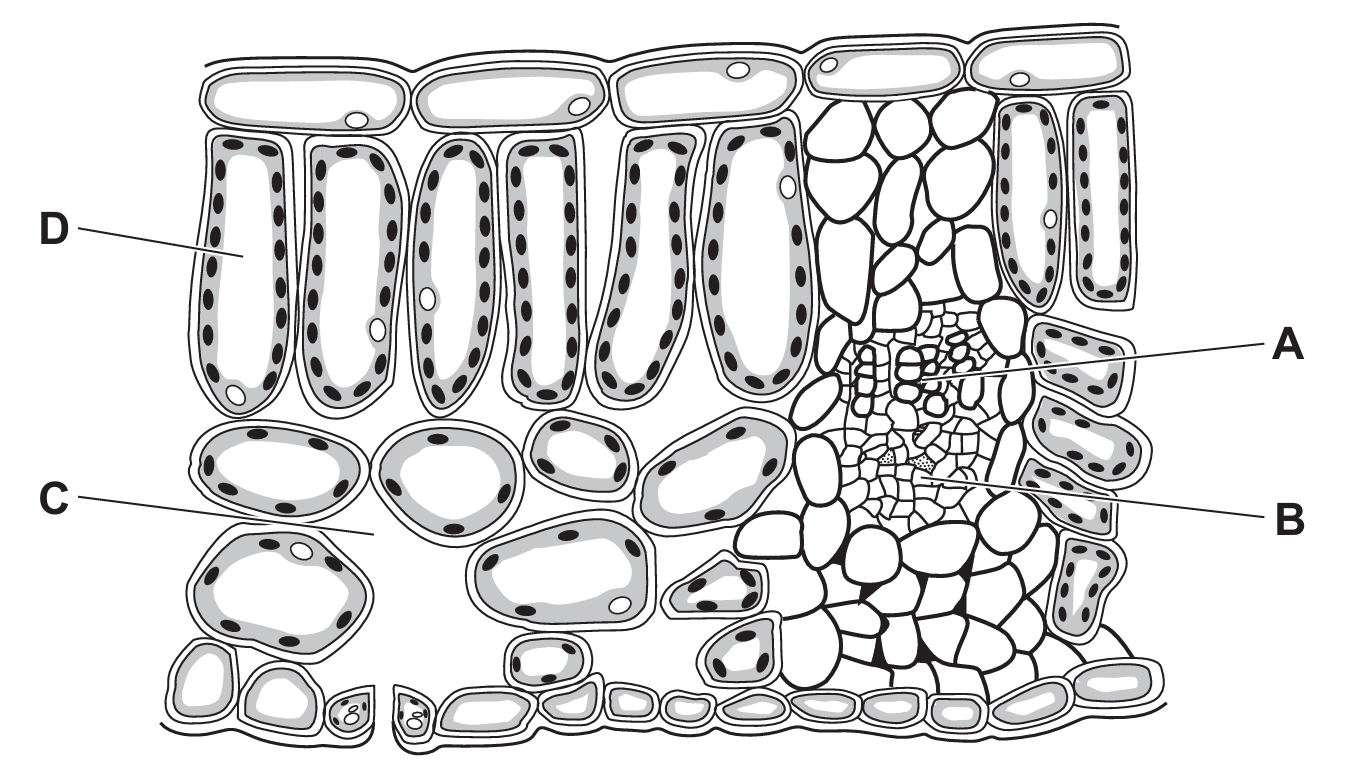
Oxygen produced during photosynthesis diffuses out of the leaf through stomata, which are pores surrounded by guard cells. The labelled part that forms these pores allows gas exchange.
✅ Answer: (C) (Stomata/guard cells)
✅ Answer: (C) (Stomata/guard cells)
▶️ Answer/Explanation
Photosynthesis occurs in the chloroplast, the green organelle found in plant cells that contains the pigment chlorophyll, which absorbs light energy.
The overall equation is \(\text{CO}_2 + \text{H}_2\text{O} \xrightarrow{\text{light}} \text{glucose} + \text{O}_2\); all stages (light-dependent and light-independent reactions) take place within the chloroplast.
✅ Answer: (A)
The overall equation is \(\text{CO}_2 + \text{H}_2\text{O} \xrightarrow{\text{light}} \text{glucose} + \text{O}_2\); all stages (light-dependent and light-independent reactions) take place within the chloroplast.
✅ Answer: (A)
Question
The diagram shows a cross-section of a leaf of a plant.
The leaf is adapted to float on water with the upper epidermis exposed to the air.

Which statement explains one adaptation visible in the diagram?
(A) Guard cells in the lower epidermis are always closed to stop water escaping the leaf.
(B) The palisade mesophyll cells are next to the lower epidermis to maximise photosynthesis.
(C) The stomata are in the upper epidermis so that gas exchange with the air can take place.
(D) There is no cuticle in the upper epidermis to prevent water entering the leaf.
▶️Answer/Explanation
Ans : C