
CIE iGCSE Co-Ordinated Science B6.2 Leaf structure Exam Style Questions Paper 3
Question
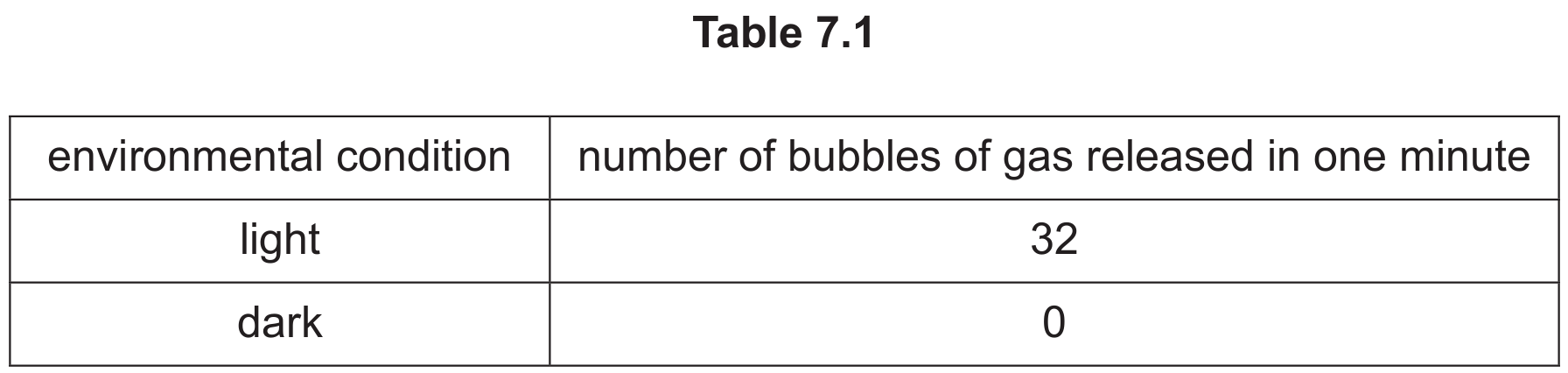
(i) Complete the sentences to explain the results shown in Table 7.1:
The aquatic plant releases more bubbles of ……………… gas when kept in the light.
This is because the process of ……………… requires energy from light.
This energy is used to react the raw materials ……………… and ……………… .
This process takes place in plant cell structures called ……………… .
Most-appropriate topic codes (Cambridge IGCSE Co-ordinated Sciences 0654):
• Topic B6.1 — Photosynthesis (Part (a)(i))
• Topic B13.1 — Coordination and response — tropisms (Part (a)(ii))
• Topic B6.2 — Leaf structure (Part (b)(i))
• Topic B8.1 — Xylem and phloem (Part (b)(ii))
• Topic B6.1 — Photosynthesis, mineral requirements (Part (c))
▶️ Answer/Explanation
(a)(i) oxygen; photosynthesis; carbon dioxide and water; chloroplasts.
The bubbles released are oxygen gas, a product of photosynthesis that occurs only in the light.
Photosynthesis uses light energy to convert carbon dioxide and water into glucose and oxygen: \(6\text{CO}_2 + 6\text{H}_2\text{O} \rightarrow \text{C}_6\text{H}_{12}\text{O}_6 + 6\text{O}_2\).
This process takes place in the chloroplasts, which contain the green pigment chlorophyll that absorbs light energy.
(a)(ii) phototropism
Phototropism is the directional growth response of a plant in response to the stimulus of light.
Shoots grow towards the light (positive phototropism), controlled by the redistribution of the hormone auxin.
Auxin accumulates on the shaded side, causing cells there to elongate more, bending the shoot towards the light.
(b)(i) (upper) epidermis
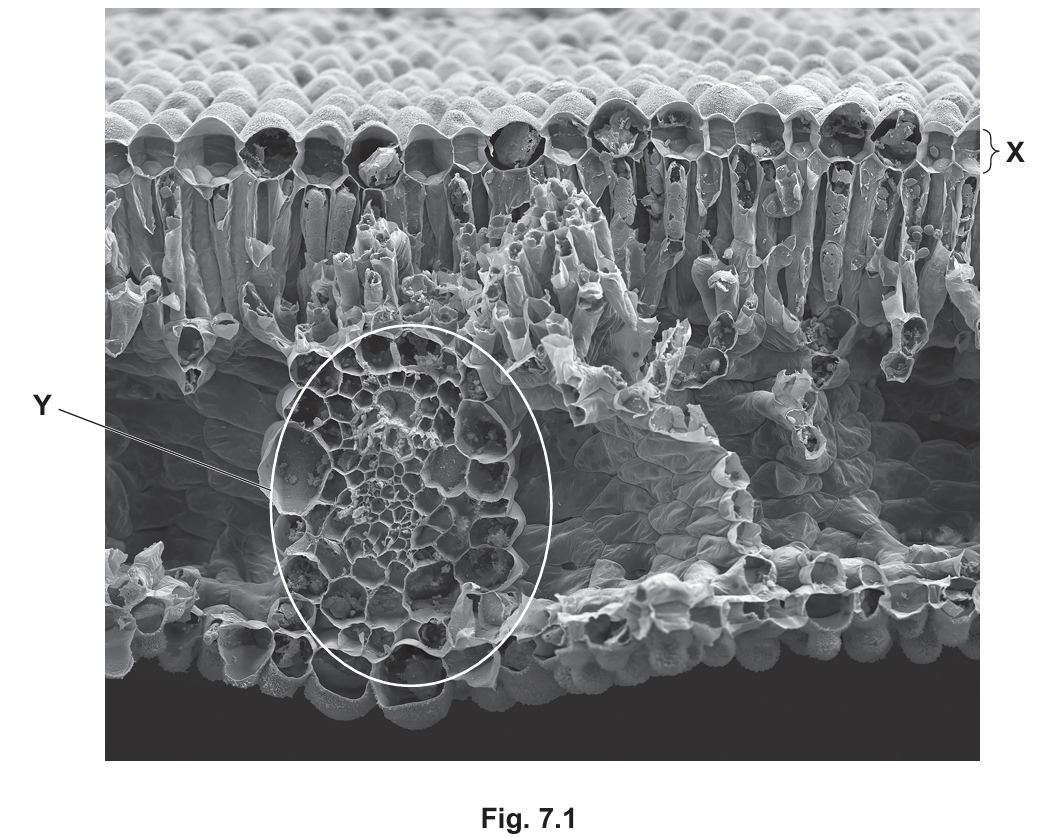
The upper epidermis is the outermost layer of cells on the upper surface of the leaf, labelled X in Fig. 7.1.
It is usually one cell thick and transparent, allowing light to pass through to the photosynthetic mesophyll cells below.
It is covered by a waxy cuticle that reduces water loss by evaporation from the leaf surface.
(b)(ii) name 1: xylem — function: transports water (and mineral ions) from roots to leaves / provides support;
name 2: phloem — function: transports dissolved sugars (from leaves to other parts of the plant / translocation).
Xylem is made of hollow dead cells forming tubes that carry water and dissolved minerals upward from the roots.
Phloem consists of living sieve tube cells and companion cells that transport dissolved organic substances (mainly sucrose) to all parts of the plant.
Both tissues are found together in vascular bundles (labelled Y), which run throughout the leaf blade.
(c) Nitrates are required to synthesise amino acids (which are then used to make proteins).
Plants absorb nitrate ions \((\text{NO}_3^-)\) from the soil through their roots by active transport.
Nitrate ions provide the nitrogen atoms needed to convert glucose (from photosynthesis) into amino acids.
Amino acids are the building blocks of proteins, which are essential for growth, enzyme production, and cell structure.
Question
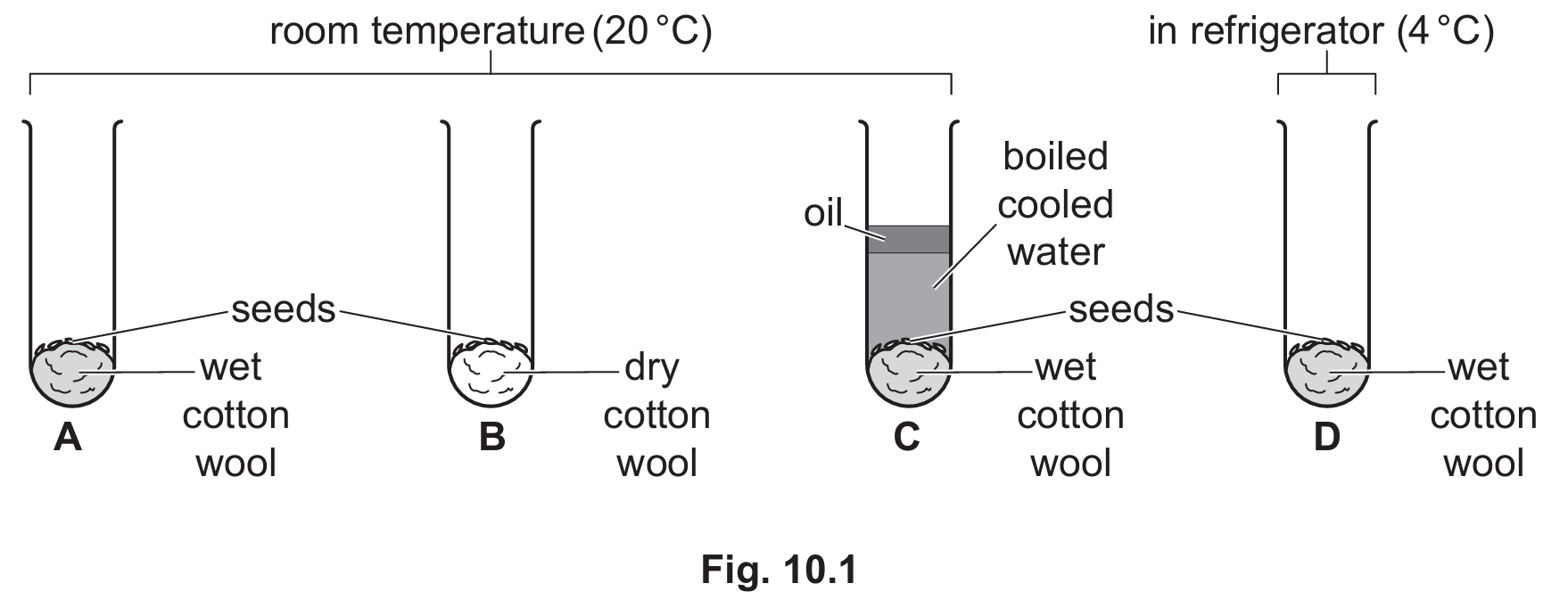
State why the seeds in test-tubes B, C and D do not germinate.
(ii) Explain why plants grow towards light.
Most-appropriate topic codes:
• Topic B15.3 — Sexual reproduction in plants, germination (Part (a))
• Topic B13.1 — Coordination and response, tropisms (Part (b))
• Topic B6.2 — Leaf structure (Part (c))
▶️ Answer/Explanation
B – no water/moisture; C – no oxygen; D – no suitable warmth
B has dry cotton wool, so the seeds lack the water needed for germination.
C has boiled, cooled water sealed under oil, which excludes dissolved oxygen.
D is kept in a refrigerator, too cold for the enzymes needed for germination to work effectively.
(b)(i) Phototropism
Phototropism is the growth response of a plant shoot toward a light source.
(b)(ii) To maximise light exposure for photosynthesis
Growing toward light increases the light energy available to the plant.
This light energy is needed to drive photosynthesis.
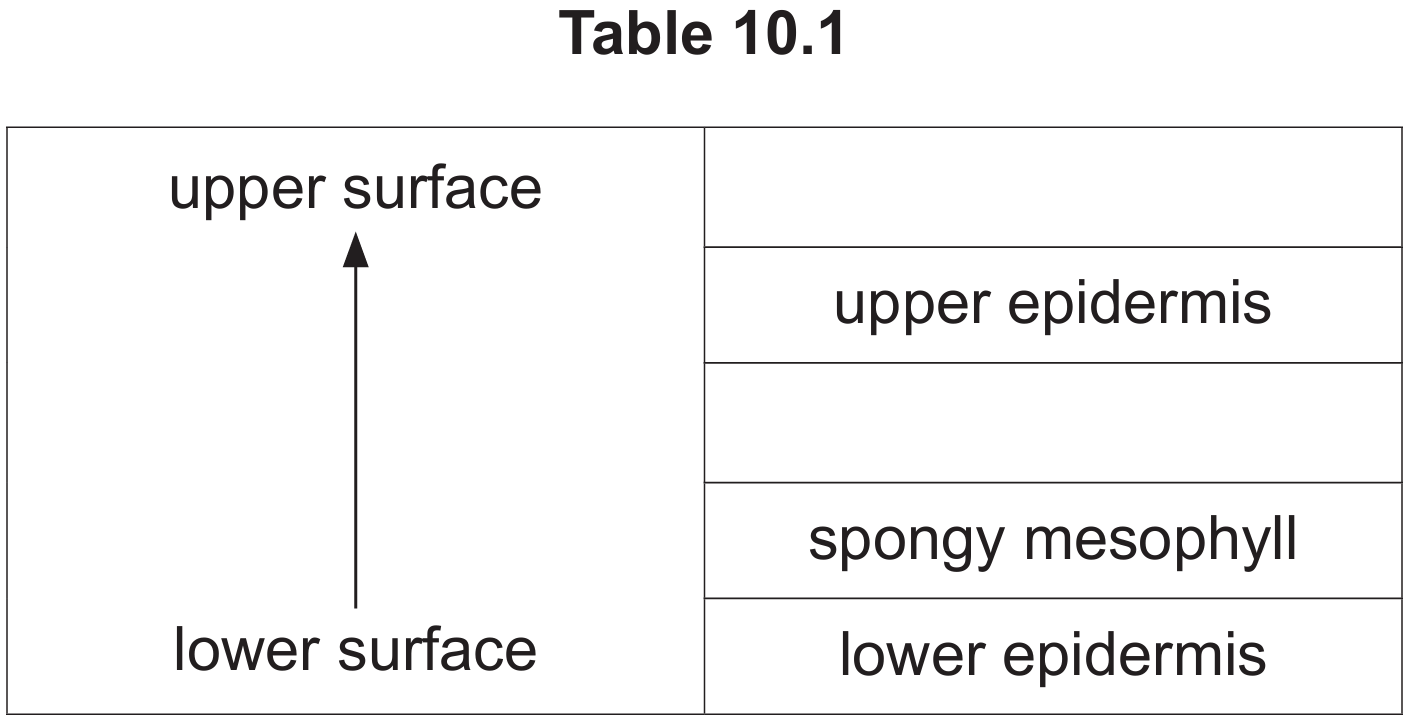
(c) Cuticle (top); palisade mesophyll (middle)
The waxy cuticle sits above the upper epidermis to reduce water loss.
The palisade mesophyll layer, packed with chloroplasts, lies just below the upper epidermis.